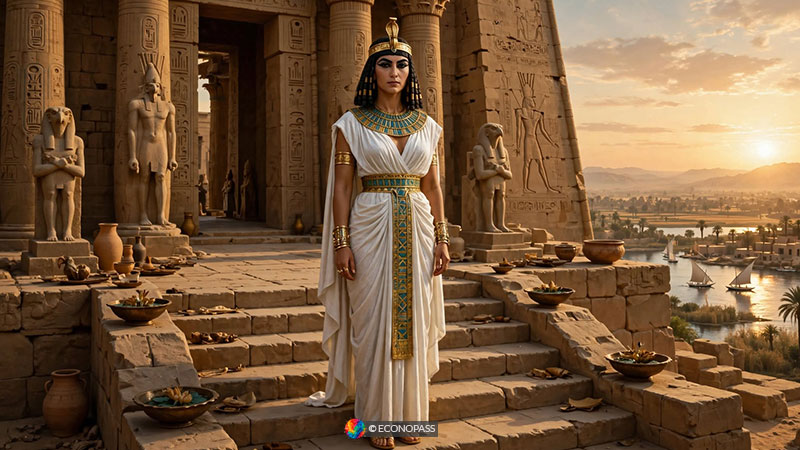
For more than two thousand years, the world has been in love with a woman who never existed.
Not Cleopatra herself. She was real, and more remarkable than any film has managed to capture. But the Cleopatra of popular imagination, the bronze-skinned Egyptian temptress who conquered Caesar and Antony with her legendary beauty, is almost entirely fiction. The actual woman was Greek, was described by the closest thing we have to a contemporary witness as not especially beautiful, spoke nine languages, ran the richest nation in the Mediterranean, and was the first member of her dynasty in nearly three hundred years to bother learning Egyptian.
Start with the nationality, because it dismantles everything else.
Cleopatra VII was not Egyptian. She was Macedonian Greek by blood, Greek by language and culture, and Greek by the dynasty that had ruled Egypt for ten generations before she was born. The Egyptian language was foreign to her until she chose to learn it.
Her family line traced back to Ptolemy I, one of Alexander the Great’s most trusted generals. When Alexander died in 323 BC, his empire fractured among his successors. Ptolemy took Egypt. He founded a dynasty that would rule for nearly three hundred years, and in those three hundred years, not one of his descendants learned to speak Egyptian. The Ptolemaic court was a Greek-speaking world from top to bottom. Greek was the language of administration, philosophy, dinner conversation, and the extraordinary library that made Alexandria the intellectual capital of the Mediterranean world. The people who lived and worked outside the palace spoke Egyptian. The people who ran the country spoke Greek and largely did not consider this a problem.
Cleopatra was the exception. When she came to power alongside her ten-year-old brother Ptolemy XIII in 51 BC, she was eighteen years old and already spoke Greek, Egyptian, Arabic, Hebrew, Ethiopian, Aramaic, Parthian, and Median. Historical accounts differ on the exact count, but nine languages is the most commonly documented figure. Her native tongue was Greek. Egyptian was a language she had deliberately chosen to learn, something no Ptolemaic ruler before her had done. Ancient writers noted this explicitly and with something close to amazement.
Why does this matter? Because the decision to learn Egyptian was not a linguistic achievement. It was a political statement of extraordinary boldness. It meant she could speak directly to her subjects, to priests, to farmers, to soldiers, without an interpreter standing between them. In a dynasty that had always governed Egypt as an occupied territory administered from above, Cleopatra was doing something genuinely new: she was trying to be Egyptian in a way no member of her family had ever attempted.
She was the first Ptolemaic ruler in nearly three centuries to speak to her own people in their language. Her dynasty had ruled Egypt for longer than the United States has existed. Not one of them had bothered before her.
And then there is the beauty question, which requires careful handling because it cuts against one of history’s most persistent myths.
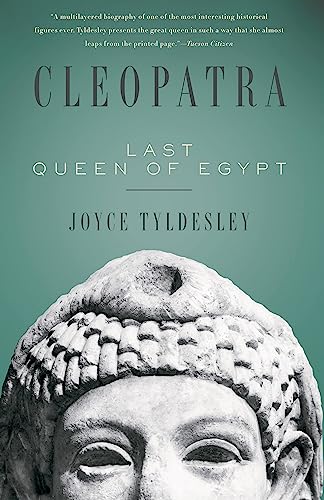
The coins are the problem. Or rather, they are the solution, depending on what you are looking for. The most reliable contemporary images of Cleopatra come from the coins struck by her own royal mints during her reign. They show a woman with a prominent aquiline nose, a sloping forehead, a sharply pointed chin, and thin lips. These are not unflattering portraits produced by her enemies. They were approved by Cleopatra herself, as was standard practice. She chose this image as her official representation to the world.
Plutarch, writing about a century after her death but drawing on sources closer to the events, addressed her appearance directly. His assessment, which has survived intact, is careful and precise: her beauty “was in itself not altogether incomparable.” This is the ancient Greek equivalent of “she was fine, but that was not really the point.” He then went further. Her charm, he wrote, rested in her irresistible presence, her persuasive character, and the stimulating quality of her conversation. The attraction of her person combined with the character that attended all she said and did was, in his words, “something bewitching.” He described the sound of her voice as a pleasure in itself.
Plutarch was not being polite. He was making a specific argument: that the woman who captivated the two most powerful men in the Roman world did so not with her face but with her mind.
“Her actual beauty was not in itself so remarkable that none could be compared with her. But the contact of her presence was irresistible.” Plutarch, Life of Antony.
Julius Caesar was fifty-two when he met Cleopatra. He was a man who had seen everything, conquered most of it, and had no particular reputation for being easily impressed. Mark Antony was a hardened military commander with a lifetime of campaigns behind him. Both men formed relationships with Cleopatra that shaped the history of the ancient world. The Roman propaganda machine, which had every political reason to portray Cleopatra as a seductress who had bewitched these men against their better judgment, consistently emphasised her sexual power. What it could not quite suppress was the persistent evidence that what actually drew these men in was something harder to dismiss and harder to weaponise: she was simply the most interesting person in the room.
She was also, by the standards of her era, the most powerful. When Cleopatra took the throne, Egypt was the wealthiest nation in the Mediterranean. She understood economics, trade policy, and the political geography of a world in which Rome was rapidly consuming everything it touched. Her alliances with Caesar and later Antony were not romantic impulses. They were calculated moves by a ruler who understood that Egypt’s independence depended on staying useful to whoever was winning the Roman civil wars. She nearly pulled it off. Her death in 30 BC, after Antony’s defeat and suicide, was not the end of a love story. It was the fall of the last independent kingdom to hold out against Rome. After Cleopatra, the Mediterranean world had one power, and it was not Egypt.
The Hollywood version of this story required a beautiful Egyptian woman driven by passion. The historical version is considerably more unsettling: a Greek-speaking polyglot mathematician and philosopher who ran a superpower for twenty years, outmanoeuvred the Roman Senate twice, and came closer than any ruler of her era to preserving her nation’s independence against the most powerful military machine the ancient world had ever produced.
She lost in the end. But she made Rome work for it for two decades, and she did it in nine languages.
The woman on those coins, with her strong nose and her uncompromising expression, was not trying to be beautiful. She was trying to look like a ruler. There is a difference, and she knew exactly what it was.
The Cleopatra we invented was easier to understand. The real one is far more interesting.
Every story has a version. I’m sharing mine. Marco Bellinari
The rabbit hole goes deeper. Go further. It is worth it.
Thank you for reading. Every fact in this article is documented and sourced. You will find the references at the bottom if you want to dig further. I hope it surprised you at least once. That is always the intention.
I would love to hear your thoughts. Follow Econopass on social media and share your reaction hereafter as a social comment. And if you do not want to miss the next story, hit follow. There is always another forgotten truth waiting to be told.
Disclosure: This article may contain affiliate links. This means we may earn a commission if you click on a link and make a purchase at no extra cost to you. This applies to featured Amazon products or any other Econopass's partners.
FediBack: Cleopatra Was Not Egyptian. And That Is Not Even the Most Surprising Thing About Her.
🟢 She ran the richest nation in the Mediterranean, spoke nine languages, and was described by Plutarch as not especially beautiful. Two thousand years of films got her completely wrong. What surprised you most? Tell me below.
🟢 She ran the richest nation in the Mediterranean, spoke nine languages, and was described by Plutarch as not especially beautiful. Two thousand years of films got her completely wrong. What surprised you most? Tell me below.
🟢 She ran the richest nation in the Mediterranean, spoke nine languages, and was described by Plutarch as not especially beautiful. Two thousand years of films got her completely wrong. What surprised you most? Tell me below.
We use cookies to ensure that we give you the best experience on Econopass website. If you continue to use this site we will assume that you are happy with it.