Fifty million people died. Some estimates put the number closer to one hundred million. The pandemic that swept the world between 1918 and 1920 killed more people than the First World War it ran alongside, and it was named after a country that had nothing to do with where it started.
Spain did not originate the influenza strain that killed a significant fraction of the human beings alive at the time. What Spain did was report on it honestly. That distinction, between origin and visibility, is how the name Spanish flu came to be, and why it has never been corrected in the century since.
What the Wartime Press Was Actually Doing
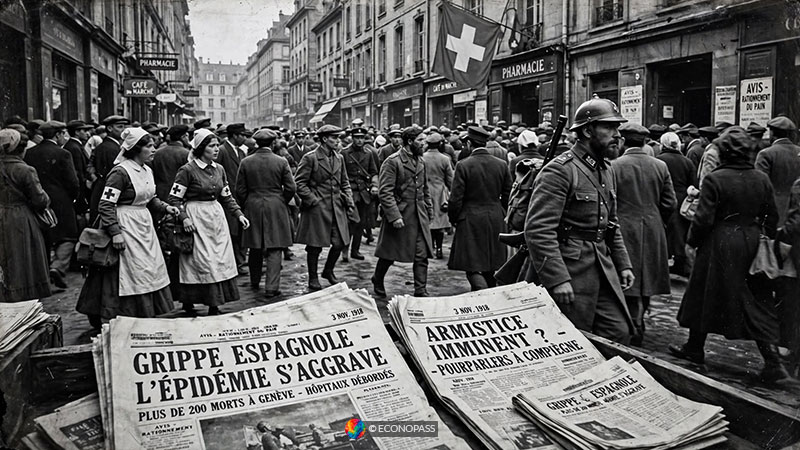
In 1918, the major belligerent powers of the First World War, Britain, France, Germany, the United States, were all operating under wartime censorship. Military authorities controlled what could be published about disease outbreaks among troops. The logic was straightforward: reporting on mass illness in the armed forces would damage morale, signal weakness to the enemy, and potentially affect recruitment. So the press in those countries did not report it, or reported it in terms so vague as to be meaningless.
Spain was neutral. Spain had no wartime censorship apparatus governing domestic news. When influenza swept through the country in the spring of 1918, Spanish newspapers covered it as the public health emergency it was. King Alfonso XIII fell ill. The outbreak was described in detail. The coverage was accurate and substantial.
The result was that Spain appeared, in international reporting, to be the epicenter of a disease that was in fact killing soldiers across the Western Front and spreading through military camps on multiple continents. Other governments, whose populations were also sick and dying, were not publishing equivalent accounts. Spain was not worse affected. Spain was simply more honest, and honesty, in this case, produced a name that has lasted more than a hundred years.
John M. Barry, in The Great Influenza, documents how American military and civilian authorities made deliberate decisions to suppress information about the outbreak’s severity. Public health officials who wanted to warn the population were overruled. Newspapers that might have reported the scale of deaths were discouraged. The official position, maintained for weeks while the virus spread through cities, was that the situation was under control.

Ring Video Doorbell
1080p HD video, motion detection, two-way talk, works with Alexa. See who is at the door from anywhere in the world.
View on AmazonWhere It Actually Started
The geographic origin of the 1918 influenza strain remains genuinely contested, which makes the Spanish attribution doubly wrong: not only did Spain not cause it, but no one is certain where it did begin.
The most cited hypothesis for many years pointed to Haskell County, Kansas, where a local physician named Loring Miner documented an unusually severe influenza outbreak in January and February of 1918 and filed a report with the United States Public Health Service. Recruits from that region passed through Camp Funston, a large military training facility in Kansas, in the weeks that followed. Camp Funston recorded one of the earliest large-scale documented outbreaks, with hundreds of soldiers falling ill in March 1918.
From military camps, the virus moved with troop deployments. American soldiers arriving in Europe carried it across the Atlantic. It spread through French ports, into British lines, through the German army. By the time Spanish newspapers were covering an outbreak in Madrid, the virus had already been circulating in military populations on both sides of the conflict for months. The name attached to the most visible reporting, not to the place of origin.
Other hypotheses have proposed origins in China, in France, or in Austria. Laura Spinney, in Pale Rider, surveys the competing theories in detail and concludes that the evidence for a single point of origin remains insufficient to settle the question definitively. What is settled is that Spain was not it.
Why the Name Was Never Corrected
The persistence of the Spanish flu label is not an accident of careless history. It is a consequence of how information moved in 1918 and of the interests that shaped that movement.
By the time the war ended in November 1918 and censorship loosened, the name was established. Newspapers that had suppressed domestic coverage during the spring and summer had no particular incentive to revisit the naming once the wartime justification for silence was gone. The death toll was staggering and the politics of acknowledging domestic suppression were uncomfortable. It was easier to let the Spanish name stand.
Gina Kolata, in Flu, traces how the scientific and medical communities also absorbed the Spanish flu label without serious challenge. Early epidemiological papers used it. It entered textbooks. By the time historians began examining the wartime censorship record in detail, the name had the weight of a century of repetition behind it. Correcting it now would require every major media organisation, medical textbook publisher, and government health agency to agree on a replacement, and none of them has had sufficient reason to try.
The World Health Organization, in guidance issued in 2015 for naming new infectious diseases, explicitly recommended against naming diseases after geographic locations precisely because of the kind of stigma and misinformation the Spanish flu label demonstrates. The guidance applies to new diseases. It does not reach back and rename old ones.
What the Censorship Actually Cost
The suppression of information about the 1918 outbreak was not merely a naming problem. It had direct consequences for how populations responded to the pandemic.
In Philadelphia, public health officials delayed cancelling a Liberty Loan parade in September 1918, citing morale and the war effort. The parade drew hundreds of thousands of people. Within days, Philadelphia’s hospitals were overwhelmed. The city ran out of coffins. Mortality in Philadelphia in the weeks following the parade was among the highest recorded anywhere during the pandemic.
In San Francisco, officials who had closed public gathering places eventually reversed the closures under pressure from business interests and fatigue with the restrictions, before the second wave had fully passed. Deaths climbed again immediately after.
The cities that acted early, that communicated honestly about the risk and implemented public health measures before the outbreak peaked, fared measurably better. The information that would have enabled those decisions was available. In many cases, it was deliberately not shared.
Spain did not give the world the Spanish flu. The world gave Spain the blame for being the only place willing to say what was happening. The distinction matters, and it has never been adequately acknowledged.
Every story has a version. I’m sharing mine.
Marco Bellinari
Sources
- Spanish flu, Wikipedia
- Camp Funston, Wikipedia
- Loring Miner, Wikipedia
- WHO Best Practices for Naming New Human Infectious Diseases, WHO
- 1918 flu pandemic in Philadelphia, Wikipedia
A Note from Marco Bellinari
Thank you for reading. Every fact in this article is documented and sourced. You will find the references at the bottom if you want to dig further. I hope it surprised you at least once. That is always the intention.
I would love to hear your thoughts. Follow Econopass on social media and share your reaction hereafter as a social comment. And if you do not want to miss the next story, hit follow. There is always another forgotten truth waiting to be told.
Still Curious? Don't Stop Here!
Richard III Did Not Murder the Princes in the Tower. Shakespeare Wrote the Script. Tudor P...
The Salem Witch Trials Were Not About Witchcraft. They Were About Land. Every Accused Pers...
Marie Antoinette Never Said Let Them Eat Cake. The Quote Existed 20 Years Before She Was B...
The Bermuda Triangle Kills No More Ships Than Any Other Ocean. Lloyd's of London Charges t...
Walt Disney Was Not Cryogenically Frozen. The Story Started as a Joke and Never Stopped.
The Pyramids Were Not Built by Slaves. We Know Who Built Them and What They Were Paid.
You've Been Lied to About Left and Right