

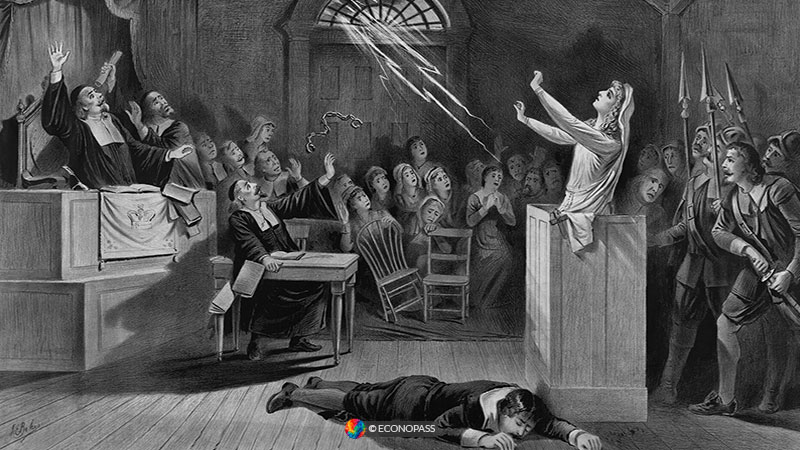
In 1692, nineteen people were hanged on Gallows Hill in Salem, Massachusetts. One was pressed to death under stones. More than one hundred and fifty were jailed. The accepted explanation for three centuries has been mass hysteria, religious panic, or the psychogenic effects of ergot contamination in the bread supply. None of these explanations required anyone to look at the land records. When historians finally did, a different picture emerged.
The thesis that the Salem witch trials were driven in significant part by property disputes is not a fringe theory. It is the conclusion that emerges from the documentary record when you stop reading the theological accounts and start reading the deeds.
The Geography of Accusation
Carol Karlsen’s analysis in The Devil in the Shape of a Woman mapped the accused against the property records of colonial Massachusetts. The pattern was not subtle. Women who stood to inherit property in the absence of male heirs, daughters with no brothers, wives with no sons, widows who had not remarried, were significantly overrepresented among the accused. Property that had no clear male claimant was property that the community’s existing inheritance structures could not easily absorb. Accusing the woman who held it of witchcraft solved that problem efficiently.
Salem Village itself was divided along economic lines that tracked closely onto the lines of accusation. The accusers were disproportionately from the western part of the village: subsistence farmers on rocky, poor land who had watched the commercial success of Salem Town to the east with accumulating resentment. The accused were disproportionately from the eastern part of the village and from Salem Town itself: merchants, prosperous farmers, people who had done well from trade. The theological explanation for this distribution is not obvious. The economic one is.
The accused in Salem were not randomly distributed across the population. They clustered among women who stood to inherit property without male intermediaries and among families whose commercial success had made them targets of sustained resentment. Karlsen’s property analysis does not argue the trials were a conspiracy. It argues they were a mechanism, and the existing social structure was well-designed to exploit it.

Ring Video Doorbell
1080p HD video, motion detection, two-way talk, works with Alexa. See who is at the door from anywhere in the world.
View on AmazonThe Putnam Problem
The most active accusers in Salem were Thomas Putnam and his wife Ann, whose daughter Ann Putnam Jr. provided some of the most damaging testimony of the trials. The Putnam family had been in a series of property and inheritance disputes for years before 1692. Thomas Putnam’s father had changed his will late in life to favor a son from his second marriage, leaving Thomas with significantly less than he had expected. The Putnams had disputed land boundaries with the Nurse family for years before the trials began. Rebecca Nurse, sixty-one years old and a respected member of the community, was accused by the Putnam family and hanged in July 1692.
The Putnam accusations tracked along the lines of prior conflict with a consistency the historical record makes difficult to dismiss as coincidence. John Proctor, hanged in August 1692, had been in a boundary dispute with neighboring families. Philip English, one of Salem’s wealthiest merchants, was accused along with his wife; his warehouse, his ships, and his commercial goods were seized while he was imprisoned awaiting trial. He escaped to New York before the case was heard but never recovered the full value of what had been taken from him.
Philip English was one of the wealthiest men in Salem in 1692. He owned a warehouse, several ships, and substantial commercial goods. When he was accused of witchcraft, his property was seized by the sheriff’s office while he awaited trial. He escaped before the verdict. He spent years attempting to recover what had been confiscated. The accusation cost him his fortune without ever producing a conviction.
What the Records Show
Giles Corey was approximately eighty years old when he was pressed to death in September 1692, the only person in American colonial history to be executed by peine forte et dure. He refused to enter a plea. The reason the historical record strongly suggests is a property calculation: without a formal conviction, his land would pass intact to his heirs. With a conviction for witchcraft, it could be seized under the legal structures then in place. Corey had recently transferred his property to his sons-in-law. He chose to be crushed under stones rather than give the court the legal mechanism to take what he had arranged to pass on. He died over two days. His property went to his heirs.
Stacy Schiff’s account in The Witches reconstructs the Salem crisis with granular sourcing across the complete documentary record. What the records show, consistently, is that the formal apparatus of accusation, arrest, and trial was not operating in a social vacuum. It was operating in a community with pre-existing conflicts, disputed boundaries, contested inheritances, and a legal structure with no reliable mechanism to protect accused persons’ property while cases were pending. The accusation itself was, in that context, a legal instrument, and it was wielded with the precision of one.
Giles Corey refused to enter a plea to his witchcraft accusation in 1692. He was pressed under stones for two days. The historical consensus is that the choice was deliberate: a conviction would have endangered the property settlement he had recently made with his sons-in-law. He understood what the court was and what it could take. He chose death over surrender. More weight, he reportedly said, each time they added more stones.
The Narrative That Survived
The witch trial story that survived into popular culture is a story about superstition and religious hysteria, about what happens when irrational fear is allowed to override reason in a closed community. It is a useful narrative because it locates the cause of Salem in irrational belief rather than in the rational self-interest of people competing for resources in a cash-poor, land-dependent colonial economy.
Mary Beth Norton’s work in In the Devil’s Snare adds a further dimension: the trials took place in a community already destabilized by years of devastating frontier war with the Wabanaki, a conflict that had produced refugee displacement, genuine trauma, and a population under sustained social stress. That stress did not create the property disputes. It created the conditions in which the mechanism of accusation could operate without the social resistance that might have contained it. A community under pressure found a mechanism for resolving its tensions. The mechanism worked. Nineteen people hanged, one was crushed, and the land changed hands.
Every story has a version. I’m sharing mine.
Marco Bellinari


Sources
- Salem Witch Trials, Encyclopaedia Britannica
- Salem Witch Trials, History.com
- The Salem Witch Trials, PBS American Experience
- Salem Witch Trials, National Geographic
- The Salem Witch Trials, History of Massachusetts

A Note from Marco Bellinari
Thank you for reading. Every fact in this article is documented and sourced. You will find the references at the bottom if you want to dig further. I hope it surprised you at least once. That is always the intention.
I would love to hear your thoughts. Follow Econopass on social media and share your reaction hereafter as a social comment. And if you do not want to miss the next story, hit follow. There is always another forgotten truth waiting to be told.
Still Curious? Don't Stop Here!

Marie Antoinette Never Said Let Them Eat Cake. The Quote Existed 20 Years Before She Was B...

The Bermuda Triangle Kills No More Ships Than Any Other Ocean. Lloyd's of London Charges t...
Walt Disney Was Not Cryogenically Frozen. The Story Started as a Joke and Never Stopped.

The Pyramids Were Not Built by Slaves. We Know Who Built Them and What They Were Paid.
You've Been Lied to About Left and Right

The First Person to Circumnavigate the Globe Was Not Magellan. He Died Halfway Through.
The Great Fire of London Did Not Kill the Plague. That Happened Six Months Earlier and Nob...