
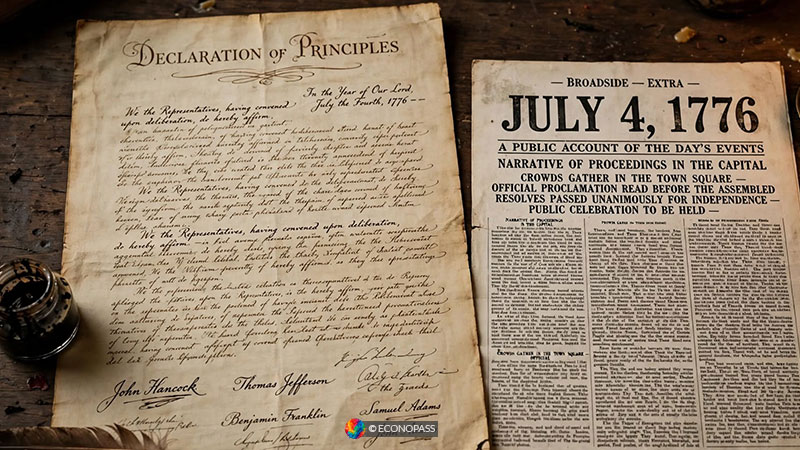
The document that hangs in the National Archives in Washington carries a date at the top: July 4, 1776. It is not the date the document was signed. It is the date the Continental Congress voted to adopt the final text, which is a legally distinct act, and the gap between that vote and the actual signatures on the parchment is twenty-nine days. Fifty-six men eventually signed the Declaration of Independence. Most of them were not in Philadelphia on July 4. Some were not even members of Congress yet.
The vote for independence had already happened two days before the date history chose to celebrate. On July 2, 1776, the Continental Congress passed the Lee Resolution, formally severing the American colonies from the British Crown. John Adams was in the room. He wrote to Abigail Adams the following day that July 2 would be “the most memorable Epocha in the History of America,” that it would be “celebrated, by succeeding Generations, as the great anniversary Festival,” with “Pomp and Parade, with Shews, Games, Sports, Guns, Bells, Bonfires and Illuminations from one End of this Continent to the other.” He specified the date. He named the wrong one. And the reason he got it wrong is the same reason July 4 became the story instead of the truth.
What the Vote on July 4 Actually Decided
On July 4, the Continental Congress did not declare independence. It had declared independence two days earlier. What it did on July 4 was approve the final text of Jefferson’s explanation of that declaration. This was partly a political act and partly an editorial one. Congress spent those two days cutting and revising Jefferson’s draft. Approximately a quarter of his original text was deleted or rewritten. The passage blaming King George for the slave trade was removed entirely, at the insistence of delegates from South Carolina and Georgia, and over Jefferson’s objection. What remained was voted on and approved.
The document authenticated on July 4 was not the parchment now held at the National Archives. It was a broadside, a printed sheet distributed for public reading. It was authenticated by two men: John Hancock as president of Congress, and Charles Thomson as secretary. Their marks were certifications for the printer, not signatures in the sense the word carries today. The broadside went to John Dunlap, a Philadelphia printer, who produced copies that were sent to newspapers, colonial governments, and George Washington’s army in the field. The document the public encountered was printed, not handwritten, and it went out under two names, not fifty-six.
Pauline Maier, in American Scripture, documented the full history of the Declaration’s drafting, adoption, and transformation into a national symbol, tracing how Congress collectively shaped the text, how Jefferson’s original was edited substantially before approval, and how the distinction between the July 4 broadside and the August 2 parchment was gradually lost as the document became mythology rather than record. Her central argument is that the Declaration was never primarily Jefferson’s work but a congressional document, and that the history commonly taught inverts the actual process. The printed broadside circulated in July. The signed parchment was produced a month later. The two are not the same document in the same state, and treating them as one is where the confusion permanently lodged itself.

Kindle Paperwhite 2026
New 7″ flush-front aluminum design, weeks of battery, glare-free in any light. The e-reader that stays on your nightstand permanently.
View on AmazonThe Parchment and the Month Between
On July 19, 1776, Congress ordered an engrossed copy of the Declaration to be prepared. Engrossing meant producing a formal parchment version in careful calligraphy, intended for official preservation. It took time to produce. The engrossed parchment was ready on August 2, 1776. On that day, most of the delegates then present in Philadelphia signed it. This is the document displayed at the National Archives. The date printed at its top reads July 4, 1776, because that is the date of adoption. The date the signatures were added is not on the document at all.
Not all fifty-six signatures arrived on August 2. Matthew Thornton of New Hampshire had not joined Congress until September 1776. He signed in November. Thomas McKean of Delaware signed at a date historians still dispute. McKean later claimed in correspondence that he had not signed until 1781, years after the war had been decided, though most scholars place his signing earlier. The parchment itself does not record individual signing dates. What it records is fifty-six names arranged by state delegation, and what it does not record is when any of them actually put pen to it.
David McCullough, in John Adams, reproduced Adams’s July 3 letter to Abigail in full and examined its significance alongside the two-day sequence of events, noting that Adams’s certainty about July 2 as the great anniversary reflected how clearly the delegates understood that the vote itself, not the explanatory document, was the act that mattered historically. Adams lived long enough to see July 4 become the date, and he knew exactly why it was not July 2. The broadside that circulated in newspapers gave the public a date to attach to the event. The vote that actually produced the event had no equivalent public document. By the time anyone was counting anniversaries, the printed Declaration had been read aloud in town squares across thirteen colonies, and the date printed on it was the date people remembered.
Who Was in the Room and When
Several men who voted for independence on July 2 never signed the parchment at all. Robert Livingston of New York sat on the Committee of Five that drafted the Declaration alongside Jefferson, Franklin, Adams, and Roger Sherman. He was recalled to New York by his state legislature before the vote and was absent for both the July 2 and July 4 proceedings. His name does not appear on the Declaration. John Dickinson of Pennsylvania opposed independence as premature, abstained from the July 2 vote, and did not sign. He later served in the Continental Army and contributed substantially to the American cause, but his name is absent from the document that defined it.
Some men who signed on August 2 had not been members of Congress when independence was declared. They signed a document committing themselves retroactively to an act they had played no part in deciding. The composition of Congress shifted between July 4 and August 2. Delegations changed. Men arrived and departed. The fifty-six names on the parchment do not correspond exactly to the men who made the decision recorded in the text above them.
Bruce Ackerman, in The Founding Moment, examined the constitutional and legal architecture of the American founding, tracing how the authority of founding documents derived not from procedural formalities but from the political legitimacy conferred by public acceptance and subsequent acts of collective ratification across the new nation. Applied to the Declaration, this framework clarifies why July 4 functions as the founding date despite its technical inaccuracy. The legal weight of the document is not in the signatures. It is in the adoption. The vote on July 4 is what gave the text its authority. The signatures that followed added solemnity but not legal substance. The date was always, in this sense, a legal judgment about which act mattered, not a report on when things physically happened.
How July 4 Survived as the Date
The names of the signers were not public knowledge for months. Congress kept them secret. Signing a declaration of independence from Britain was treason under British law. Publishing the names of the signers while the British army was actively operating in the colonies was a tactical decision Congress was not willing to make. The signed Declaration was not publicly released until January 18, 1777, when Congress finally authorized publication of the full document with its signatures. By that date, July 4, 1776 had already been celebrated as the anniversary for the first time, with bells and bonfires in Philadelphia, six months after the event.
The secrecy meant the August 2 signing had no public moment. No crowd gathered. No newspapers marked it. The act that history now displays behind bulletproof glass, the parchment with fifty-six names, was performed in private and kept private for half a year. The act that the public experienced was the broadside of July 4, read aloud to crowds and printed in every colonial newspaper that could get a copy. That was the date the Declaration entered public consciousness. The parchment and its signatures were a later document confirming an event the public had already processed and dated.
July 4 is not false. It is the date the text was adopted, which is a real event with real consequences. But it is not the date fifty-six men signed their names to it and accepted the personal risk that those signatures represented. That happened on August 2, and on dates scattered across the following months, by men some of whom had not been part of the founding vote and at least one of whom may have signed years after the war was over. July 4 became Independence Day because a printed broadside needed a date and the parchment signing had none. History chose the date it could find.
Every story has a version. I’m sharing mine.
Marco Bellinari


Sources
- United States Declaration of Independence, Wikipedia
- Committee of Five, Wikipedia
- Lee Resolution, Wikipedia
- Signing of the United States Declaration of Independence, Wikipedia
- John Dunlap, Wikipedia

A Note from Marco Bellinari
Thank you for reading. Every fact in this article is documented and sourced. You will find the references at the bottom if you want to dig further. I hope it surprised you at least once. That is always the intention.
I would love to hear your thoughts. Follow Econopass on social media and share your reaction hereafter as a social comment. And if you do not want to miss the next story, hit follow. There is always another forgotten truth waiting to be told.
Still Curious? Don't Stop Here!

Socrates Was Not Executed for His Philosophy. The Trial Was Political. The Charges Were a ...
The 300 Spartans at Thermopylae Were Not 300. There Were 7,000 Greek Soldiers. History Dro...
The Spanish Flu Did Not Come from Spain. Spain Was Simply the Only Country Reporting Hones...
Richard III Did Not Murder the Princes in the Tower. Shakespeare Wrote the Script. Tudor P...
The Salem Witch Trials Were Not About Witchcraft. They Were About Land. Every Accused Pers...

Marie Antoinette Never Said Let Them Eat Cake. The Quote Existed 20 Years Before She Was B...

The Bermuda Triangle Kills No More Ships Than Any Other Ocean. Lloyd's of London Charges t...