On the morning of March 15, 44 BC, Julius Caesar received at least five separate warnings that he was going to be murdered that day.
He went anyway.
This is not a metaphor for courage. It is not an invented dramatic device. Every warning is documented by Roman historians writing from primary sources. The question that history has never fully answered is the one that stays with you after you know the facts: why did the most strategically brilliant mind in Rome walk calmly into the room where sixty men were waiting to kill him?
Caesar had been warned for thirty days. He knew the date. He knew the place. He chose to go. History still cannot fully explain why.
The warnings had started a month earlier. In mid-February, during the festival of Lupercalia, Caesar consulted a haruspex named Spurinna. A haruspex was not a street fortune teller. He was a trained specialist in Etruscan divination, employed by the Roman state, consulted during moments of public and personal crisis. His method involved examining the entrails of sacrificed animals and reading the signs within them. When Spurinna examined the bull offered that day, he found something that stopped him cold: the heart was missing.
He told Caesar plainly. His life was in danger. The threat would last thirty days and end on the Ides of March. Caesar, who had survived two decades of war, civil conflict, and political assassination attempts, thanked him and moved on.
The Ides of March, in the Roman calendar, fell on March 15. The thirty days ended exactly there.
“The Ides of March are come,” Caesar said to Spurinna on the morning of his death, passing him in the street with the confidence of a man who had been right about everything, always. Spurinna looked at him quietly. “Ay, Caesar. But not gone.” Suetonius, The Twelve Caesars
The night before the assassination, Caesar’s wife Calpurnia woke screaming from a dream. She had seen his statue running with blood, and men bathing their hands in it. According to Suetonius, Caesar himself had dreamt that he was flying above the clouds and clasping the hand of Jupiter. These were not dismissed as ordinary nightmares. In Roman culture, dreams of this kind carried the same weight as a military intelligence report. Calpurnia begged him not to go to the Senate that day. She went down on her knees.
Caesar agreed to stay home.
Then one of his closest friends changed his mind.
His name was Decimus Brutus. Not Marcus Brutus, the man Shakespeare immortalised. Decimus. A man Caesar trusted so completely that he had named him a beneficiary in his will. Decimus Brutus was also one of the sixty conspirators waiting to kill him at the Theatre of Pompey.
Decimus arrived at Caesar’s house that morning and talked him out of staying. He told Caesar it would be an insult to the Senate to cancel. That the senators had assembled in large numbers and were waiting. That postponing would make him look weak, superstitious, ruled by his wife’s dreams. Caesar, who had never in his life wanted to appear weak before the Senate, let himself be persuaded. He put on his toga and left the house.
The man who talked Caesar out of staying home that morning was one of the conspirators. He had been named in Caesar’s own will. Caesar never knew.
On the way to the theatre, someone pressed a note into Caesar’s hand. According to Suetonius, it contained details of the assassination plot. Caesar put it with the other documents he was carrying in his left hand, intending to read it when he had a moment. He never read it. It was found in his hand after his death.
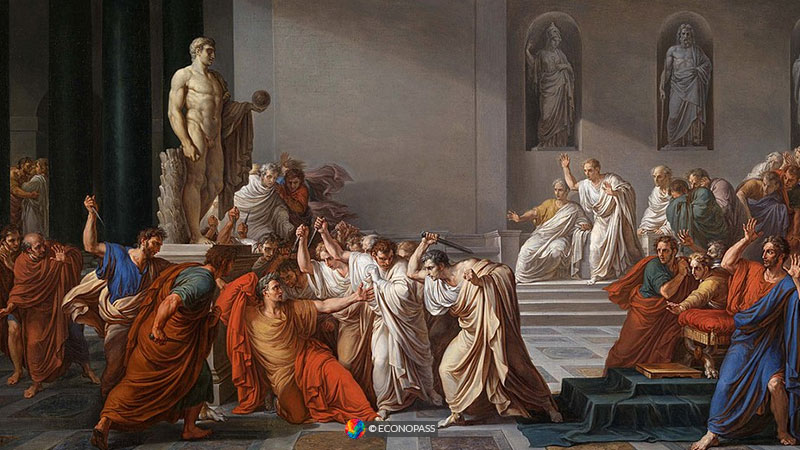
Inside the theatre, the conspirators had arranged themselves carefully around the room. One of them, Tillius Cimber, approached Caesar first under the pretext of pleading for his exiled brother. He grabbed Caesar’s toga, holding him in place. That was the signal.
Casca struck first, a blow to the throat. Caesar grabbed his arm. He had a moment, perhaps two, where he might have fought back. Then the rest came. Sixty men were in on the plot. Not all of them struck. But enough did. Caesar was stabbed twenty-three times. Only one wound, the second blow to his chest, would have been fatal on its own. The physician Antistius, who examined the body afterward, documented this finding in a public report. It was the first recorded forensic autopsy in history. The word forensic itself comes from the Latin forensis, meaning of the forum, because Antistius presented his findings there.
Caesar died without speaking. Or almost without speaking. Suetonius records that when Marcus Brutus rushed at him, he may have said, in Greek: “You too, my child?” Shakespeare rendered this as “Et tu, Brute?” The Greek version is more interesting, and more disturbing. There is a persistent historical theory, supported by Plutarch and others, that Brutus may have been Caesar’s illegitimate son. If true, the last words spoken by the greatest military commander Rome had ever produced were addressed to the child he had never acknowledged, who had just stabbed him.
Twenty-three stab wounds. One fatal. The body lay in the Senate for three hours before anyone moved it. Outside, the sixty conspirators who had just changed the world walked quickly toward the Capitoline Hill, surrounded by gladiators hired in advance to protect them if anything went wrong.
The conspirators had planned for resistance. They had not planned for what actually happened: nothing. The Roman people did not rise to defend the Republic. The senators fled. The city went quiet. It would take three more years of civil war, the deaths of Brutus and Cassius, and the emergence of Augustus Caesar before Rome found a new equilibrium. The Republic the conspirators thought they were saving never came back. In killing Caesar, they had made the Empire inevitable.
What remains unexplained, after all of it, is the morning itself. Caesar was not a reckless man. He was arguably the most careful strategic thinker of his age, a man who had survived campaigns that killed hundreds of thousands of his soldiers through a combination of intelligence, preparation, and an almost preternatural ability to read a situation before it developed. He had been warned for thirty days. He had the note in his hand. He knew Spurinna’s prediction had not yet expired when he passed him on the street that morning and made his little joke about the Ides of March.
One explanation offered by historians is fatigue. Caesar was fifty-five years old, suffering from epilepsy, and had been fighting wars or political battles for nearly his entire adult life. He had mentioned to friends that he was tired of being on guard, tired of living as if every room contained an enemy.
Another is pride. A man who has been warned as many times as Caesar had, and survived as many attempts as Caesar had, begins to believe in his own invulnerability. He had crossed the Rubicon. He had defeated Pompey. He had survived Gaul, Egypt, Africa, and Spain. The idea that he could be killed by sixty senators in a theatre may simply have felt, to him, implausible.
The third explanation is the most uncomfortable. Perhaps he knew. Perhaps Caesar, who was suffering from illness and exhaustion, who had rewritten his will recently, who had told his friends he was tired of protecting himself, walked into that room with a full understanding of what was waiting there. Not out of courage. Out of acceptance.
History cannot tell us which of these is true. What it can tell us is this: on the morning of March 15, 44 BC, Julius Caesar received at least five warnings that he was going to die that day. He had a note about the plot in his left hand when he entered the room. He passed the man who had predicted his death on the street and made a joke. And then he walked in, and sat down, and waited.
Every story has a version. I’m sharing mine. Marco Bellinari
The rabbit hole goes deeper. Go further. It is worth it.
Thank you for reading. Every fact in this article is documented and sourced. You will find the references at the bottom if you want to dig further. I hope it surprised you at least once. That is always the intention.
I would love to hear your thoughts. Follow Econopass on social media and share your reaction hereafter as a social comment. And if you do not want to miss the next story, hit follow. There is always another forgotten truth waiting to be told.
Disclosure: This article may contain affiliate links. This means we may earn a commission if you click on a link and make a purchase at no extra cost to you. This applies to featured Amazon products or any other Econopass's partners.
We use cookies to ensure that we give you the best experience on Econopass website. If you continue to use this site we will assume that you are happy with it.