

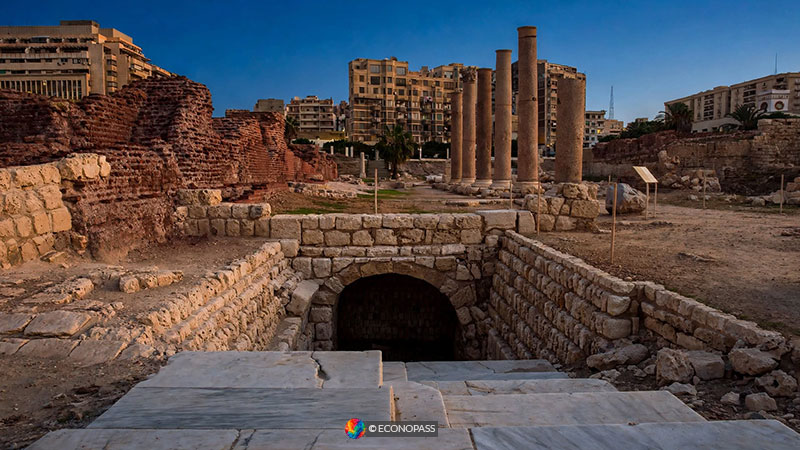
The story is perfect. A great fire, a catastrophic loss, centuries of human knowledge reduced to ash in a single night. Julius Caesar is usually the villain, sometimes Caliph Omar, occasionally the Christians under Theophilus. The details shift depending on who is telling it, but the structure stays the same: ignorance destroys wisdom, barbarism erases civilization, and the world is set back by a thousand years. It is a story built for retelling. The problem is that it did not happen the way anyone has told it. The Library of Alexandria did not burn down. It faded. And the fire story was written four hundred years after the event it claims to describe.
This matters not as a correction of minor detail but as a case study in how myths form and calcify. The Library of Alexandria has been burning in the popular imagination for two thousand years, and the story has been used to indict Caesar, to condemn Islam, to frame Christianity as the enemy of learning, depending on the century and the agenda of the person doing the framing. All of those arguments rest on a foundation that does not exist. The fire is not in the contemporaneous record. The great single catastrophe is not there. What is there is slower, less dramatic, and considerably more instructive.
What the Library Actually Was
The Library of Alexandria was not a single building. It was an institution, the Mouseion, attached to the royal palace complex of the Ptolemaic dynasty, funded by the Ptolemaic kings beginning around 300 BCE. It was part library, part research institute, part court ornament. Scholars were housed, fed, and paid to work there. The goal was the collection of all written knowledge in the Greek-speaking world, and the Ptolemies pursued it with the resources of one of the wealthiest states in the ancient Mediterranean. Ships entering Alexandria’s harbor reportedly had their scrolls confiscated, copied, and returned, with the copies sent back and the originals kept.
At its height, ancient sources give wildly varying figures for the collection: 40,000 scrolls, 400,000, 700,000. The numbers are almost certainly exaggerated, as such numbers routinely are in ancient sources, but the point is clear enough. It was large. It was prestigious. It attracted the best scholars of the Hellenistic world. Euclid worked there. Eratosthenes, who calculated the circumference of the Earth with remarkable accuracy, served as its chief librarian. Archimedes likely visited. For roughly two centuries it functioned as the intellectual center of the Greek-speaking world.
Lionel Casson, in Libraries in the Ancient World, provides the most careful reconstruction of what the Alexandrian Library actually was and what contemporary sources actually say about it. His account is notable for what it does not find: no ancient source writing at the time of Julius Caesar’s visit describes a catastrophic fire destroying the main library. What Caesar’s own account describes, and what other contemporary sources corroborate, is a fire on the docks that destroyed a warehouse containing books intended for export. A large loss. Not the Library. The conflation happened later, in sources written generations after Caesar’s death, and the conflation has never stopped.

Apple AirTag 4-Pack (2nd Gen)
Keys, luggage, wallet, backpack: one per thing you cannot afford to lose. Works with Find My across hundreds of millions of Apple devices.
View on AmazonWhat Caesar Actually Did
Julius Caesar arrived in Alexandria in 48 BCE, pursuing Pompey after the battle of Pharsalus. He became entangled in the succession dispute between Cleopatra and her brother Ptolemy XIII, found himself militarily besieged in the palace quarter, and in the fighting set fire to ships in the harbor to prevent them being used against him. That fire spread to dockside warehouses. Ancient sources, including Livy and Seneca writing within a century of the event, describe the destruction of a warehouse containing books, possibly 40,000 scrolls intended for export to Rome.
What they do not describe is the destruction of the Library itself. Caesar’s own account of the Alexandrian war does not mention it. Strabo, who visited Alexandria roughly twenty years after Caesar and wrote extensively about the city, describes the Mouseion as intact and functioning. If Caesar had destroyed the great Library, Strabo’s silence on the subject would be extraordinary. He was not silent on the subject of Alexandria’s intellectual life. He was simply describing a city that still had one.
Luciano Canfora, in The Vanished Library, traces every ancient reference to the Library’s destruction and maps the precise moment at which the warehouse fire becomes, in the textual record, the Library fire. The transformation happens gradually, across centuries, in sources increasingly distant from the events. Each retelling adds detail. Each retelling loses the qualifier. By the time the story reaches its fully formed version, the warehouse has become the Library, the partial loss has become total destruction, and Caesar has become the man who ended ancient learning. The original sources, read carefully, say something much smaller and much more complicated.
How Institutions Actually Die
The Library declined over centuries through mechanisms that are less cinematic but far more historically common. Ptolemaic royal funding diminished as the dynasty weakened under Roman pressure. The position of chief librarian, once held by scholars of the caliber of Eratosthenes and Apollonius of Rhodes, disappears from the historical record after the first century BCE, suggesting institutional decay rather than catastrophic destruction. Alexandria remained an intellectual center, but increasingly on the margins of power rather than at its heart.
Mark Antony reportedly gave Cleopatra 200,000 scrolls from the library of Pergamon to replace books lost in Alexandria, which suggests the collection had suffered losses by the mid-first century BCE, but also that it continued to exist and was considered worth replenishing. The institution continued to function in some form for centuries. Christian scholars worked in Alexandria well into the fourth and fifth centuries CE. The Mouseion is last mentioned in a source from 260 CE, still operating. What ended it was not fire but a long process of reduced funding, shifting intellectual centers, and the gradual reorientation of scholarly life toward Constantinople and other cities.
Islam Issa, in Alexandria: The City That Changed the World, situates the Library’s history within the full arc of Alexandria as a city, tracking how each successive power, Ptolemaic, Roman, Byzantine, Arab, used and reshaped the city’s intellectual institutions rather than simply destroying them. The Arab conquest of 641 CE, which carries its own version of the Library destruction story, an account written five centuries after the supposed event by a historian named Bar Hebraeus, presents Caliph Omar ordering all books burned on the grounds that they either agree with the Quran and are therefore redundant, or disagree with it and are therefore heretical. Modern historians regard this account as a legend with no basis in contemporaneous Arabic sources. The Library, by 641, had been declining for three hundred years. There was nothing left to burn.
Why the Story Persists
The Library of Alexandria story persists because it is useful. It provides a before-and-after: a golden age of knowledge, a catastrophic rupture, a dark age that follows. That narrative structure is enormously appealing because it locates the cause of ignorance in a single identifiable moment and a single identifiable villain. Caesar, the Christians, the Arabs, the villain rotates depending on the historical grievance being expressed. The story is not primarily about the Library. It is about whatever argument the person telling it wants to make.
The actual history is less satisfying and more true. Great institutions do not usually end in a night. They lose funding incrementally. Their best people leave for better opportunities. Their collections are neglected, then dispersed. The administrative structure that maintained them dissolves through a hundred small decisions, none of which feels like a catastrophe at the time. The Library of Alexandria ended the way most things end: not with fire, but with the slow withdrawal of the conditions that made it possible. That story is harder to tell. It is also the one that actually happened.
Every story has a version. I’m sharing mine.
Marco Bellinari


Sources
- Library of Alexandria, Wikipedia
- Mouseion, Wikipedia
- Burning of the Library of Alexandria, Wikipedia
- Eratosthenes, Wikipedia
- Ptolemaic Kingdom, Wikipedia

A Note from Marco Bellinari
Thank you for reading. Every fact in this article is documented and sourced. You will find the references at the bottom if you want to dig further. I hope it surprised you at least once. That is always the intention.
I would love to hear your thoughts. Follow Econopass on social media and share your reaction hereafter as a social comment. And if you do not want to miss the next story, hit follow. There is always another forgotten truth waiting to be told.
Still Curious? Don't Stop Here!
The Declaration of Independence Was Not Signed on July 4. Most Delegates Signed It a Month...
Socrates Was Not Executed for His Philosophy. The Trial Was Political. The Charges Were a ...
The 300 Spartans at Thermopylae Were Not 300. There Were 7,000 Greek Soldiers. History Dro...
The Spanish Flu Did Not Come from Spain. Spain Was Simply the Only Country Reporting Hones...

Richard III Did Not Murder the Princes in the Tower. Shakespeare Wrote the Script. Tudor P...
The Salem Witch Trials Were Not About Witchcraft. They Were About Land. Every Accused Pers...

Marie Antoinette Never Said Let Them Eat Cake. The Quote Existed 20 Years Before She Was B...