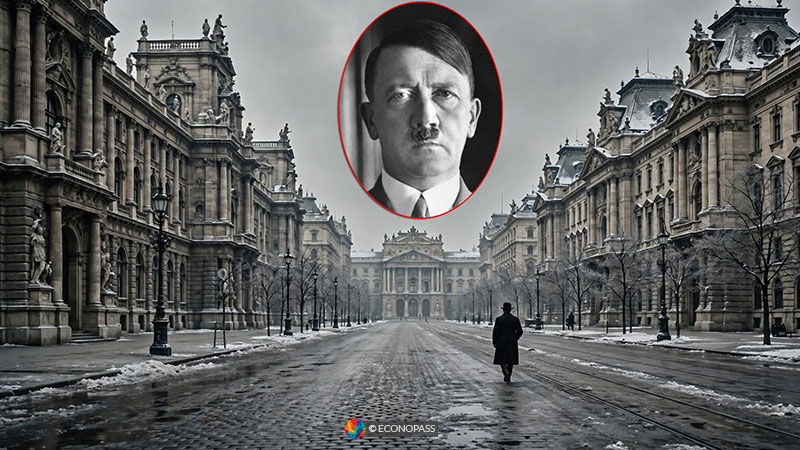
Every schoolchild learns that Adolf Hitler was the German dictator who started the Second World War. The word German appears in that sentence twice in its implications: his nationality, and the country he led. One of those is correct.
Hitler was Austrian. Born on April 20, 1889, in Braunau am Inn, a small town in the Austro-Hungarian Empire that is today part of Austria. He remained an Austrian citizen until 1932, one year before he became Chancellor of Germany. For forty-three years of his life, he held no German citizenship whatsoever. The man responsible for the Third Reich was, for almost his entire life, a foreigner in the country he destroyed.
This matters not as a technicality but as history. The question of what made Hitler is inseparable from the question of where Hitler came from. And the answer is Vienna. Not Berlin, not Munich, not the trenches of the First World War, though all of those played a role. The city that produced the worldview that would animate the worst regime in modern history was the capital of the Habsburg Empire, a cosmopolitan, multilingual, multiethnic city in terminal decline. Hitler lived there from 1907 to 1913, between the ages of eighteen and twenty-four. Those were the years in which his antisemitism hardened from vague prejudice into ideology.
He arrived in Vienna with ambitions to be an artist. He had already failed the entrance examination to the Vienna Academy of Fine Arts once. He failed it again in 1908, when the examiners noted that his submitted drawings showed too few human figures and suggested he consider architecture instead. He had no secondary school leaving certificate, which was required for the architecture programme. He was rejected twice by the institution he most wanted to enter, in the city that represented everything he both desired and resented.
For five years he drifted, living first in a rented room and then in a homeless shelter, selling hand-painted postcards of Viennese landmarks. He read voraciously, particularly pan-German nationalist newspapers and antisemitic pamphlets that circulated freely in the political culture of fin-de-siecle Vienna. The city’s mayor at the time, Karl Lueger, had built a political career on openly antisemitic populism and was enormously popular. Hitler later acknowledged Lueger as one of the greatest politicians he had ever encountered. Vienna gave him his politics before Germany gave him his platform.
In 1913 he moved to Munich, partly to escape the Austrian draft. When the First World War began, he volunteered for the German Army, not the Austrian one. After the war, he entered German politics in Bavaria. He became a German citizen in February 1932, eleven months before becoming Chancellor. His entire political career was German. His entire formation was Austrian. History has tended to emphasise the career and overlook the formation.
Austria’s own relationship with this history is the part of the story that remains most uncomfortable. After the war, Austria successfully presented itself to the international community as the first victim of Nazi aggression, citing the 1938 Anschluss, the annexation of Austria by Germany, as the moment Austria ceased to exist as an independent state. This framing was adopted by the Allied powers and enshrined in the Moscow Declaration of 1943, which declared Austria a victim rather than a perpetrator.
The historical reality is considerably more complicated. Braunau am Inn’s predominantly Roman Catholic burghers welcomed Germany’s annexation and were proud of Hitler, its native son. Austrians served in the Wehrmacht, staffed the concentration camps, and participated in the Holocaust at rates disproportionate to their share of the German Reich’s population. Adolf Eichmann, who organised the logistics of the extermination of European Jews, was Austrian. Rudolf Hoess, commandant of Auschwitz, was German, but a significant number of his most senior staff were Austrian.
Austria maintained the victim narrative with considerable success for decades. It was not until 1991, in a speech by Chancellor Franz Vranitzky, that Austria officially acknowledged its shared responsibility for the crimes of the Nazi era. The acknowledgment came 46 years after the end of the war. The house in Braunau am Inn where Hitler was born was for many years used as a bank, then a library, then a centre for disabled people. In 2020 the Austrian government finally demolished it, after years of debate, to prevent it becoming a pilgrimage site for neo-Nazis. The building is gone. The question of what Austria owes the history that happened partly in its name is not.
Hitler did not see himself as Austrian. He despised the Habsburg multiethnic empire and its tolerance of what he considered racial mixing. He dreamed of a pan-German nation that would unite all German-speaking peoples under one state. The Anschluss, which he orchestrated in 1938, was in part a fulfilment of the obsession he had developed as a homeless young man walking the streets of Vienna, reading pamphlets, and nursing resentments in a city that had twice told him he was not good enough.
Austria produced him. Germany employed him. History assigned him entirely to Germany. The full accounting is more complicated than any of those three sentences.
Every story has a version. I’m sharing mine. Marco Bellinari
The rabbit hole goes deeper. Go further. It is worth it.
Thank you for reading. Every fact in this article is documented and sourced. You will find the references at the bottom if you want to dig further. I hope it surprised you at least once. That is always the intention.
I would love to hear your thoughts. Follow Econopass on social media and share your reaction hereafter as a social comment. And if you do not want to miss the next story, hit follow. There is always another forgotten truth waiting to be told.
Disclosure: This article may contain affiliate links. This means we may earn a commission if you click on a link and make a purchase at no extra cost to you. This applies to featured Amazon products or any other Econopass's partners.
These articles and stories are free because of a few ads. To support us, simply turn off your ad blocker for Econopass. It takes one click on the ad blocker icon in your browser. Thank you!
We use cookies to ensure that we give you the best experience on Econopass website. If you continue to use this site we will assume that you are happy with it.