
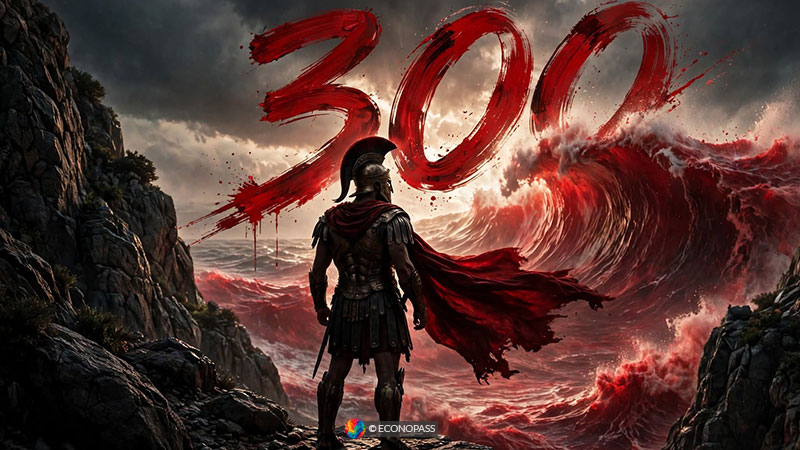
The number is 300. It is on merchandise, in films, in the cultural shorthand for heroic sacrifice against impossible odds. It is also wrong. The Greek force that held the pass at Thermopylae in 480 BCE numbered somewhere between 5,000 and 7,000 soldiers depending on the source. The 300 were real. They were also roughly four percent of the total force. History remembered the four percent and left the rest at the pass.
This is not a minor rounding error. It is a structural omission that erases thousands of soldiers from one of the most retold battles in Western history, and replaces a coalition military action with a myth of Spartan exceptionalism that the surviving historical record does not support.
The Number Everyone Knows Is Wrong
Herodotus, writing within living memory of the battle, gives specific numbers. He lists the contingents: 300 Spartans under Leonidas, 700 Thespians under Demophilus, 400 Thebans, 1,000 Phocians, 80 Mycenaeans, and larger contingents from Arcadia, Corinth, Tegea, and other allied city-states. His combined total approaches 5,200 fighters. Modern historians, accounting for probable gaps in the ancient count and for the helots (enslaved labourers who accompanied Spartan warriors as attendants and fighters), put the realistic figure at 7,000 or higher. The lowest credible estimate from any serious scholarship is still above 4,000.
The pass itself, Thermopylae, meaning “the hot gates” after the sulfur springs at the site, is a coastal chokepoint between the mountains and the sea. At its narrowest point it was wide enough for only a few men to stand abreast. The Greek coalition held it for three days against a Persian force that ancient sources place in the hundreds of thousands and modern historians more cautiously estimate at between 100,000 and 300,000. The terrain made the Persian numerical advantage irrelevant. The Greeks held it as a coalition. The story has been told as if only Spartans were there.
Tom Holland, in Persian Fire, reconstructs the full political and military context of the Persian Wars and makes clear that Thermopylae was one element of a coordinated Greek strategy involving the fleet at Artemisium, the Athenian navy, and a broader coalition that included city-states with very different interests and very different reasons for showing up. The 300 Spartans were the most famous contingent in a force assembled through negotiation, coercion, and shared self-interest. They were not the entire force. They were not even the majority of the final stand.
These Little Gadgets Solve Something You Didn't Know Was Annoying You.
The kind of find you send to three friends immediately. Small, smart, oddly satisfying.
Find Your GadgetWho Was Actually There
The roster reads like a coalition built out of urgency rather than unity. Many of the city-states present had recently been debating whether to submit to Persia rather than fight. The Thebans who marched to Thermopylae were there under political pressure from the broader Greek alliance; Thebes would medize, collaborating openly with Persia, before the year was out. The Phocians were motivated partly by the fact that Thessaly, their neighboring region, had already submitted, making them next in line regardless of what they chose.
What they shared was geography. Thermopylae was the last defensible chokepoint before the Persian army could pour into central Greece. Hold it long enough for the Greek fleet to maneuver, and there was a strategy. Lose it immediately, and there was not. The battle was a coordinated military action using terrain to neutralize a crushing numerical disadvantage. It required multiple city-states, multiple commanders, and a collective decision to stand rather than withdraw. The mythology that grew around it required only one city’s name.
Paul Cartledge, in Thermopylae: The Battle That Changed the World, examines the battle in full historical context and traces precisely how the story was simplified in the decades and centuries following 480 BCE, as Athens and Sparta competed to define the meaning of the Persian Wars for their own political purposes. The reduction of Thermopylae to 300 Spartans served Sparta’s self-image as the supreme military culture of Greece. It served later Western traditions that wanted a clean narrative of disciplined soldier-citizens holding against Eastern despotism. What it did not serve was accuracy.
The Last Day: Who Actually Stayed
On the third day, a local man named Ephialtes led the Persians along a mountain path that circumvented the pass. The Phocians guarding it retreated when the Persian force came through. Leonidas, learning of the flanking maneuver, dismissed most of the allied contingents and ordered them to withdraw and fight elsewhere.
He kept the Spartans. He also kept the Thebans, most likely as hostages; their loyalty to the Greek cause was considered uncertain. And the Thespians stayed. The 700 Thespians under Demophilus were not ordered to remain. They chose to. Their reasoning, insofar as Herodotus preserves it, was stark: Thespiae lay directly in the path of the Persian advance. It had no fortifications that could stop an army. Whether the Thespians died at Thermopylae or retreated to their city, the city faced the same destruction. They stayed.
Herodotus, in The Histories, records the final stand with a precision that makes the selective memory of later tradition all the more striking: he names the Thespian commander Demophilus, notes that the Thespians stayed of their own will, and distinguishes their choice clearly from the situation of the Thebans. He gives the Thespians their moment in full. The tradition that followed him did not. The final stand at Thermopylae involved approximately 300 Spartans, 700 Thespians, and 400 Thebans. The number 300 refers to one contingent of that force. It became the name of the entire battle.
The People History Forgot Completely
The Persians destroyed Thespiae after Thermopylae. They burned it as a specific punishment for the city’s refusal to submit. The 700 men who stayed at the pass had left behind a city without walls and without the soldiers who might have defended it. Thespiae was rebuilt afterward but never regained the prominence it had before 480 BCE. The city that chose defiance over survival was erased twice: once by fire, and again by the story that replaced the battle with a single number.
Simonides of Ceos wrote the epitaph for the Spartan dead: “Go tell the Spartans, stranger passing by, that here obedient to their laws we lie.” It is among the most translated lines in ancient literature. It was written specifically for the Spartans. The Thespians had their own epitaph, also attributed to Simonides. Almost no one knows it.
The 300 are on screen in two major productions and on more merchandise than can be counted. The 700 who made the same choice, faced the same end, and had their home city burned in consequence are a footnote in Herodotus that most people have never reached. The number 300 is accurate for one contingent of one coalition in a three-day battle. History has been running with it for 2,500 years and has not looked back.
Every story has a version. I’m sharing mine.
Marco Bellinari


Sources
- Battle of Thermopylae, Wikipedia
- Thespiae, Wikipedia
- Leonidas I, Wikipedia
- Simonides of Ceos, Wikipedia
- Ephialtes of Trachis, Wikipedia

A Note from Marco Bellinari
Thank you for reading. Every fact in this article is documented and sourced. You will find the references at the bottom if you want to dig further. I hope it surprised you at least once. That is always the intention.
I would love to hear your thoughts. Follow Econopass on social media and share your reaction hereafter as a social comment. And if you do not want to miss the next story, hit follow. There is always another forgotten truth waiting to be told.
Still Curious? Don't Stop Here!
The Spanish Flu Did Not Come from Spain. Spain Was Simply the Only Country Reporting Hones...
Richard III Did Not Murder the Princes in the Tower. Shakespeare Wrote the Script. Tudor P...
The Salem Witch Trials Were Not About Witchcraft. They Were About Land. Every Accused Pers...

Marie Antoinette Never Said Let Them Eat Cake. The Quote Existed 20 Years Before She Was B...

The Bermuda Triangle Kills No More Ships Than Any Other Ocean. Lloyd's of London Charges t...
Walt Disney Was Not Cryogenically Frozen. The Story Started as a Joke and Never Stopped.
The Pyramids Were Not Built by Slaves. We Know Who Built Them and What They Were Paid.