Her name was not Joan. It was not Arc. She never called herself by either. She was not French in any way that the word would have meant anything to a 15th-century peasant. She never killed anyone in battle. And she was not burned for witchcraft.
Almost everything you think you know about Jeanne la Pucelle, the young woman who changed the course of the Hundred Years War, is a construction assembled by centuries of mythology, nationalism, and selective memory. The real person underneath the legend is more interesting than any of it.
Her name at birth was Jehanne, sometimes recorded as Jehanne Romée after her mother’s family, sometimes as Jehanne d’Arc after her father Jacques d’Arc. During her trial in 1431, when asked her name, she replied: “In my village I was called Jehanne. When I came to France they called me Jehanne la Pucelle.” La Pucelle means the Maid, the Virgin. She identified with the title, not with any surname. “Joan of Arc” is an Anglicisation that did not enter wide usage until centuries after her death. She would not have recognised it.
The concept of France itself requires some examination. In the early 15th century, when Jehanne was born in the village of Domrémy around 1412, France was not a unified nation-state in any modern sense. It was a patchwork of feudal territories, duchies, and contested lands in the middle of a war that had been running for nearly eighty years. Jehanne was born in a border region that changed hands between competing factions. She was not fighting for France the nation. She was fighting for the Valois claim to the throne and for the coronation of the Dauphin Charles, who she believed was the rightful king. The national icon France later made her was a retroactive construction applied to a much more specific medieval cause.
The voices are the part of her story that modern audiences find most difficult to interpret, and the part the historical record is actually most detailed about. Jehanne is considered the most documented person in Western civilisation up until her era. The trial transcripts from 1431 and the rehabilitation trial of 1456 survive in French archives and run to thousands of pages. Everything Jehanne said in her own defence was recorded. She described hearing the voices of Saint Michael, Saint Catherine, and Saint Margaret, beginning around the age of thirteen. She described them as accompanied by light. She said they came more clearly when church bells rang.
Modern medicine has proposed various diagnoses for Jehanne’s experiences: epilepsy, schizophrenia, bipolar disorder, tuberculoma affecting the brain. None of these diagnoses can be confirmed from the historical record, and several physicians and historians have argued that the medical retrofitting of modern categories onto a 15th-century peasant girl is itself a form of distortion. What is documented is that her voices were consistent throughout her life, that she answered questions about them carefully and precisely during months of hostile interrogation, and that she never recanted her account of what she had experienced. Whatever the voices were, she died rather than deny them.
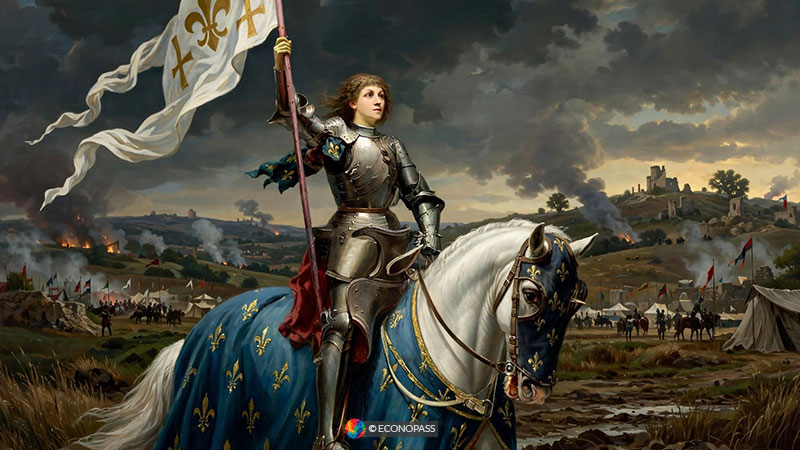
The military reality of her campaigns is also significantly different from the legend. Joan of Arc never personally killed anyone in battle. She carried a banner, not a weapon. She was present at battles and her presence had an extraordinary effect on the morale of French forces, but her role was inspirational and strategic, not combative. She was wounded twice, by an arrow above the breast at Orleans and by a crossbow bolt during an unsuccessful assault on Paris, which tells us she was close to the fighting. But the image of the warrior maiden cutting down English soldiers is a later artistic invention.
Her capture at Compiègne in 1430 and the subsequent trial deserve careful attention. She was captured by Burgundian forces, who sold her to the English for ten thousand livres. The trial that followed was a Church trial for heresy, conducted by the Bishop of Beauvais, Pierre Cauchon, who owed his position to English patronage. The formal charge leading to Joan of Arc’s execution was heresy, not witchcraft. The specific charge was that she had relapsed into heresy by resuming male clothing after initially agreeing to abandon it. The trial was politically motivated, procedurally corrupt, and later annulled by the Church itself. In 1456, a rehabilitation trial declared the original verdict invalid. In 1920, she was canonised.
She is therefore the only person in the history of the Catholic Church to have been both condemned and canonised by that same institution. The Church that burned her also made her a saint. This fact is so extraordinary that it tends to be mentioned and then passed over quickly, as if it were merely an interesting footnote. It is not a footnote. It is the whole story of what happens when political power uses religious authority as a weapon, and then has to account for that use across the centuries.
The bob haircut, which became one of the defining fashion statements of the 20th century, is documented to have been inspired by Jehanne. The style originated in Paris in 1909, directly inspired by her cropped hair, which she wore short as commanded by her voices. One of the most recognisable silhouettes of modern fashion is a medieval French peasant girl following instructions from saints she heard in her head.
History selects what it wants from a person and builds a symbol. The symbol of Joan of Arc has been used by French nationalists, by the Catholic Church, by feminists, by the far right, by the far left, and by every faction in between that needed a young woman in armour to make their point. The actual Jehanne, the one who answered questions at her trial with extraordinary precision and courage, who carried a banner instead of a sword, who died rather than say she had not heard what she had heard, is considerably more interesting than any of them.
Every story has a version. I’m sharing mine. Marco Bellinari
The rabbit hole goes deeper. Go further. It is worth it.
Thank you for reading. Every fact in this article is documented and sourced. You will find the references at the bottom if you want to dig further. I hope it surprised you at least once. That is always the intention.
I would love to hear your thoughts. Follow Econopass on social media and share your reaction hereafter as a social comment. And if you do not want to miss the next story, hit follow. There is always another forgotten truth waiting to be told.
Disclosure: This article may contain affiliate links. This means we may earn a commission if you click on a link and make a purchase at no extra cost to you. This applies to featured Amazon products or any other Econopass's partners.
FediBack: Joan of Arc Was Not Who You Think She Was. The Real Story Is More Complicated.
🟢 The Church that burned her also canonised her 500 years later. She never killed anyone in battle. And her name was never Joan of Arc. After reading this, what surprised you most? Tell me below.
🟢 The Church that burned her also canonised her 500 years later. She never killed anyone in battle. And her name was never Joan of Arc. After reading this, what surprised you most? Tell me below.
🟢 The Church that burned her also canonised her 500 years later. She never killed anyone in battle. And her name was never Joan of Arc. After reading this, what surprised you most? Tell me below.
These articles and stories are free because of a few ads. To support us, simply turn off your ad blocker for Econopass. It takes one click on the ad blocker icon in your browser. Thank you!
We use cookies to ensure that we give you the best experience on Econopass website. If you continue to use this site we will assume that you are happy with it.