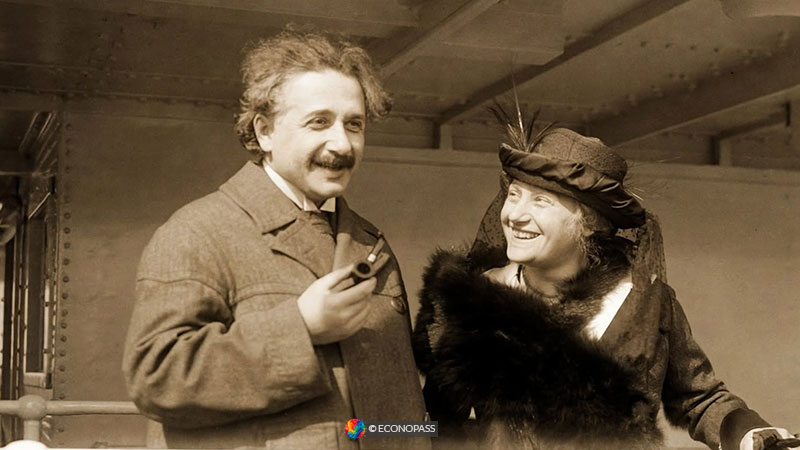
There are people who failed school and went on to do great things. Einstein was not one of them. That is the first thing.
The myth that Albert Einstein failed mathematics in school is one of the most persistent falsehoods in popular history. It appears in motivational posters, commencement speeches, and self-help books the world over, deployed to comfort struggling students with the reassurance that even genius stumbles. The problem is that it is completely untrue, and the actual record has been available to anyone willing to look for over a century.
Einstein’s 1896 Swiss Matura certificate, preserved in the Einstein Papers Project at Princeton, shows perfect scores in every mathematics subject. In algebra, geometry, descriptive geometry, and physics, he received a 6 out of 6, the highest possible grade on the Swiss scale. The myth appears to have originated from a 1935 Ripley’s Believe It or Not column that misread the Swiss grading system, where 6 is the top mark, not the bottom. When a rabbi showed Einstein the column at Princeton, he laughed and said: “Before I was fifteen I had mastered differential and integral calculus.”
He did fail an entrance examination. This is documented and real. At fifteen, after dropping out of school in Munich, Einstein attempted to enter the Federal Polytechnic Academy in Zurich and was rejected. The examination showed weak performance in French and botany. His mathematics and physics scores were, by the examiners’ own assessment, exceptional. He was rejected for the language components of a science entrance exam, retook the preparatory year, and was admitted the following year with excellent marks. This is not a story about failure. It is a story about a fifteen-year-old who was better at physics than French.
The second myth concerns his Nobel Prize. Most people, if asked what Einstein won the Nobel for, will say relativity. The theory of special relativity, published in 1905. The theory of general relativity, completed in 1915. The work that reshaped our understanding of space, time, gravity, and the structure of the universe. It seems obvious that the Nobel committee would have recognised him for this.
They did not. Einstein won the 1921 Nobel Prize in Physics for his explanation of the photoelectric effect, published in 1905 in the same extraordinary year as special relativity. The Nobel committee’s citation is explicit: the prize was awarded for “his discovery of the law of the photoelectric effect.” Relativity is not mentioned. The committee had been uncomfortable with relativity for years, uncertain about its experimental verification and concerned about its philosophical implications. The photoelectric effect was concrete, measurable, and had direct practical applications. Einstein’s explanation of it established the quantum nature of light and laid a foundational brick of quantum mechanics. It was a different kind of genius from relativity, and the Nobel committee found it more manageable.
Einstein himself was characteristically equivocal about this. He was not present at the Nobel ceremony in 1922 because he was travelling in Japan. His acceptance speech, delivered the following year, discussed relativity rather than the photoelectric effect. He understood what the prize was for. He simply had other things on his mind.
The third myth is the darkest, and the most consequential. Einstein is widely described as the father of the atomic bomb. The equation E=mc2, the most famous in the history of science, is understood by most people as having led directly to nuclear weapons. Einstein is therefore implicated, in the popular imagination, in the deaths of over two hundred thousand people at Hiroshima and Nagasaki.
The reality is considerably more complicated. E=mc2 does establish the equivalence of mass and energy, which is the theoretical foundation for understanding nuclear reactions. But the equation predates the bomb by four decades and does not constitute a blueprint for building one. The Manhattan Project that actually designed and constructed the atomic bomb was a massive engineering and physics undertaking involving thousands of scientists, none of whom was Einstein. He was excluded from the project because Army intelligence considered him a security risk due to his pacifist and socialist associations.
Einstein’s actual role in the development of nuclear weapons was a single letter. In 1939, Hungarian physicist Leo Szilard, who had fled Nazi Germany and understood the implications of recent fission discoveries, convinced Einstein to co-sign a letter to President Roosevelt warning that Germany might be developing nuclear weapons and urging the United States to monitor the situation and prepare. Einstein later described signing that letter as the greatest mistake of his life. “Had I known that the Germans would not succeed in producing the bomb,” he said, “I would never have signed that letter.” He played no role in the Manhattan Project, had no involvement in the decision to use the weapons, and spent the final decade of his life campaigning for nuclear disarmament.
Three myths. Three corrections that the historical record has supported for decades. The failed student who topped every mathematics examination. The relativity pioneer who won his Nobel for something else. The father of the bomb who was excluded from building it and spent his life trying to undo the damage his letter had helped set in motion.
The real Einstein is more interesting than the mythological one. He was a man who thought in images rather than words, who did not speak until he was four years old, who revolutionised physics twice in a single year, who was capable of extraordinary intellectual courage and occasional profound personal failure, and who spent the last thirty years of his life in a largely unsuccessful attempt to unify the fundamental forces of nature.
He did not fail mathematics. He failed at something harder: finding a single equation that explained everything. That failure, at least, was the right kind.
Every story has a version. I’m sharing mine. Marco Bellinari
The rabbit hole goes deeper. Go further. It is worth it.
Thank you for reading. Every fact in this article is documented and sourced. You will find the references at the bottom if you want to dig further. I hope it surprised you at least once. That is always the intention.
I would love to hear your thoughts. Follow Econopass on social media and share your reaction hereafter as a social comment. And if you do not want to miss the next story, hit follow. There is always another forgotten truth waiting to be told.
Disclosure: This article may contain affiliate links. This means we may earn a commission if you click on a link and make a purchase at no extra cost to you. This applies to featured Amazon products or any other Econopass's partners.
FediBack: Everything You Know About Einstein Is Wrong. Here Are Three Things History Quietly Corrected.
These articles and stories are free because of a few ads. To support us, simply turn off your ad blocker for Econopass. It takes one click on the ad blocker icon in your browser. Thank you!
We use cookies to ensure that we give you the best experience on Econopass website. If you continue to use this site we will assume that you are happy with it.