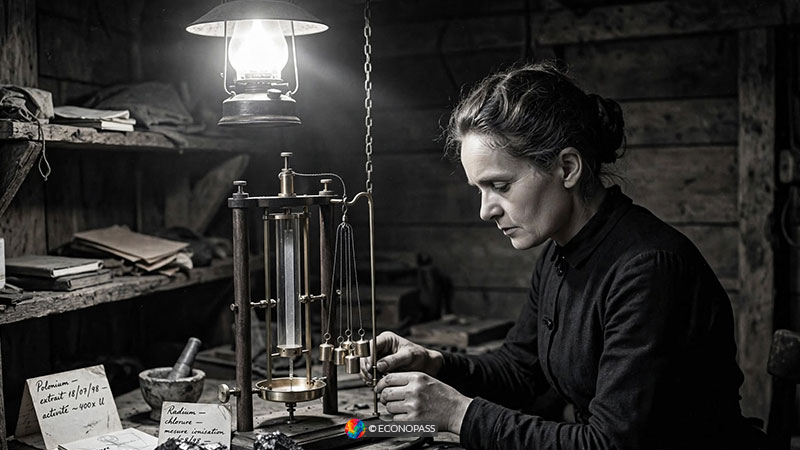
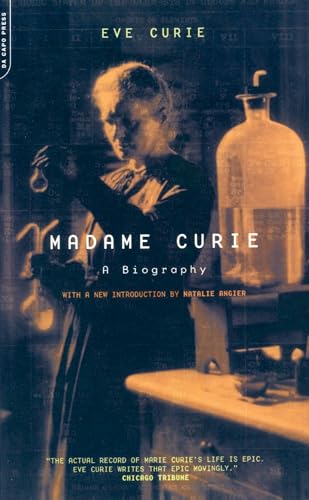
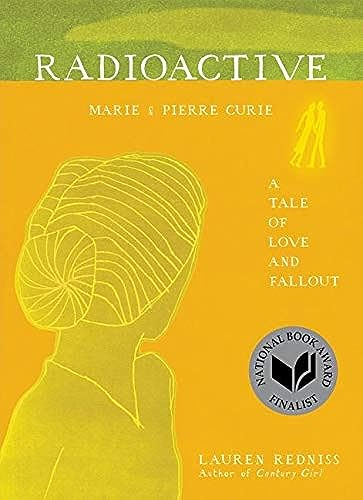
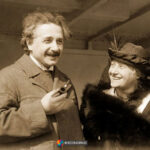
In January 1911, Marie Curie was the most decorated scientist in the world. She had already won the Nobel Prize in Physics in 1903, the first woman ever to receive it. She had discovered two new elements, polonium and radium, and coined the word radioactive. She was a professor at the Sorbonne, the first woman to hold that position. She was, by any measure, the most prominent scientist in France.
The French Academy of Sciences voted against admitting her by two votes.
Then, to make their position clear, they voted again. This time on whether women should ever be admitted to the Academy. The result was 90 to 52 against. Not just against Curie. Against all women, permanently, as a category. The most powerful scientific body in France had looked at the two-time Nobel Prize winner in their midst and decided that the problem was not her qualifications. The problem was her sex.
The man who beat her for the seat was Edouard Branly, a French physicist whose work on wireless communications was real but considerably less significant than discovering radioactivity. At the time of the vote, Branly’s most famous contribution had already been eclipsed by Guglielmo Marconi, who had won the Nobel Prize in Physics two years earlier. The Academy chose a man whose greatest work had been superseded over a woman who had invented the scientific field she worked in. The margin was two votes. Two members of the French Academy of Sciences, voting on January 23, 1911, decided the outcome.
Curie’s response was characteristically direct. She refused to allow the Academy to publish any of her work for the next decade. The institution that would not admit her as a member was also denied access to her research. She continued working, continued publishing through other channels, and later that same year received word at the Solvay Conference in Brussels that she had been awarded the Nobel Prize in Chemistry, making her the first person in history to win Nobel Prizes in two different scientific disciplines. She remains the only person to have done so.
The Nobel Committee, aware of a personal scandal involving Curie at the time, suggested she decline to travel to Stockholm to accept the award. The scandal involved a relationship with a fellow physicist, Paul Langevin, who was separated from his wife. The French press had been vicious, calling her a foreign homewrecker. The Nobel Committee, nervous about the optics, privately encouraged her to stay away.
She went anyway. Her acceptance speech did not acknowledge the controversy. It acknowledged the science. “The way in which radium was discovered is proof that scientific work must not be considered from the point of view of the direct usefulness of it,” she told the Stockholm audience. “It must be done for itself, for the beauty of science.” She picked up the medal, gave the speech, and came home. The scandal faded. The Nobel Prize did not.
Her relationship with France remained complicated throughout her life. The country that rejected her for the Academy admitted her to the Academie Nationale de Medecine in 1922, eleven years after the vote. It was a different institution with different rules. It was also a concession that changed nothing about the original decision. The French Academy of Sciences did not admit its first woman until 1979, when Yvonne Choquet-Bruhat was elected. That is 68 years after the vote against Curie. Marie Curie herself died in 1934 and was never a member.
The first woman the Academy admitted after Curie was not a stranger to her legacy. Marguerite Perey, who discovered the element francium and was finally admitted to the Academy in 1962, had been one of Curie’s own students. The institution excluded the teacher in 1911 and admitted the student fifty-one years later. The teacher’s name is on the periodic table. Curium, element 96, was named in her honour in 1944, ten years after her death.
When she died, France gave her a state funeral and buried her in the Pantheon alongside the heroes of the Republic. In 1995, her remains were transferred there in a ceremony attended by the President of France. She was the first woman to be interred in the Pantheon on her own merits. The country that had refused her a seat in its Academy of Sciences in 1911 placed her among its greatest citizens in 1995. The French Academy of Sciences, which still exists, has never officially acknowledged the 1911 vote as an error.
She tried to donate her Nobel Prize medals to the French National Bank to support the war effort in 1914. They refused those too.
She kept the medals. She kept working. She kept winning.
Every story has a version. I’m sharing mine. Marco Bellinari
The rabbit hole goes deeper. Go further. It is worth it.
Thank you for reading. Every fact in this article is documented and sourced. You will find the references at the bottom if you want to dig further. I hope it surprised you at least once. That is always the intention.
I would love to hear your thoughts. Follow Econopass on social media and share your reaction hereafter as a social comment. And if you do not want to miss the next story, hit follow. There is always another forgotten truth waiting to be told.
Disclosure: This article may contain affiliate links. This means we may earn a commission if you click on a link and make a purchase at no extra cost to you. This applies to featured Amazon products or any other Econopass's partners.
FediBack: Marie Curie Won Two Nobel Prizes. France Still Voted Her Out of Its Academy of Science.
🟢 She lost the Academy vote by two votes. Then she won her second Nobel Prize the same year. After reading this, what detail hit you hardest? Tell me below.
🟢 She lost the Academy vote by two votes. Then she won her second Nobel Prize the same year. After reading this, what detail hit you hardest? Tell me below.
🟢 She lost the Academy vote by two votes. Then she won her second Nobel Prize the same year. After reading this, what detail hit you hardest? Tell me below.
These articles and stories are free because of a few ads. To support us, simply turn off your ad blocker for Econopass. It takes one click on the ad blocker icon in your browser. Thank you!
We use cookies to ensure that we give you the best experience on Econopass website. If you continue to use this site we will assume that you are happy with it.