In the early hours of April 15, 1912, the RMS Titanic sank in the North Atlantic. More than 1,500 people died. The story became the most documented maritime disaster in history, the subject of books, films, and museum exhibitions on every continent. You know the name. You know the iceberg. You know the band played on.
What almost nobody knows is that the Titanic had a sister ship. She was larger. She also sank. And she has been almost entirely forgotten.
Three Ships, One Family
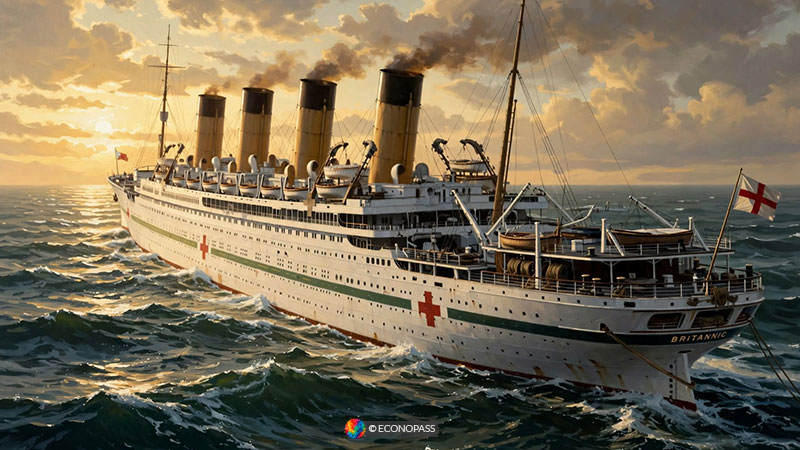
The White Star Line commissioned three Olympic-class ocean liners at the beginning of the twentieth century. The Olympic came first, launched in 1910. The Titanic followed in 1911. The third ship, originally named Gigantic during construction, was renamed Britannic before she ever sailed. At 48,158 tonnes, she was the largest of the three. She was also the most modern, fitted with improvements designed in direct response to the Titanic disaster, including a double hull, larger watertight compartments, and enough lifeboats for every person on board.
She was built to be unsinkable. She sank in 55 minutes.
She Never Carried a Single Passenger
The Britannic was launched in February 1914. World War I began in August of the same year. Before she could enter commercial service, the British government requisitioned her as a hospital ship. She was repainted white with large red crosses on her hull and funnels, the international symbol of medical neutrality. She made five successful voyages between Britain and the Aegean, carrying wounded soldiers from the Gallipoli campaign.
On her sixth voyage, on November 21, 1916, she struck a mine in the Kea Channel off the coast of Greece. She sank in less than an hour. Of the 1,066 people on board, 30 died, most of them killed when lifeboats were drawn into the still-running propellers before the engines could be stopped. The majority survived, rescued by nearby ships within hours.
The lower death toll should be a story of triumph. Instead it became a footnote. The war had more pressing headlines.
The Woman Who Survived Both
Violet Jessop was a stewardess who was on board the Olympic when it collided with HMS Hawke in 1911. She was on the Titanic when it sank, and survived. She was on the Britannic when it sank, and survived again. She continued working at sea after the war and died in 1971, aged 83. Her memoir was published posthumously. It is not widely read.
Her story alone should be famous. The fact that it is not tells you something about how history decides what to remember.
Violet Jessop – Wikimedia Commons – Public Domain
Three ships. Three disasters. One woman on all of them. She went back to sea after every one.
Why the Britannic Disappeared From the Story
The Titanic sank during peacetime, on a maiden voyage, carrying some of the wealthiest people in the world. It happened slowly enough that witnesses could describe it in detail. The inquiry that followed was one of the most extensive in maritime history. The story had everything a disaster narrative requires: hubris, class, sacrifice, and survivors willing to talk.
The Britannic sank during wartime, in a war zone, carrying military medical personnel. The British government had little interest in publicising the loss of a hospital ship to a German mine while the war was still being fought. By the time the war ended, the Titanic had already become mythology. There was no room in the story for a sequel.
The wreck of the Britannic was located in 1975 by Jacques Cousteau. She lies at a depth of 120 metres in the Aegean Sea, largely intact. She is the largest shipwreck accessible to recreational divers in the world. Very few people know she exists.
The Sister the Story Forgot
The Titanic was a tragedy. The Britannic is something else: a story that was set aside because a larger story had already claimed the space it would have occupied. She was better built, better prepared, and lost far fewer lives. She served a humanitarian purpose. She rests at the bottom of a sea most people will never visit, carrying the name almost nobody recognises.
History does not always forget the unimportant things. Sometimes it forgets the important ones because something more dramatic happened first.
Every story has a version. I’m sharing mine. Marco Bellinari
The rabbit hole goes deeper. Go further. It is worth it.
Thank you for reading. Every fact in this article is documented and sourced. You will find the references at the bottom if you want to dig further. I hope it surprised you at least once. That is always the intention.
I would love to hear your thoughts. Follow Econopass on social media and share your reaction hereafter as a social comment. And if you do not want to miss the next story, hit follow. There is always another forgotten truth waiting to be told.
Disclosure: This article may contain affiliate links. This means we may earn a commission if you click on a link and make a purchase at no extra cost to you. This applies to featured Amazon products or any other Econopass's partners.
These articles and stories are free because of a few ads. To support us, simply turn off your ad blocker for Econopass. It takes one click on the ad blocker icon in your browser. Thank you!
We use cookies to ensure that we give you the best experience on Econopass website. If you continue to use this site we will assume that you are happy with it.