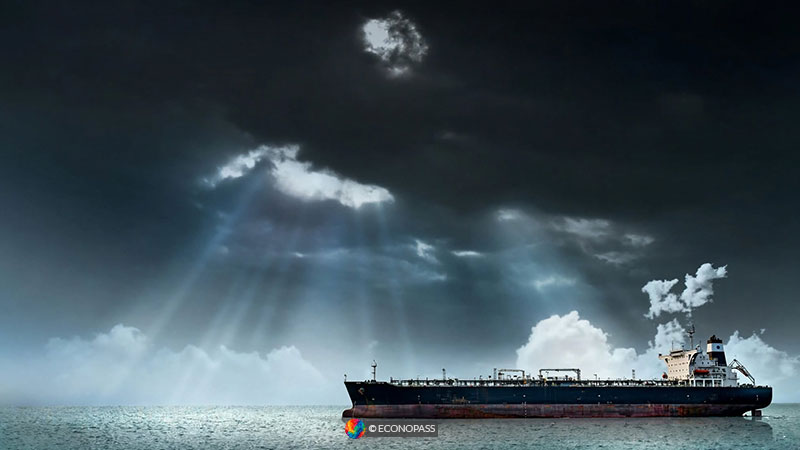
Lloyd’s of London is the oldest and most specialized insurance market in the world. It has been pricing maritime risk since 1688. It prices hurricane corridors, war zones, piracy routes, shallow reefs, and every stretch of open water where ships go down and the underwriters have to pay out. It prices all of it, and it charges accordingly.
The Bermuda Triangle does not get a surcharge. Ships and aircraft transiting the area between Miami, Bermuda, and Puerto Rico pay exactly the same rates as those traveling comparable routes elsewhere in the Atlantic. Lloyd’s actuaries have reviewed the historical loss data. They have concluded that the region does not present elevated risk. The Bermuda Triangle is, in the opinion of the world’s most rigorous maritime risk assessors, not a special place.
Lloyd’s of London has insured ships against every maritime risk on earth since 1688. It does not charge a premium for the Bermuda Triangle. The actuaries looked at the numbers and found nothing there.
What the Data Actually Shows
The United States Coast Guard maintains records of maritime incidents across all domestic and adjacent waters, including the area designated as the Bermuda Triangle. When researchers have compared the incident rate in the Bermuda Triangle against other heavily trafficked stretches of ocean, the region does not stand out. The number of ships lost there, adjusted for traffic volume, is consistent with or lower than comparable areas in the North Sea, the South China Sea, and the waters around Indonesia and the Philippines.
Lawrence David Kusche spent years investigating the claims made about the Bermuda Triangle for The Bermuda Triangle Mystery: Solved. His method was to go back to the original sources for each alleged disappearance: Coast Guard records, Lloyd’s of London shipping registers, newspaper archives, weather bureau reports. What he found was a pattern of systematic distortion. Ships reported as having disappeared in calm weather had in fact gone down in storms. Vessels described as vanishing without a trace had been found with their crews. Events said to have occurred inside the Triangle had taken place hundreds of miles outside it. A number of the most dramatic incidents in the Bermuda Triangle canon either did not happen as described or did not happen in the Triangle at all.
The myth required a specific kind of negligence to persist: nobody went back to check. A story circulated. The next writer repeated it. The next book cited the book before it. The primary sources were never consulted because the story already sounded like a fact.
Our Pick
Anker PowerCore 10,000mAh
Charges an iPhone 3× over. Dual USB-C ports, pocket-sized, no cables needed at the airport.
The term “Bermuda Triangle” was coined by journalist Vincent Gaddis in a 1964 article for Argosy magazine. The concept was not original to Gaddis. Writer E.V.W. Jones had identified a pattern of disappearances in the region for the Associated Press in 1950. But it was Gaddis who named the area, drew the rough triangular boundary, and gave the phenomenon its identity.
Charles Berlitz brought it to mass audiences with his 1974 book The Bermuda Triangle, which spent weeks on bestseller lists and sold millions of copies. Berlitz presented the disappearances as documented fact, attributed them to everything from undersea civilizations to extraterrestrial activity, and made no serious effort to verify the historical record behind the incidents he described. The book was enormously successful. It was also, in its factual claims, largely wrong in ways that were not difficult to check.
The Bermuda Triangle became famous in 1974. Kusche spent the following year checking every incident in the book against primary sources. He published his findings in 1975. The corrections reached a fraction of the audience the original book reached.
The incident most commonly cited as the foundational mystery of the Bermuda Triangle is the disappearance of Flight 19, a group of five US Navy Avenger torpedo bombers that went missing on a training flight on December 5, 1945. Fourteen men were lost. A search-and-rescue aircraft sent to find them also disappeared, taking thirteen more. The incident is real. What is not real is the supernatural explanation that accumulated around it. The flight leader’s compass was malfunctioning. The squadron became disoriented over the ocean in deteriorating weather conditions. The aircraft ran out of fuel. The loss of the search aircraft was attributed to an explosion, likely caused by a fuel leak. These are documented findings from the official Navy investigation.
Why Ordinary Explanations Were Not Enough
Brian Dunning, in Skeptoid: Critical Analysis of Pop Phenomena, identifies the structural reason why the Bermuda Triangle persisted as a mystery long after the evidentiary basis for it had been dismantled: the explanation is less interesting than the phenomenon. A plane that crashes because the pilot is lost and the fuel runs out is a tragedy. A plane that vanishes without explanation in a region where dozens of others have vanished is a mystery. Mysteries attract attention. Tragedies are archived.
The additional factor is confirmation bias in reporting. Every incident that occurred anywhere near the designated region was catalogued as a Bermuda Triangle event. Incidents that occurred within the same region and had obvious explanations were quietly set aside. The incidents that defied easy explanation were highlighted. What emerged was a curated dataset: the anomalies only, stripped of the base rate, presented as though they represented the full picture of what happened in that part of the ocean.
This is not a feature unique to the Bermuda Triangle. It is how most geographic mysteries operate. The selection of cases is the argument. If you apply the same selection criteria to any heavily trafficked stretch of ocean, you can construct a similar pattern. The North Atlantic in winter. The coast of Newfoundland during the age of sail. The waters off the Philippines during monsoon season. Disappearances happen everywhere ships travel. The ocean does not require a supernatural explanation to kill people. It requires only weather, navigation errors, mechanical failure, and the statistical certainty that some percentage of transits, across any route and any era, will not be completed.
Apply the same selection criteria to any heavily trafficked stretch of ocean and you can construct a Bermuda Triangle. The method is the mystery, not the location.
What Remains After the Myth Is Removed
What remains, when the fabricated incidents are removed and the mislocated events are placed back where they occurred and the storms are restored to the calm-weather disappearances, is an ordinary stretch of ocean. Busy, because it is a major shipping and aviation corridor between the United States, the Caribbean, and the Atlantic. Subject to sudden severe weather, because that part of the world generates tropical storms and the weather systems that produce them. Prone to methane hydrate deposits on the seafloor, which can destabilize suddenly and reduce water buoyancy, though the relevance of this to surface shipping remains a subject of scientific debate rather than established fact.
The mystery was built from real events. The real events have real explanations. The explanations were not interesting enough to displace the mystery once the mystery had a name, a shape drawn on a map, and a bestselling book attached to it.
Lloyd’s of London is still not charging a surcharge.
Every story has a version. I’m sharing mine. Marco Bellinari
The rabbit hole goes deeper. Go further. It is worth it.
Thank you for reading. Every fact in this article is documented and sourced. You will find the references at the bottom if you want to dig further. I hope it surprised you at least once. That is always the intention.
I would love to hear your thoughts. Follow Econopass on social media and share your reaction hereafter as a social comment. And if you do not want to miss the next story, hit follow. There is always another forgotten truth waiting to be told.
Disclosure: This article may contain affiliate links. This means we may earn a commission if you click on a link and make a purchase at no extra cost to you. This applies to featured Amazon products or any other Econopass's partners.
These articles and stories are free because of a few non-intrusive ads. To support us, simply turn off your ad blocker for Econopass. It takes one click on the ad blocker icon in your browser. Thank you!
We use cookies to ensure that we give you the best experience on Econopass website. If you continue to use this site we will assume that you are happy with it.