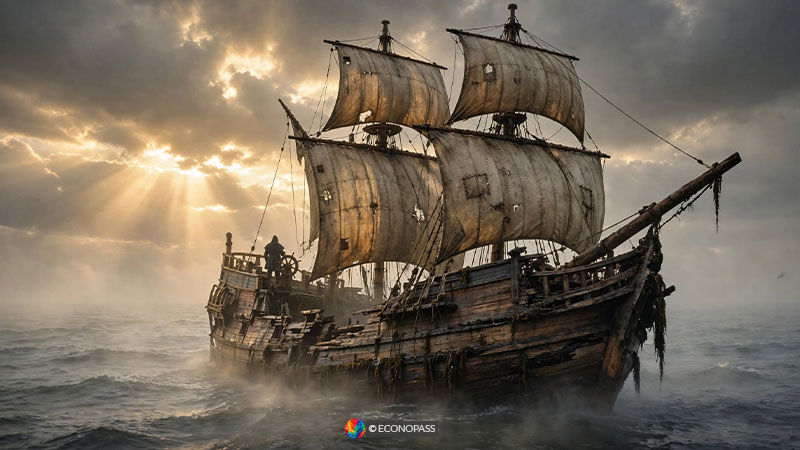
On September 6, 1522, a single ship named the Victoria limped into the harbor of Sanlúcar de Barrameda in southern Spain. It had left that same port nearly three years earlier as part of a fleet of five vessels carrying roughly 270 men. Eighteen men returned. The ship was carrying spices and a record no one had previously held: the first completed circumnavigation of the globe. The man in command was not Ferdinand Magellan. Magellan had been dead for sixteen months, killed on a beach in the Philippines. The man standing on the deck of the Victoria was a Basque sailor named Juan Sebastián Elcano. History has spent five centuries getting this wrong.
What Actually Happened in the Philippines
On April 27, 1521, Magellan made a decision that ended his life and nearly ended the entire expedition. He chose to intervene in a local conflict on the island of Mactan, siding with a chief named Humabon against a rival named Lapu-Lapu. He led roughly 60 men into shallow water, underestimating both the terrain and Lapu-Lapu’s warriors. The attack failed. The Spanish crossbowmen could not get close enough for their weapons to be effective. Magellan was surrounded and killed. He had crossed the Atlantic, found a passage through the southern tip of South America, crossed the Pacific, and reached the Spice Islands. He had crossed roughly three-quarters of the world. He did not finish.
Ferdinand Magellan died on April 27, 1521, on the island of Mactan in the Philippines. He had been at sea for nineteen months. The circumnavigation he is credited with completing required another sixteen months of sailing after his death. He was not present for any of it.
Our Pick
Apple AirPods Pro 3
2× better noise cancellation, heart rate sensing, Live Translation, and 10 hours battery. The earbuds most people end up choosing.
After Magellan’s death, the expedition collapsed into confusion. Two of the remaining ships were scuttled for lack of crew. Command changed hands multiple times through death, mutiny, and execution. Juan Sebastián Elcano, a Basque navigator from Getaria, eventually took command of the Victoria and made the decision that defined the entire enterprise: to sail west, across the Indian Ocean and around the Cape of Good Hope, rather than turn back the way they had come. That choice meant completing the circumnavigation. He pushed his 18 surviving men across waters the expedition had not charted, avoiding Portuguese-controlled ports where the Spanish crew would have been arrested, rationing food and water to near-starvation levels, and arriving home with a hold full of cloves that paid for the entire voyage.
Charles V of Spain granted Elcano a coat of arms. The motto on that coat of arms read Primus circumdedisti me: You first encircled me. The globe itself was on the crest. Spain knew exactly who had done it. Laurence Bergreen’s Over the Edge of the World reconstructs the full expedition in detail, including what the surviving records reveal about the leadership vacuum after Magellan’s death and what Elcano actually navigated to get the ship home.
Charles V of Spain granted Juan Sebastian Elcano a coat of arms bearing a globe and the Latin motto “Primus circumdedisti me” (You first encircled me). The Spanish crown knew who had completed the voyage. The historical record has spent centuries suggesting otherwise.
There Is a Third Name Worth Knowing
Before Elcano’s claim is even settled, there is a more complicated argument to consider. Among the men who sailed with Magellan from Spain in 1519 was an enslaved man known as Enrique of Malacca. He had been purchased by Magellan in Malacca, in what is now Malaysia, sometime before 1511 and had traveled with him to Europe. When the expedition reached the Philippines in 1521, Enrique was able to communicate with local people in a language they understood. If he was from the Visayas region of the Philippines, or from anywhere in the Malay Archipelago close enough to his linguistic homeland, then reaching those islands from the west would mean that he, not Elcano, was the first human being to complete a full personal circumnavigation of the globe. The argument is disputed. His exact origin is not confirmed in the historical record. But the case exists, it is taken seriously by historians, and it appears in precisely zero popular accounts of the Magellan story. Antonio Pigafetta’s firsthand chronicle of the voyage, available in translation as Magellan’s Voyage, is the primary source from which most of what we know about Enrique is drawn.
How the Myth Was Built
The simplest explanation for why Magellan gets the credit is also the most accurate one: he was the commander who planned and launched the expedition, and commanders receive credit for what their expeditions accomplish regardless of whether they survive. This is a convention of historical attribution, not a factual claim. Julius Caesar did not personally win every battle fought by the Roman legions under his command. The logic applied to exploration is the same. The man with the idea and the funding receives the entry in the encyclopedia, whether or not he lived to see the result.
The problem is that popular history does not present this as a convention. It presents Magellan as the man who circumnavigated the globe. In most English-language accounts, Elcano is a footnote, if he appears at all. Roger Crowley’s Conquerors places the Magellan expedition in the broader context of Iberian maritime expansion in the early sixteenth century, where the politics of credit and sponsorship shaped how these voyages were recorded and remembered as much as the voyages themselves did.
The convention of attributing an expedition’s achievement to its commander regardless of outcome is a historical practice, not a factual claim. Magellan conceived and launched the voyage. Elcano completed it. Popular history has collapsed this distinction into a single name, and it chose the wrong one.
What the Numbers Say
Five ships. Roughly 270 men. Three years. Eighteen survivors. One ship. The Victoria returned so undermanned that the crew could barely operate the rigging. The men who made it home had outlasted mutinies, starvation, scurvy, battles, disease, and the bureaucratic hostility of Portuguese ports trying to impound a Spanish vessel. They had crossed every major ocean on the planet. The man who commanded that final leg, who chose the route, held the crew together, and delivered the ship, was Juan Sebastián Elcano. The globe on his coat of arms says what the history books for five centuries have preferred not to.
Every story has a version. I’m sharing mine. Marco Bellinari
The rabbit hole goes deeper. Go further. It is worth it.
Thank you for reading. Every fact in this article is documented and sourced. You will find the references at the bottom if you want to dig further. I hope it surprised you at least once. That is always the intention.
I would love to hear your thoughts. Follow Econopass on social media and share your reaction hereafter as a social comment. And if you do not want to miss the next story, hit follow. There is always another forgotten truth waiting to be told.
Disclosure: This article may contain affiliate links. This means we may earn a commission if you click on a link and make a purchase at no extra cost to you. This applies to featured Amazon products or any other Econopass's partners.
FediBack: The First Person to Circumnavigate the Globe Was Not Magellan. He Died Halfway Through.
These articles and stories are free because of a few non-intrusive ads. To support us, simply turn off your ad blocker for Econopass. It takes one click on the ad blocker icon in your browser. Thank you!
We use cookies to ensure that we give you the best experience on Econopass website. If you continue to use this site we will assume that you are happy with it.