

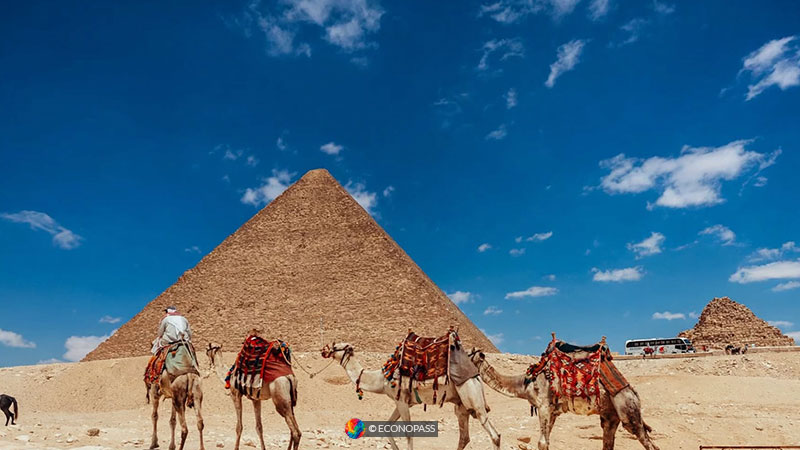
The story was always convenient. A pharaoh with ambitions too large for any human workforce. A conquered people forced to drag stone across the desert at the point of a sword. The pyramids as monuments to tyranny. It is a compelling image. It is also wrong. We know it is wrong because we found where the builders lived, where they ate, where they were buried, and what they were given in return for their work.
The slave narrative comes from Herodotus. He visited Egypt around 450 BCE and wrote that the pyramids were built by slaves. The Great Pyramid of Giza was finished around 2560 BCE. Herodotus was writing approximately two thousand years after the fact, in a language the builders did not speak, based on accounts he received from Egyptian priests who had their own reasons for storytelling. Archaeologists have spent decades finding what he could not have known.
Herodotus was not wrong because he lied. He was wrong because he was two thousand years too late and no one corrected him until the ground did.
What the Ground Said
In the 1990s, Egyptologist Mark Lehner excavated a workers’ village at Giza, less than four hundred metres south of the Sphinx. What he found was not a slave camp. It was a functioning settlement with bakeries, breweries, a medical facility, and housing for a rotating workforce. The site contained evidence of industrial-scale food production: enough cattle and sheep bones to suggest that approximately ten thousand workers were fed meat regularly. Lehner, whose The Complete Pyramids remains the definitive study of the construction record, concluded that the pyramid builders were skilled Egyptian citizens working in organised shifts.
The workers rotated in three-month stints. They came from villages across northern and southern Egypt. They were organized into named gangs with identities that suggest something closer to professional pride than forced conscription. Two of those crews were called “Friends of Khufu” and “Drunkards of Menkaure.” Enslaved people do not typically name their work crews.

Anker PowerCore 10,000mAh
Charges an iPhone 3× over. Dual USB-C ports, pocket-sized, no cables needed at the airport.
View on AmazonThe Wadi el-Jarf Papyri
In 2013, a team excavating the ancient harbor of Wadi el-Jarf, on the Red Sea coast, found something no one had ever seen: papyri dating to the reign of Khufu, the pharaoh who built the Great Pyramid. They are the oldest papyri ever discovered. Among them is a journal kept by an official named Merer, who supervised a team of workers transporting limestone from the Tura quarry to Giza.
Merer records daily operations, provisions, personnel, and logistics. His entries describe a workforce that received rations, moved in coordinated crews, and operated within a structured administrative system. This is not the record of a slave operation. It is the record of an organized labor force supported by the state.
The oldest administrative document ever found describes a pyramid construction workforce being fed, managed, and moved with the precision of a logistics operation, not a forced labor camp.
What They Were Paid
Payment in ancient Egypt did not mean coins. The economy ran on commodities. Workers received food, beer, linen, and medical care. The system Egyptologists describe is a corvée: seasonal civic labor exchanged for state support. Workers who were injured on the site received treatment. Skeletons found at Giza show evidence of amputations that healed, which means the injured were kept alive and cared for. That is not what slave labor looks like.
In 2010, Egyptian authorities displayed tombs found near the pyramid complex dating to the 4th Dynasty, the same period as the construction. The tombs contained the remains of workers buried with beer and bread for the afterlife. Zahi Hawass, then Egypt’s chief of antiquities, was direct: people buried this close to the pyramids, with provisions for the next world, were not slaves. They were workers who died in the service of a project the state considered sacred, and they were buried accordingly.
Why the Myth Survived
Herodotus planted the seed. Cecil B. DeMille watered it with The Ten Commandments in 1956, a film that fixed the image of whip-driven slaves and stone in the popular imagination for generations. The problem is that DeMille’s pyramid builders were Jewish slaves under Ramesses II, who ruled around 1279 BCE. The Great Pyramid was finished thirteen hundred years before Ramesses was born. The two stories are not even in the same century.
Barbara Mertz, whose work on Egyptian archaeology shaped how a generation understood the ancient world, spent considerable effort untangling popular myth from the archaeological record. The persistence of the slave narrative, she argued, says more about how modern cultures imagine ancient power than about anything the Egyptians actually did. A monument that large, built by people who chose to build it, is a harder story to tell. It requires you to take the civilization seriously on its own terms.
The pyramid myth was never really about Egypt. It was about how the modern world prefers to imagine what large ambitions require of the people beneath them.
What It Changes
If the pyramids were built by paid workers rotating through three-month shifts, supplied by a state capable of feeding ten thousand people a day, organized into named professional crews with their own identities and their own burial rights, then what we are looking at is not a monument to cruelty. It is a monument to administrative capability at a scale no other civilization of that era came close to matching. The Great Pyramid is extraordinary regardless of who built it. But knowing that it was built by Egyptians, for Egyptians, by workers who ate meat and were buried with honor, changes what it says about the civilization that produced it.
The slave narrative was always easier. It required nothing of ancient Egypt except brute force. The actual story requires something more uncomfortable: respect.
Every story has a version. I’m sharing mine.
Marco Bellinari


Sources
- More evidence slaves didn’t build pyramids, CBS News
- New evidence that pyramid builders were free, History News Network
- New find shows slaves didn’t build pyramids, Egypt says, Herald Net
- What evidence proves pyramid builders were not slaves, Lenz.io
- Egypt: New Find Shows Slaves Didn’t Build Pyramids, RD World Online
A Note from Marco Bellinari
Thank you for reading. Every fact in this article is documented and sourced. You will find the references at the bottom if you want to dig further. I hope it surprised you at least once. That is always the intention.
I would love to hear your thoughts. Follow Econopass on social media and share your reaction hereafter as a social comment. And if you do not want to miss the next story, hit follow. There is always another forgotten truth waiting to be told.