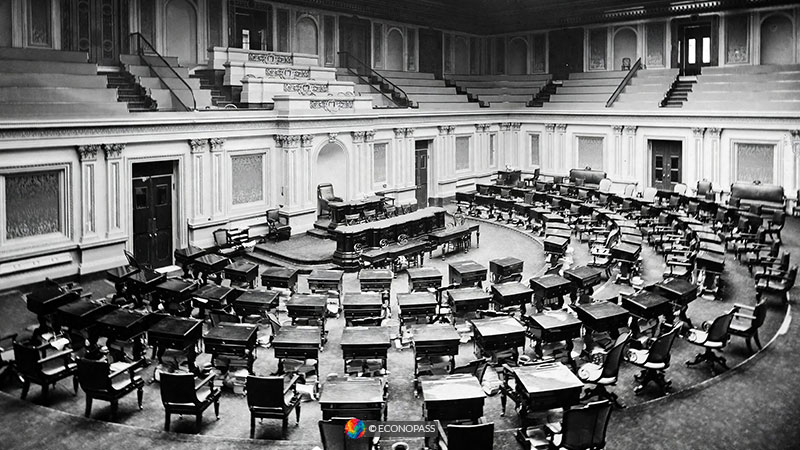
They call themselves conservatives. They say they are protecting freedom, the Constitution, the American way. But at some point between Ronald Reagan’s second term and today, something fundamental shifted. Most Americans never got a memo.
This is not an opinion piece. The facts will do the talking.
When the history of a nation is rewritten fast enough, people stop noticing the original was replaced.
The Party You Think You Know: Then vs. Now
To understand what happened to American conservatism, you need to hold two photographs side by side: what the Republican Party stood for in the 1980s, and what it stands for today. The contrast is not subtle.
Our Pick
eufy E25 Robot Vacuum & Mop
Powerful suction, mop combo, smart navigation, works with Alexa. Set it, forget it, come home to clean floors.
Then: Ronald Reagan signed the Economic Recovery Tax Act of 1981, slashing the top marginal rate from 70% to 50%. He is remembered as the great tax cutter. What is less remembered: he then raised taxes at least eight times between 1982 and 1988, including the Tax Equity and Fiscal Responsibility Act of 1982, described by the Congressional Budget Office as the largest peacetime tax increase in American history. Reagan understood that governance requires adjustments.
Now: The 2017 Tax Cuts and Jobs Act delivered 83% of its permanent benefits to the top 1% of earners, according to the Tax Policy Center. Deficit concerns, once the bedrock of fiscal conservatism, evaporated. The national debt crossed $36 trillion. No Republican budget plan in the current era has balanced the books, because none is designed to.
Healthcare
Then: In 1974, Republican President Richard Nixon proposed the Comprehensive Health Insurance Plan: a mandate requiring employers to provide health coverage and a federal program for those who could not afford it. By modern Republican standards, Nixon’s plan would be called socialism. It was not. It was pragmatic governance.
Now: The Republican Party spent a decade promising to repeal the Affordable Care Act. When given full control of Congress in 2017, they failed, and offered no replacement. Millions of Americans remain uninsured not because there is no solution, but because the political cost of governing has become too high.
Guns
Then: Ronald Reagan actively supported the Brady Handgun Violence Prevention Act, writing in a 1991 New York Times op-ed: “Every year, an average of 9,200 Americans are murdered by handguns… If the passage of the Brady Bill… can save only one person’s life, I say that makes the bill worth passing.” He also supported the Federal Assault Weapons Ban of 1994.
Now: After the 2012 Sandy Hook massacre of 20 children between six and seven years old, Congress did nothing. After Uvalde in 2022, Congress did almost nothing. The math is not complicated.
Foreign Policy
Then: Reagan’s foreign policy was muscular multilateralism. NATO was sacred. American global leadership was the Republican brand. The Soviet threat was met with alliances, not with admiration for the adversary.
Now: A former Republican president openly questioned whether the US should honor its NATO commitments, reportedly told Putin the US would not defend allies who did not meet spending targets, and expressed admiration for strongmen in Hungary, North Korea, and Russia. These are not conservative positions. They are their mirror image.
Reagan would not recognize what carries his name today. And the people cheering loudest for it have never read what he actually said.
Left vs. Right: The Global Reality Check
American political vocabulary is broken. The words “left,” “right,” “socialist,” and “liberal” mean radically different things in the United States than they do in every other wealthy democracy on earth. This is not an accident.
In Germany, the center-right Christian Democratic Union, which governed for 16 years under Angela Merkel, supports universal healthcare, robust environmental regulation, a high minimum wage, and strong labor protections. In France, the Gaullists built the country’s universal health system and have never seriously proposed dismantling it. In Canada, the Conservative Party supports single-payer healthcare as a baseline. In Australia, the Liberal Party, the right-wing party, maintains Medicare for all citizens.
What these parties share across France, Germany, Canada, Australia, the Netherlands, Sweden, Japan, is a consensus that a functioning market economy requires a social floor. That is not socialism. That is what economists call the mixed economy, which has been the operating model of every successful rich democracy since 1945.
When American politicians label universal healthcare “socialism,” they are not making an economic argument. They are using a word most of their voters cannot define to block a policy that every comparable country has implemented, many of them under conservative governments. The United States is the only wealthy nation without universal health coverage. The US spends more per capita on healthcare than any country on earth, roughly twice what France or Germany spends, and achieves worse outcomes on life expectancy, infant mortality, and chronic disease management. This is not ideology. This is data.
The Constitution Is Not a Slogan
The Constitution of the United States is not long. It fits comfortably in a small pamphlet. Its core architecture, three co-equal branches, an independent judiciary, checks and balances, and the rule of law above all persons including the president, was designed by men who had just lived under a king and were determined never to do so again.
What is happening in 2026 is not a policy disagreement.
In early 2026, the Department of Justice filed suit against the entire federal district bench in Maryland, naming individual judges by name, for issuing rulings the executive branch disagreed with. The American Bar Association called the action an unprecedented attack on judicial independence. A federal judge ultimately dismissed the case. But the message had been sent.
Vice President JD Vance stated publicly that “judges aren’t allowed to control the president,” a claim that would have been considered constitutionally illiterate in any previous administration, from either party. Article III of the Constitution exists for precisely the opposite reason.
Freedom House’s 2026 report rated the United States at 81 out of 100, the lowest score in the organization’s history for this country, down from 94 in 2017. The report cited executive branch resistance to court orders, removal of oversight officials, and pressure on the press. A score of 81 places the US in the “Free” category. The trajectory is the data point that matters.
The Constitution does not protect itself. It is protected by people who understand what it says, and who are willing to say so out loud.
The Ghost of Communism and the Myth of Socialism
The words get thrown around with a confidence that suggests the people using them have never opened a dictionary.
Communism is a political and economic system in which the state owns all means of production, private property is abolished, and a single party exercises total control over economic and political life. The Soviet Union, Maoist China, Cuba, and North Korea are historical or current examples. Communist regimes have been responsible for some of the most catastrophic human rights abuses of the 20th century. Communism is not a label applied casually by serious analysts.
Democratic socialism means public or collective ownership of key sectors of the economy alongside a market system, with strong social protections: universal healthcare, free education, unemployment insurance, public pensions. Denmark, Sweden, Norway, Finland, the Netherlands, and Germany operate under social-democratic models. They also consistently rank at the top of global indices for happiness, life expectancy, education, and economic mobility. None of them have abolished private property. None of them are Communist.
When Republican politicians call Medicaid expansion a step toward the Soviet Union, they are not making a factual argument. They are using a word associated with suffering and oppression to frighten people away from policies that every comparable democracy treats as basic public infrastructure.
The American Medical Association called Medicare “socialized medicine” in 1965 when Lyndon Johnson signed it into law. Today, Medicare is consistently supported by over 80% of Americans, including the majority of Republicans. The word “socialism” failed to stop it. Reality intervened.
Extremism and the Edge of the Cliff
Political extremism does not arrive as extremism. It arrives dressed as common sense, as patriotism, as protecting what was always there. The process has a name in academic literature: democratic backsliding. In How Democracies Die, Harvard professors Steven Levitsky and Daniel Ziblatt documented the pattern across dozens of countries. The sequence is consistent: erosion of norms before laws, capture of institutions before force, reframing of opponents as enemies before anything more drastic.
The PRRI survey released in October 2026 found that 62% of Republicans support detaining undocumented immigrants in internment camps until they can be deported. The word “internment camp” has a specific history in the United States. The Japanese-American internment of World War II is officially recognized as one of the darkest episodes in American history. Its rehabilitation as policy is not a minor development.
Political scientists who study civil conflict do not use the phrase “civil war” lightly. Barbara Walter, a professor at the University of California San Diego and a member of a CIA advisory board that monitors political instability worldwide, published research warning that the United States was displaying early markers of pre-civil conflict: factionalism, declining democratic norms, and the normalization of political violence. By 2026, those markers have not receded.
Research consistently shows that lower levels of formal education correlate with higher susceptibility to authoritarian messaging and conspiracy theories. This is not a moral judgment about individuals. It is a structural vulnerability that some politicians have learned to exploit. Keeping people uncertain, frightened, and semantically confused is a governing strategy. It works until people stop letting it.
An electorate that cannot define the words being used against it cannot defend itself from them.
What Comes Next Is Not Inevitable
The Republican Party of Eisenhower built the interstate highway system. The Republican Party of Nixon created the Environmental Protection Agency. The Republican Party of Reagan signed immigration reform that offered amnesty to three million undocumented immigrants. The Republican Party of George H.W. Bush signed the Americans with Disabilities Act. These are historical facts belonging to the same party that today calls infrastructure spending “radical” and environmental regulation “tyranny.”
Democracies have pulled back from the edge before: in France in the 1930s and again in the 1960s, in South Korea in the 1980s, in Brazil after Bolsonaro. The common thread in every recovery was a citizenry that chose to engage with reality instead of the story being sold to them.
The facts do not belong to a party. They belong to anyone willing to look at them. That is what the word “conservative” originally meant: conserving what works, discarding what does not, and leaving the country in better shape for those who come after.
That definition is still available. The question is whether anyone will claim it.
The Middle is Where People Live
The loudest voices in any political system share one interest: keeping you convinced the choice is binary. Left or right, red or blue, us or them. But pull back far enough and the picture changes. Across cultures, across centuries, across every documented study of human values, the majority of people have always lived somewhere in the middle. They wanted security and liberty at the same time. They believed in personal responsibility and collective care without seeing a contradiction. They were suspicious of power in all its forms. The extremes make the noise. The middle is where humanity actually lives. That has always been the inconvenient fact that ideologues on both ends cannot afford you to notice.
Every story has a version. we’re sharing ours. Marco Bellinari – Author Simon de Lafronde – Co-Author
Note: Comments are closed for this article, thank you for your understanding.
The rabbit hole goes deeper. Go further. It is worth it.
Thank you for reading. Every fact in this article is documented and sourced. You will find the references at the bottom if you want to dig further. I hope it surprised you at least once. That is always the intention.
I would love to hear your thoughts. Follow Econopass on social media and share your reaction hereafter as a social comment. And if you do not want to miss the next story, hit follow. There is always another forgotten truth waiting to be told.
Disclosure: This article may contain affiliate links. This means we may earn a commission if you click on a link and make a purchase at no extra cost to you. This applies to featured Amazon products or any other Econopass's partners.
These articles and stories are free because of a few non-intrusive ads. To support us, simply turn off your ad blocker for Econopass. It takes one click on the ad blocker icon in your browser. Thank you!
We use cookies to ensure that we give you the best experience on Econopass website. If you continue to use this site we will assume that you are happy with it.