The image everyone carries is a woman with a lamp, moving quietly through hospital wards in the dark, tending to wounded soldiers. It is one of history’s most successful public relations operations. It is also almost entirely wrong.
Florence Nightingale did not change medicine by caring. She changed it by counting.
The Number That Ended a War’s Real Casualty Rate
When Nightingale arrived at Scutari in 1854, British soldiers were dying at a rate that had no parallel in recent European conflict. The official explanation was the war itself. Enemy fire. Battle wounds. The brutal mathematics of combat.
She did not accept that explanation. She started counting.
What she found was this: of every 18,000 British soldiers who died during the Crimean War, 16,000 died not from wounds but from preventable diseases. Cholera. Typhus. Dysentery. Infections that spread through contaminated water, overcrowded wards, and the complete absence of basic sanitation. The war was not killing the soldiers. The hospitals were.
That was not an observation. It was a data finding, documented, cross-referenced, and built into a statistical report that she hand-delivered to the Secretary of State for War. Nobody had asked her to produce it. Nobody had asked her to count anything. She counted anyway.
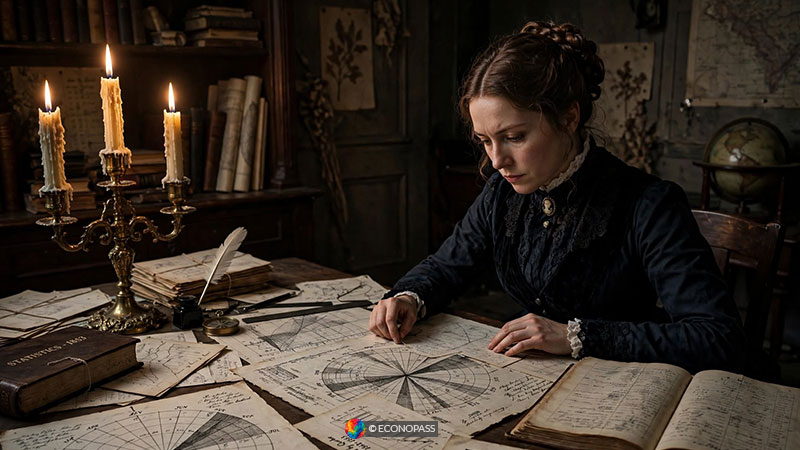
She arrived at Scutari with notebooks, not bandages. The lamp was symbolic. The ledger was real.
She Invented a New Kind of Chart to Make Politicians Listen
Having the numbers was not enough. Nightingale understood something that most scientists of her era did not: data presented as tables produces polite nodding. Data presented as pictures produces action.
She invented what she called the diagram of the causes of mortality in the army in the East. It is known today as a polar area chart, or a coxcomb diagram. Each segment represented a month. Each layer represented a cause of death: wounds, disease, other causes. The visual message was impossible to ignore. The preventable deaths dwarfed everything else. Blue for disease. Red for wounds. The blue sectors were enormous. The red sectors were almost nothing.
She had these printed and sent to members of Parliament, to the Queen, to journalists. She did not write a letter asking them to care. She showed them a picture that made the argument for her.
In her own words, she wrote: “To understand God’s thoughts we must study statistics, for these are the measure of his purpose.”
That line has been quoted as piety for 150 years. It was actually a methodological statement. She believed that reality, properly counted, would always speak for itself. Her job was to make sure it spoke loudly enough, and to the right people, in a format they could not dismiss.
The Royal Statistical Society Did Not Admit Her as a Courtesy
In 1858, Nightingale became the first woman elected to the Royal Statistical Society. This was not a symbolic gesture. The Society did not do symbolic gestures. They elected her because her statistical methods were rigorous, original, and consequential in ways that most of her male contemporaries had not matched.
She had spent the years since returning from Crimea producing what amounted to an 830-page evidence-based indictment of British military medicine. The report, “Notes on Matters Affecting the Health, Efficiency, and Hospital Administration of the British Army,” was not a memoir. It was a dataset with argument attached. It included comparative mortality rates, detailed breakdowns by cause and month, and a series of visualizations that remain influential in data science education today.
She had done most of this while confined largely to her room. The exact nature of her illness has been debated for a century. What is not debated is that she produced, from that room, one of the most consequential bodies of public health research of the nineteenth century. The bedridden woman with the reputation for gentle nursing was running a statistical operation that would reshape medicine across continents.
The lamp was the story the Victorians needed. The numbers were the story that actually saved lives.
She Designed Hospital Architecture Using Mortality Data
The pavilion design of hospitals, which dominated medical architecture for the next century, is directly traceable to Nightingale’s statistical analysis of how disease spread through buildings. She showed, with data, that long open wards with cross-ventilation produced dramatically lower infection rates than crowded enclosed rooms. This was not intuition. It was the result of tracking mortality rates across multiple hospitals, multiple countries, and multiple years.
She wrote the book on hospital design, literally. “Notes on Hospitals,” published in 1859, became the standard reference for medical architects across Europe and North America. It was grounded entirely in comparative data. The book that followed, “Notes on Nursing,” aimed at a general audience, sold widely and became the text people associated with her name. This is why history filed her under nursing. The architectural manual, the mortality analysis, the military health reform: these landed in the parts of history that do not get read.
Steven Johnson’s The Ghost Map documents the same era and a parallel revolution in evidence-based medicine, John Snow mapping cholera deaths in London with the same cold logic Nightingale applied to Crimea. The two were doing the same thing: making the invisible visible through data, and forcing institutions to act on what they could no longer unsee.
What the Lamp Story Cost Her
The lady with the lamp image was not Nightingale’s invention. It was constructed largely by Henry Wadsworth Longfellow’s 1857 poem, which reduced a ferocious intellectual to a symbol of female tenderness. Nightingale reportedly found it mortifying.
She spent the last fifty years of her life advancing the science of public health. She designed statistical forms still used in hospitals today. She advised governments on sanitation systems in India without ever visiting India, working instead from data she collected through correspondence with colonial officials and medical officers across the subcontinent. She never stopped working. She also never stopped being introduced, in speeches and newspaper articles, as the gentle nurse who brought comfort to the wounded.
Hugh Small’s Florence Nightingale: Avenging Angel argues that the sanitized legend was not just flattering but actively damaging, that it obscured the full scale of what she accomplished by recasting scientific achievement as feminine virtue. The lamp became the story. The math got buried. And a woman who essentially invented evidence-based medicine entered history as a symbol of compassion rather than a pioneer of the discipline that would eventually save more lives than any treatment then available.
The Version of Florence Nightingale That History Preferred
History tends to take complex people and file them under the simplest available label. Nightingale was filed under nursing because nursing is comprehensible, because care is a legible female achievement, because a woman with numbers was harder to explain to a Victorian audience than a woman with a lamp.
The fuller version is considerably more useful. A statistician who understood that the most powerful political tool available to her was a well-designed chart. A researcher who produced, from a sickroom, data that changed hospital design across two continents. Someone who grasped, long before the term existed, that evidence-based medicine was the only kind that worked, and that the evidence would only matter if it could be seen clearly enough to be acted on.
She was not tending to soldiers. She was building the argument that would make their deaths preventable the next time. Mark Bostridge’s Florence Nightingale: The Making of an Icon traces exactly how the legend was constructed and what it buried in the process. The icon is the wrong story. The statistician is the real one.
Every story has a version. I’m sharing mine. Marco Bellinari
The rabbit hole goes deeper. Go further. It is worth it.
Thank you for reading. Every fact in this article is documented and sourced. You will find the references at the bottom if you want to dig further. I hope it surprised you at least once. That is always the intention.
I would love to hear your thoughts. Follow Econopass on social media and share your reaction hereafter as a social comment. And if you do not want to miss the next story, hit follow. There is always another forgotten truth waiting to be told.
Disclosure: This article may contain affiliate links. This means we may earn a commission if you click on a link and make a purchase at no extra cost to you. This applies to featured Amazon products or any other Econopass's partners.
FediBack: Florence Nightingale Was Not a Gentle Nurse. She Was a Statistician Who Rewrote Medical Science.
These articles and stories are free because of a few non-intrusive ads. To support us, simply turn off your ad blocker for Econopass. It takes one click on the ad blocker icon in your browser. Thank you!
We use cookies to ensure that we give you the best experience on Econopass website. If you continue to use this site we will assume that you are happy with it.