

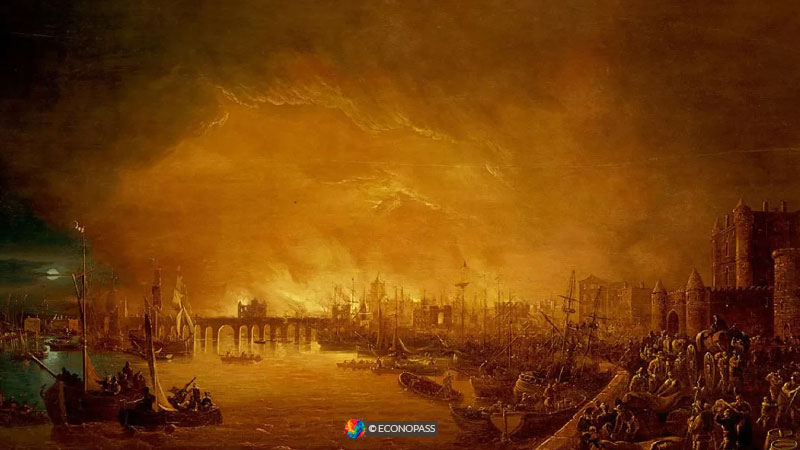
The Great Fire of London is one of the most famous events in English history. It started in a bakery on Pudding Lane on the morning of September 2, 1666. It burned for four days. It destroyed most of the medieval city. And according to a story that has been repeated in classrooms and documentaries for generations, it ended the Great Plague by burning down the rat-infested slums where the disease had taken hold.
That story is wrong. The plague was already over. It had been over for the better part of a year before the first spark fell.
The Plague Peaked in the Summer of 1665
The Great Plague of London reached its peak in August and September of 1665, roughly a year before the fire. At the height of the epidemic, the weekly Bills of Mortality recorded over 7,000 deaths in a single week. By the end of 1665, London had lost somewhere between 75,000 and 100,000 people, roughly a quarter of its entire population.
But by December 1665, the weekly death toll had already fallen dramatically. By February 1666, plague deaths were in the dozens rather than the thousands. By the spring of 1666, the disease had retreated to the point where normal city life had largely resumed. Samuel Pepys, whose diary provides one of the most detailed firsthand records of the period, noted that London was returning to something like its former self well before any fire was imaginable.
At its peak in the week ending September 19, 1665, the Bills of Mortality recorded 7,165 plague deaths in London in a single week. By February 1666, that number had fallen to under fifty per week. The Great Fire did not occur until September 1666.
The fire and the plague are separated by roughly twelve months. They are connected in the popular imagination because they happened in the same city within the same decade. They are not connected by cause and effect. The fire arrived after the plague had already run its course, and was then woven into the story of the plague’s end because it made the story tidier.
The Fire Burned the Wrong Part of the City
Even setting aside the timeline, the geography does not hold up. The Great Fire burned the City of London, the historic square mile at the heart of the capital, the wealthiest part of the city. It destroyed the Royal Exchange, St Paul’s Cathedral, the Guildhall, and approximately 13,200 houses belonging largely to merchants and tradespeople with something to lose.
The plague had been most devastating in the poorer outer parishes: Stepney, Southwark, Whitechapel, and the overcrowded courts and alleys that pressed against the city walls from the outside. These areas were not touched by the fire. The slums where the disease had concentrated, where rats and people lived in the closest possible proximity, survived the fire entirely and continued to exist in more or less the same condition for generations afterward.
The parishes most severely affected by the plague in 1665 were largely outside the old city walls. The Great Fire, which burned primarily within those walls, did not reach them. The rat population in the worst-affected areas was undisturbed.
The rats that carried the fleas that carried the plague were not in the merchant quarter. Burning the merchant quarter did not change the conditions in the places that mattered. The fire, for all its destruction, missed its supposed target entirely.
What Actually Ended the Plague
The honest answer is that historians are not certain. Plague had returned to London repeatedly throughout the medieval and early modern periods, and after 1665 it did not return in the same way. The reasons proposed include changes in the rat population over the following decades, a possible shift in the dominant strain of disease, improvements in housing standards, and the theory that the black rat, which carried fleas more efficiently, was being gradually displaced by the larger brown rat, which had different habits and a different relationship with human habitation.
The fire is not among the serious candidates in any of these explanations. What the fire did do was destroy a medieval street layout that had not fundamentally changed since the Norman period. The city rebuilt wider and with more stone. That may have contributed something over the following decades. But the plague was not waiting around for the rebuilding. It was already gone.
Why the Story Refuses to Die
The narrative survives because it is satisfying. Catastrophe followed by catastrophe, and then from the wreckage of the second disaster, something like renewal. Christopher Wren rebuilding St Paul’s. The old medieval city replaced by something wider and cleaner. The story of the fire ending the plague fits into a larger story about London destroying its own diseased past and emerging transformed.
It is also the kind of story that travels well in a classroom. One event causes another. The bad thing was ended by the dramatic thing. History has a shape and a logic. The actual explanation, which involves rat species displacement and epidemiological uncertainty and a disease that simply burned itself out as diseases sometimes do, does not have the same clean arc.
Plague continued to appear across continental Europe well into the eighteenth century. The last major outbreak in Western Europe was the Great Plague of Marseille in 1720, more than fifty years after the Great Fire of London. Fire alone was not sufficient to end plague where it occurred.
The Great Fire did not end the plague. The plague ended the plague, the way epidemics end: by running out of susceptible hosts, by burning through a population that had no immunity and leaving behind the survivors who did, by retreating for reasons that are still not fully understood. The fire arrived after all of that had already happened, destroyed an enormous amount, and was then handed credit it had not earned.
That is how most historical myths about cause and effect operate. Two things happen near each other in time. One is dramatic. One is complicated. The complicated one gets forgotten. The dramatic one gets the credit. And then the credit hardens into fact, and the fact gets taught, and the teaching goes on long enough that nobody thinks to check the dates.
In this case, the dates are not even close.
Every story has a version. I’m sharing mine.
Marco Bellinari


Sources
- Great Plague of London, Wikipedia
- Great Fire of London, Wikipedia
- The Diary of Samuel Pepys
- Great Plague of Marseille, Wikipedia

A Note from Marco Bellinari
Thank you for reading. Every fact in this article is documented and sourced. You will find the references at the bottom if you want to dig further. I hope it surprised you at least once. That is always the intention.
I would love to hear your thoughts. Follow Econopass on social media and share your reaction hereafter as a social comment. And if you do not want to miss the next story, hit follow. There is always another forgotten truth waiting to be told.