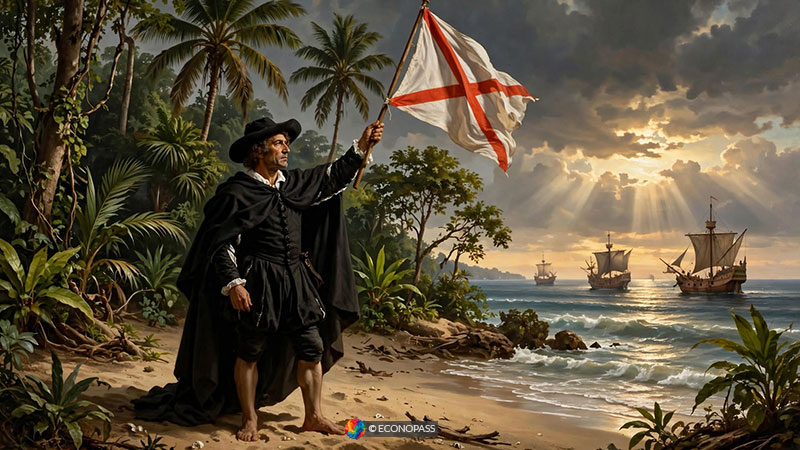
In 1492, Columbus sailed the ocean blue. He landed in the Caribbean, enslaved the people he found there, never realised he had found a new continent, and died believing he had reached Asia. Not one of those four facts appears in the version most people were taught.
Start with the simplest one. Columbus never set foot on the continent of North America. Not once, across four voyages. He landed on Caribbean islands what are now the Bahamas, Cuba, Hispaniola, Puerto Rico and on his later voyages explored the coasts of Central and South America. The territory that became the United States was entirely outside his geographical reach. The man who supposedly discovered America never saw it.
This matters more than it might seem. The “discovery of America” narrative attaches to a specific place, the landmass that became the United States, and to a specific meaning, the moment Europeans first encountered it. Columbus did neither. If you want the first European to reach North American soil, the documented candidate is Leif Eriksson, the Norse explorer who established a settlement at L’Anse aux Meadows in what is now Newfoundland, Canada, around 1000 CE. That is approximately 500 years before Columbus set sail. The Viking settlement has been archaeologically excavated and confirmed. It is a UNESCO World Heritage Site. Columbus arriving 500 years later to the Caribbean did not constitute a first.
The discovery problem runs deeper than geography. When Columbus arrived in the Bahamas on October 12, 1492, he encountered the Taino people. They were not the remnants of a sparse population. Estimates of the pre-Columbian indigenous population of the Americas vary widely, but most serious scholars put the figure somewhere between 50 and 100 million people. The Americas were not an empty land waiting to be discovered. They were home to sophisticated civilisations, established trade networks, agricultural systems, cities, and cultures that had been developing for thousands of years. Tenochtitlan, the Aztec capital, had a population of around 200,000 people at its height, making it one of the largest cities in the world, larger than any city in Europe at the time. You cannot discover a place where people already live. You can only arrive.
Columbus himself never used the word discovery. He called the Taino people he encountered “Indians,” because he believed, and continued to believe until his death in 1506, that he had reached the eastern edge of Asia. The Indies. He called the Caribbean islands the West Indies, a name that persists in English to this day. He adjusted his calculations repeatedly to make the geography fit his theory rather than accepting that he had found something his maps did not contain. By the end of his life, having made four voyages and encountered an enormous landmass he could not reconcile with any known geography, he still insisted he was somewhere near China.
The man who understood that Columbus had found something genuinely new was Amerigo Vespucci, an Italian explorer and cartographer who sailed to the South American coast in 1501 and correctly identified it as a previously unknown continent. He called it the Mundus Novus the New World. His letters describing the continent circulated widely across Europe, and in 1507 a German cartographer named Martin Waldseemuller, drawing a new map of the world that incorporated Vespucci’s findings, named the new continent America, after Amerigo. The name stuck. Columbus never received credit for finding what he found because he never accepted that he had found it. The continent is named after someone else because the man who arrived first refused to believe he had arrived anywhere new.
His actual name was not Christopher Columbus either. He was born Cristoforo Colombo in Genoa, in what is now Italy, around 1451. The Spanish called him Cristobal Colon. Christopher Columbus is an Anglicisation that became standard in English-speaking countries centuries after his death. The man the world remembers is named after a version of himself that he never used.
None of this diminishes the sheer audacity of what he did. Sailing west across an uncharted ocean in three small wooden ships, with no knowledge of what lay on the other side, with a crew that was frightened and mutinous, required extraordinary courage and an almost delusional confidence in his own calculations. He was wrong about nearly everything he believed about the voyage. He was right that sailing west would eventually bring him somewhere. That the somewhere turned out to be an entirely new hemisphere that European maps did not contain is not a failure of ambition. It is simply not what he thought it was.
The holiday that celebrates him in the United States, Columbus Day, was not established by the federal government until 1937. It was pushed through Congress largely by Italian-American advocacy groups who wanted a national figure to celebrate, and Columbus, as a Genoese Italian, fit the bill. The choice was contested from the beginning by indigenous groups who pointed out that what Columbus’s arrival actually initiated was a century of conquest, enslavement, and epidemic disease that killed the majority of the indigenous population of the Americas. Several US states and cities have replaced Columbus Day with Indigenous Peoples’ Day. The debate about what to call the holiday is a debate about what story the holiday is telling.
The real story is not a story about discovery. It is a story about what happens when two worlds that have been developing in complete isolation for thousands of years suddenly collide, and about who gets to name that collision and what they choose to call it afterward. Columbus sailed west and found something. He never knew what it was. Other people decided what to call it, what to celebrate, and whose name to put on the map.
His name is not on the map. Someone else’s is.
Every story has a version. I’m sharing mine. Marco Bellinari
The rabbit hole goes deeper. Go further. It is worth it.
Thank you for reading. Every fact in this article is documented and sourced. You will find the references at the bottom if you want to dig further. I hope it surprised you at least once. That is always the intention.
I would love to hear your thoughts. Follow Econopass on social media and share your reaction hereafter as a social comment. And if you do not want to miss the next story, hit follow. There is always another forgotten truth waiting to be told.
Disclosure: This article may contain affiliate links. This means we may earn a commission if you click on a link and make a purchase at no extra cost to you. This applies to featured Amazon products or any other Econopass's partners.
FediBack: Columbus Did Not Discover America. He Never Even Set Foot on the Continent.
🟢 Columbus arrived in the Caribbean 500 years after Leif Eriksson reached North America. And the continent is named after a man who never even led the voyage. After reading this, which detail landed hardest? Tell me below.
🟢 Columbus arrived in the Caribbean 500 years after Leif Eriksson reached North America. And the continent is named after a man who never even led the voyage. After reading this, which detail landed hardest? Tell me below.
🟢 Columbus arrived in the Caribbean 500 years after Leif Eriksson reached North America. And the continent is named after a man who never even led the voyage. After reading this, which detail landed hardest? Tell me below.
These articles and stories are free because of a few ads. To support us, simply turn off your ad blocker for Econopass. It takes one click on the ad blocker icon in your browser. Thank you!
We use cookies to ensure that we give you the best experience on Econopass website. If you continue to use this site we will assume that you are happy with it.