The image is everywhere. The horned helmet appears on Halloween costumes, pub signs, sports team logos, airline safety cards, and the opening credits of television series. It is one of the most recognisable silhouettes in popular culture. It is also completely made up, and the man who made it up has a name.
Carl Emil Doepler was a German costume designer. In 1876, he was commissioned to create the costumes for the first complete performance of Richard Wagner’s Ring Cycle at the Bayreuth Festival Theatre. The Ring Cycle draws on Norse mythology, featuring Odin, Valkyries, and the heroes of the Germanic sagas. Doepler needed his Viking characters to look suitably dramatic for the stage. He gave them horned helmets. The opera was a sensation. The costumes were widely reproduced in illustrated programmes, newspaper reviews, and souvenir merchandise across Europe. And an image that had been invented for theatrical effect became, over the following decades, what Vikings looked like.
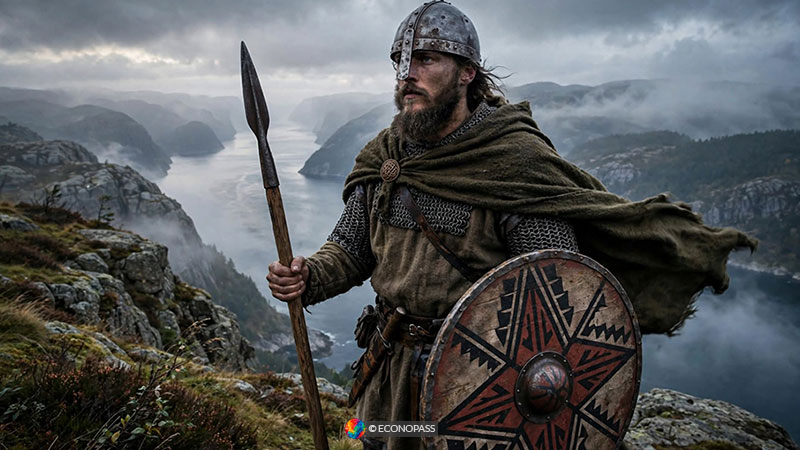
Not one horned Viking helmet has ever been found in any archaeological excavation. After more than a century of serious archaeological work across Scandinavia, the British Isles, Iceland, Greenland, and every location where the Norse settled or raided, the total number of horned helmets recovered from the Viking Age is zero. The only complete Viking helmet ever discovered is the Gjermundbu helmet, found in a burial mound in Norway in 1943. It is a simple rounded iron cap with a nose guard. No horns. No wings. No theatrical embellishment of any kind. It looks exactly like what a helmet designed to protect a human head in close combat would look like.
Horned helmets did exist in Scandinavia. They simply have nothing to do with the Vikings. The Viksoe helmets, a pair of Bronze Age horned helmets found in a Danish bog in 1942, are genuine, beautifully made, and approximately 3,000 years old. They predate the Viking Age by more than a millennium. They were almost certainly ceremonial objects, used in religious rituals rather than battle. The practical problems with horned helmets in actual combat are obvious: the horns create leverage points that an opponent can grab, they add weight and shift balance, and they make it significantly harder to move through dense undergrowth or tight ship rigging. No military culture that valued survival would have adopted them as standard battlefield equipment.
The real Vikings wore iron or leather helmets when they wore helmets at all, and many did not. Norse sagas, which are detailed about weapons and equipment in a way that reflects genuine military culture, describe helmets without horns. Tapestries and carvings from the period show warriors in simple conical or rounded headgear. The written record and the archaeological record agree: the horned helmet is absent from both.
The myth did not begin entirely with Doepler. Swedish artist Gustav Malmstrom had illustrated a popular edition of the Frithiofs Saga in the 1820s with horned-helmeted Vikings, and the image had already begun circulating in Romantic-era depictions of the Norse past. But it was Wagner’s Ring Cycle and its global reach that cemented the image permanently. By the time early cinema needed a visual shorthand for “Viking,” the horned helmet was already the established answer. A costume designer’s theatrical choice in 1876 became the defining image of a civilisation that had flourished and ended eight centuries earlier.
The real Vikings were considerably more interesting than the horned helmet version. They were traders as much as raiders, establishing commercial networks from Newfoundland to Constantinople. They settled Iceland, Greenland, and briefly North America. They founded the city of Dublin. They served as the personal bodyguard of the Byzantine Emperor in Constantinople. They discovered the North American continent five centuries before Columbus. Their legal system, the Thing, was one of the earliest forms of representative assembly in European history.
None of that requires horns to be impressive. But the horned helmet myth has proven extraordinarily durable, partly because it serves a narrative purpose. The horned helmet signals danger, otherness, wildness. It is a visual grammar for barbarian. The actual Norse helmet, a practical iron cap designed by craftsmen who understood violence and survival, signals something less romantic but considerably more true: these were people who thought carefully about staying alive.
The Gjermundbu helmet, the only complete one ever found, sits in the Museum of Cultural History in Oslo. It was buried with its owner, a warrior who died sometime around 970 CE. The man who wore it into battle chose a helmet that gave him the best chance of surviving. He did not choose one with horns. He chose function over theatre. The theatre came later, courtesy of a German costume designer and a very successful opera. History did not put the horns there. Wagner did.
The next time you see a horned Viking helmet, you now know its actual origin. It was made for a stage in Bavaria in 1876. The Vikings never saw it. They would not have recognised it. They would probably have found the whole thing impractical.
Every story has a version. I’m sharing mine. Marco Bellinari
The rabbit hole goes deeper. Go further. It is worth it.
Thank you for reading. Every fact in this article is documented and sourced. You will find the references at the bottom if you want to dig further. I hope it surprised you at least once. That is always the intention.
I would love to hear your thoughts. Follow Econopass on social media and share your reaction hereafter as a social comment. And if you do not want to miss the next story, hit follow. There is always another forgotten truth waiting to be told.
Disclosure: This article may contain affiliate links. This means we may earn a commission if you click on a link and make a purchase at no extra cost to you. This applies to featured Amazon products or any other Econopass's partners.
FediBack: The Vikings Did Not Have Horned Helmets. Not One Has Ever Been Found.
🟢 A German costume designer in 1876 invented the image the whole world now associates with Vikings. After reading this, does it change how you see them? Tell me below.
🟢 A German costume designer in 1876 invented the image the whole world now associates with Vikings. After reading this, does it change how you see them? Tell me below.
🟢 A German costume designer in 1876 invented the image the whole world now associates with Vikings. After reading this, does it change how you see them? Tell me below.
These articles and stories are free because of a few ads. To support us, simply turn off your ad blocker for Econopass. It takes one click on the ad blocker icon in your browser. Thank you!
We use cookies to ensure that we give you the best experience on Econopass website. If you continue to use this site we will assume that you are happy with it.