
In 1507, a small workshop in the Vosges mountains of Lorraine (France/Germany) produced a document that would name half the world. The man who made it had never crossed the Atlantic. He had never seen the continent he was labeling. He was working from a letter. And the letter, some historians now believe, may have been a forgery.
The Workshop in Saint-Die
Martin Waldseemüller was not a navigator. He was a German cartographer living in Saint-Die, a quiet town in Lorraine, working inside a small scholarly circle called the Gymnasium Vosagense. His collaborator was Matthias Ringmann, a humanist scholar with a gift for Latin and an appetite for the new cosmographical knowledge flooding into Europe from Portuguese and Spanish expeditions. Together, they were preparing a printed edition of Ptolemy’s ancient geography, updated for a world that had just discovered it was larger than anyone had thought.
Waldseemüller drew the maps. Ringmann wrote the accompanying text, the Cosmographiae Introductio, a short introduction to the new understanding of the world’s shape. And both of them were working from a letter, a printed pamphlet circulating in learned circles across Europe, purportedly written by an Italian merchant and explorer named Amerigo Vespucci.
The letter described four voyages to a landmass the author called a New World, a continent so vast and so populated that it could not possibly be Asia. It was addressed to Piero Soderini, the head of the Florentine republic, and signed with the name Amerigo Vespucci.
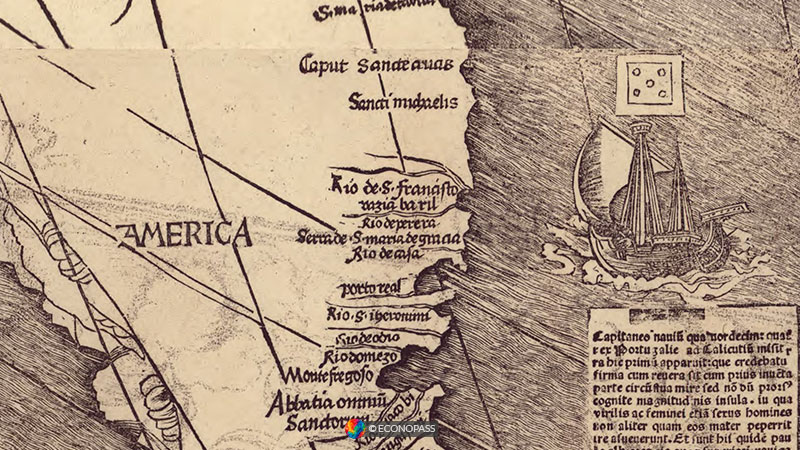
Waldseemüller and Ringmann read the Soderini Letter and made a decision that would echo for five centuries. They named the new southern landmass America, in honor of Americus Vespucius, the Latinized form of Vespucci’s name. The word appeared on a printed map for the first time in 1507. No one seriously called it anything else after that.

Kindle Paperwhite 2026
New 7″ flush-front aluminum design, weeks of battery, glare-free in any light. The e-reader that stays on your nightstand permanently.
View on AmazonThe Letter That May Not Have Been His
The Soderini Letter is the fulcrum on which the name America rests. Remove it, and Waldseemüller has no reason to honor Vespucci. Remove the honor, and the continent gets a different name, or none at all.
The problem is that historians have been arguing about the letter’s authenticity for well over a century. The letter, circulated in print around 1504 and 1505, claimed that Vespucci had made a first voyage to the South American mainland in May 1497. That date is critical. Christopher Columbus did not reach the South American mainland until his third voyage, in August 1498. If Vespucci’s 1497 date is accurate, he found the mainland first. If the date is fabricated, Vespucci’s priority claim collapses entirely.
No Spanish or Portuguese expedition record from 1497 corroborates a Vespucci voyage that year. There is no ship’s log. No royal authorization. No crew list. The 1497 voyage exists only in the Soderini Letter itself.
Scholars including historian Germán Arciniegas argued that the Soderini Letter was composed, altered, or supplemented by editors who wanted to elevate Vespucci’s standing, possibly without his knowledge or involvement. The letter circulated in printed form across Europe before Vespucci could have corrected it.
Amerigo Vespucci died in 1512. He left no documented protest of the Soderini Letter, no written denial of the disputed voyages, and no claim to or renunciation of the honor Waldseemüller had given him. What historians are left with is a letter of murky origin, a cartographer who acted on it in good faith, and a name printed on enough maps to become permanent.
Toby Lester’s book The Fourth Part of the World traces this entire episode in careful detail, following the chain of texts and cartographers that turned a disputed letter into a continental name. The question he raises is not whether the name was given, but whether it was deserved.
The Name He Tried to Take Back
The Waldseemüller map of 1507 was printed in a run of roughly one thousand copies. It was large, twelve sheets that assembled into a wall-sized image of the known world, six feet wide and four feet tall. The map placed the word “America” on the southern landmass, the continent now called South America. The northern landmass was left unnamed. Columbus’s territorial claim on that land was still being negotiated with the Spanish crown, and Waldseemüller was careful enough not to get between those arguments.
The map sold. It circulated among scholars, courts, and printing houses. The name it introduced spread through Europe faster than any correction could follow. And then, six years after publishing it, Waldseemüller quietly removed the name from his next major work.
In his 1513 edition of Ptolemy’s geography, the continent that had been labeled “America” was relabeled “Terra Incognita.” Unknown land. No explanation was offered. Waldseemüller did not publish a correction or a retraction. He simply stopped using the word he had placed there. Some historians interpret this as a tacit acknowledgment that the Soderini Letter’s claims, and the priority argument they rested on, could not hold up to scrutiny.
It was too late. By 1513, the name America had already spread through printed maps from Lisbon to Kraków. The Waldseemüller map had done its work. No retraction from one cartographer in Lorraine could undo a print run of a thousand copies already in circulation.
The map itself disappeared from history for nearly four centuries. All other known copies were lost or destroyed. Then, in 1901, a Jesuit historian named Joseph Fischer discovered a single surviving copy inside Wolfegg Castle in Baden-Württemberg, Germany. It had been folded inside a portfolio, stored and forgotten, since at least the sixteenth century.
Ten Million Dollars for a Name
In 2003, the Library of Congress purchased the surviving Waldseemüller map for ten million dollars, the largest amount ever paid for a single map at that time. It is now displayed in the Library’s Thomas Jefferson Building in Washington. It is the only copy from that original print run of one thousand known to exist.
The Amerigo Vespucci question has not been resolved. A History of the World in 12 Maps by Jerry Brotton places the Waldseemüller map in its full cartographic context, showing how a single document made in a small French town reorganized the European imagination of the globe. Amerigo by Felipe Fernandez-Armesto examines Vespucci himself with rigorous skepticism, separating the man from the legend the letter constructed around him.
The Soderini Letter remains in the historical record as a document of uncertain origin, uncertain authorship, and enormous consequence. Martin Waldseemüller read it, trusted it, and drew a name on a map. He later had his doubts. Five hundred years of printed maps had already followed his lead by then.
The name America does not appear on any document signed by Columbus. It does not appear in any Spanish crown record of the discovery. It was invented by a German cartographer in a small town in Lorraine, based on a letter no one has been able to fully authenticate, honoring a Florentine merchant whose most famous voyage may never have taken place.
That is what appears on every map you have ever seen.
Every story has a version. I’m sharing mine.
Marco Bellinari
Sources
- Library of Congress, Waldseemüller Map
- Wikipedia, Waldseemüller Map
- Wikipedia, Soderini Letter
- Encyclopaedia Britannica, Martin Waldseemüller
- Wikipedia, Amerigo Vespucci

A Note from Marco Bellinari
Thank you for reading. Every fact in this article is documented and sourced. You will find the references at the bottom if you want to dig further. I hope it surprised you at least once. That is always the intention.
I would love to hear your thoughts. Follow Econopass on social media and share your reaction hereafter as a social comment. And if you do not want to miss the next story, hit follow. There is always another forgotten truth waiting to be told.
Still Curious? Don't Stop Here!

The Berlin Wall Did Not Fall Because of a Political Decision. It Fell Because of a Press C...
Hannibal Crossed the Alps With Elephants. Only One Survived. History Remembers the Crossin...
Nikola Tesla Did Not Die Penniless and Forgotten. The FBI Seized His Papers the Morning Af...
The First Person to Walk on the Moon Almost Did Not Make It Back. The Thing That Saved Him...
The Library of Alexandria Was Not Burned Down. It Declined Over Centuries. The Fire Story ...
The Declaration of Independence Was Not Signed on July 4. Most Delegates Signed It a Month...

Socrates Was Not Executed for His Philosophy. The Trial Was Political. The Charges Were a ...