
East Berlin, November 9, 1989. 6:53 p.m. A press conference room in the International Press Center on Mohrenstrasse. Gunter Schabowski, spokesman for the East German Communist Party, sits at a table in front of cameras and a room full of journalists. He has been handed a note minutes before entering. He has not had time to read it in full. He will read it out loud in approximately seven minutes, and what he says will cause the Berlin Wall to fall. Not because of a political calculation. Not because of pressure from Washington or Moscow. Because of a word he used that he did not intend to use, about a regulation he had not been briefed on, in front of a press corps that was about to broadcast it live to the world.
The note he was handed at the door
The regulation Schabowski read out that evening had been approved by the East German Politburo earlier that day. Its purpose was specific and limited: to allow East German citizens to apply for exit visas through official channels, without the extensive bureaucratic process previously required. The intent was a controlled, gradual process. Applications would be submitted. Permits would be issued. The border would remain managed.
Egon Krenz, the new General Secretary of the Socialist Unity Party, had handed Schabowski the note shortly before the press conference began. Schabowski had spent recent days in New York at the United Nations. He had not attended the Politburo meeting where the regulation had been debated. He had not been told that the new rules were intended to take effect the following day, through a formal application process. He walked into the room with a piece of paper he had not read, in front of an international press corps that had been following the collapse of the East German state for weeks.
The regulation itself stated that the new travel rules would come into force the following day, through an application procedure. This detail was in the documentation. Schabowski did not mention it. He had not been briefed on it. He had not read far enough into the note to find it. He later said he had assumed he was fully informed. He was not.

Apple AirPods Pro 3
2× better noise cancellation, heart rate sensing, Live Translation, and 10 hours battery. The earbuds most people end up choosing.
View on AmazonImmediately, without delay
At 6:57 p.m., Riccardo Ehrman, an Italian journalist representing the ANSA news agency, asked when the new travel regulations would take effect. Schabowski shuffled through the papers in front of him. He found something that read like an answer. He said, in German: “sofort, unverzuglich.” Immediately, without delay.
The room shifted. Other journalists followed up. Someone asked whether the regulations also applied to West Berlin. Schabowski said yes. Daniel Johnson of The Daily Telegraph asked what that meant for the Berlin Wall. Schabowski sat briefly frozen and then gave a rambling answer about the wall being tied to the larger question of disarmament. The press conference ended. Schabowski went home.
East German state television broadcast his remarks within the hour. West German television did the same. By 8 p.m., tens of thousands of East Germans had heard that the borders were open. Not that applications were being accepted. Not that a new process had begun. That the borders were open. Right now. Tonight.
The Cold War had lasted forty-four years. Its most significant physical symbol did not fall because of a summit, a treaty, or a political decision. It fell because a party spokesman was handed a document he had not read, answered a question with words he did not mean, and left a press conference before anyone realized what he had said.
The checkpoint commander who had no orders
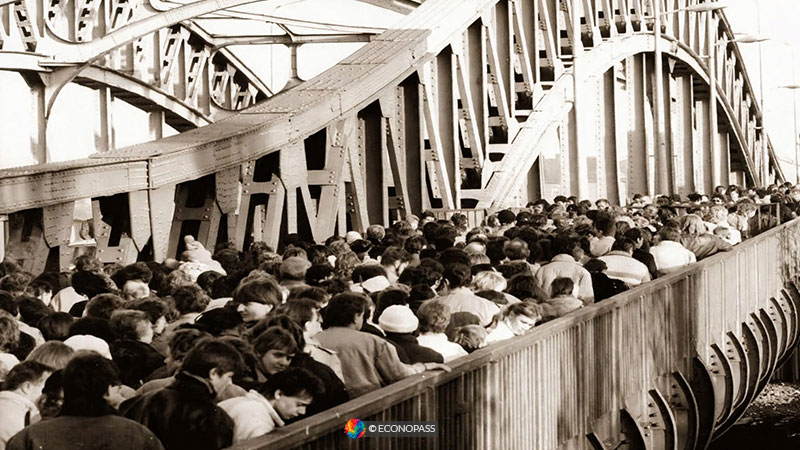
By 9 p.m., crowds had gathered at every crossing point along the Berlin Wall. The largest was at Bornholmer Strasse, also known as the Bosebruck checkpoint. The commander on duty that night was Harald Jager, a career border officer. He called his superiors for instructions. His superiors called their superiors. No clear order came back down the chain.
At 9:20 p.m., Jager’s guards began letting a small number of people through in an attempt to relieve the pressure. The crowd continued to grow. By 11 p.m., thousands were pressing against the barrier. Jager was running out of options and running out of manpower. He called again for guidance. None came. He made the decision on his own authority. At approximately 11:30 p.m., Harald Jager told his officers to open the gates and stop checking identification. The barrier at Bornholmer Strasse lifted.
Jager later said he had no other option. The crowd had become too large, the pressure too great, and his guards were overwhelmed. He opened the first gate of the Berlin Wall not because a government had authorized it, not because a political agreement had been reached, not because history had decided the moment had arrived. He opened it because thousands of people were standing in front of it and he had not received an order telling him to keep it shut.
When asked about that night later, Jager said he felt abandoned by his government. He had asked for guidance repeatedly throughout the evening. None came. The decision that ended the Cold War’s most visible structure was made by a mid-ranking border officer who could not reach anyone with authority to tell him what to do.
What the history books kept and what they left out
The version of events that entered the history books centers on political forces: the protest movements across East Germany, the collapse of Soviet authority under Gorbachev, the economic pressure from the West, the courage of ordinary East Germans who had been marching for weeks. All of these things were real. All of them were part of what made November 9 possible. None of them explain why the Wall opened at 11:30 p.m. on that specific night, at that specific checkpoint, as the result of a press conference and a border commander who could not get his phone calls returned.
Schabowski was not a hero of the story. He was a bureaucrat who was handed a note at the wrong moment and read it without understanding it. Jager was not a dissident. He was a border guard who opened a gate because he had no orders not to and no capacity to keep it closed. The Wall did not come down in a surge of political will. It came down because of a word choice at a press conference and a decision made in the absence of any instruction at all.
The larger forces were real. The protest movements were real. The political pressure was real. But the trigger was a mistake. That is what the cleaner version of this story prefers not to say.
Every story has a version. I am sharing mine.
Marco Bellinari
Sources
- Wilson Center Digital Archive: Schabowski Press Conference Transcript, November 9, 1989
- World History Commons: Guenter Schabowski Press Conference, GDR International Press Center
- Berlin Wall Memorial: Opening and Fall of the Berlin Wall
- National Security Archive, George Washington University: 1989 Berlin Wall Documents
- Al Jazeera: Interview with Gunter Schabowski, 2009
A Note from Marco Bellinari
Thank you for reading. Every fact in this article is documented and sourced. You will find the references at the bottom if you want to dig further. I hope it surprised you at least once. That is always the intention.
I would love to hear your thoughts. Follow Econopass on social media and share your reaction hereafter as a social comment. And if you do not want to miss the next story, hit follow. There is always another forgotten truth waiting to be told.
Still Curious? Don't Stop Here!
Hannibal Crossed the Alps With Elephants. Only One Survived. History Remembers the Crossin...
Nikola Tesla Did Not Die Penniless and Forgotten. The FBI Seized His Papers the Morning Af...
The First Person to Walk on the Moon Almost Did Not Make It Back. The Thing That Saved Him...
The Library of Alexandria Was Not Burned Down. It Declined Over Centuries. The Fire Story ...
The Declaration of Independence Was Not Signed on July 4. Most Delegates Signed It a Month...
Socrates Was Not Executed for His Philosophy. The Trial Was Political. The Charges Were a ...
The 300 Spartans at Thermopylae Were Not 300. There Were 7,000 Greek Soldiers. History Dro...