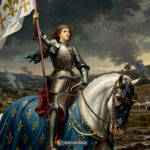
His name was Wilhelm Tell in German. Guillaume Tell in French. William Tell in English. Three languages, three nations that claimed ownership of the same legend. The man himself does not appear in a single Swiss document written during his lifetime.
The story is precise enough to feel real. The date: 18 November 1307. The place: the market square of Altdorf, in the canton of Uri. The villain: Gessler, an Austrian governor so cruel he mounted his hat on a pole and ordered every passing Swiss to bow before it. The hero: a peasant crossbowman from Bürglen who refused. The punishment: shoot an apple from your son’s head or both of you die. Tell reached for two bolts. He placed one in the bow. He told his son not to move.
The shot split the apple. The crowd went silent. Gessler asked about the second bolt. Tell said it was for Gessler himself, had the first one killed his son. He was arrested. He escaped during a storm on Lake Lucerne. He ambushed Gessler on a mountain pass and put an arrow through him. Switzerland was free.
It is a perfect story. It has a villain, a test of nerve, a father’s love, a political assassination and a nation born from individual courage. It is also, in all likelihood, a story that never happened.
The First Problem: The Sources Are 150 Years Too Late
The earliest written reference to Tell appears in a document called the White Book of Sarnen, compiled around 1474. That is 167 years after the events it describes. It does not name Tell. It simply includes an unnamed crossbowman among a list of conspirators. The name Wilhelm Tell appears slightly later, in a ballad called the Tellenlied, with the oldest surviving manuscript dated to 1501. Neither source was written anywhere near 1307. Neither source cites anything older.
The Swiss Confederation was founded in 1291. The Tell story is set in 1307. The first written mention of Tell appears in 1474. For 167 years, the most famous Swiss hero left no trace in any Swiss document.
The version most people know today comes from Aegidius Tschudi, a 16th-century Swiss chronicler who wrote around 1570. Tschudi added the given name Wilhelm, the birthplace in Bürglen, the precise date of November 18, and the detail about the second arrow. He was known to embellish his sources. Historians since the 19th century have treated additions found only in Tschudi as probable inventions. But Tschudi’s account is what Friedrich Schiller used when he wrote his famous play Wilhelm Tell in 1804. And Schiller’s play is what the world knows.
The Second Problem: The Story Already Existed Somewhere Else
In 1760, a Swiss scholar named Gottlieb Emanuel von Haller noticed something uncomfortable. The core of the Tell story, the father, the child, the apple, the arrow, the second bolt kept for the tyrant, appeared almost word for word in a 12th-century Danish chronicle. Saxo Grammaticus, writing around 1200, described a Danish archer named Palnatoki who was forced by King Harald Bluetooth to shoot an apple from his son’s head. Palnatoki explained his second arrow. He later killed Harald with it.
Haller published his findings in French. The book was publicly burned in Altdorf, the very town where Tell supposedly performed his shot. The Swiss were not ready for that conversation. They are still not entirely ready. A 2004 survey found that 58 percent of Swiss people believed Tell was a real historical figure.
The apple shot, the second arrow, the tyrant killed afterward: all of it appears in a Danish source written a century before Tell was supposed to have existed. The Swiss burned the book that pointed this out.
Palnatoki is not the only parallel. Similar legends of archers forced to shoot at targets placed on their children appear in Norse sagas, in English folklore, and in stories from across northern Europe. The motif is ancient, recurring, and clearly travelled. The specific version attached to Switzerland appears to have arrived there and been given a name, a date, a canton, and a monument.
The Third Problem: What Switzerland Needed in the 19th Century
Modern Switzerland as a unified federal state did not exist until 1848. Before that it was a loose confederation of cantons with different languages, different religions, and no shared national identity. What it needed, urgently, was a founding myth. A hero who embodied resistance to tyranny, individual courage, and the refusal to bow before foreign power. Wilhelm Tell, in German. Guillaume Tell, in French. William Tell, in English. A name that crossed every language border in the country.
Schiller’s 1804 play arrived at exactly the right moment. It was performed across Europe during the Napoleonic Wars, became a symbol of resistance to occupation, and gave Switzerland a hero whose story every citizen could share. Rossini turned it into an opera in 1829. The legend calcified into fact. By the time historians began seriously questioning Tell’s existence in the 1840s, the statue in Altdorf had already been planned. It was erected in 1895. The date carved on the base: 1307.
Switzerland chose August 1 as its National Day in 1891, marking the 1291 Federal Charter. Uri, the canton where Tell supposedly lived, responded by erecting a Tell monument dated 1307. Two different founding moments. One of them never happened.
Friedrich Guillimann wrote in 1607 that the Tell story seemed “pure fable” to him. Joseph Eutych Kopp made the systematic historical case against it in the 1840s. From the second half of the 19th century, professional historians have largely agreed: there is no 14th-century evidence for Wilhelm Tell, for Gessler, for the apple shot, or for any of the events the legend describes. The name does not appear in Austrian records of the period either, and Austria kept detailed records of its Swiss territories.
What Remains
None of this means Switzerland’s founding was a fiction. The Federal Charter of 1291 is real. The cantons of Uri, Schwyz, and Unterwalden did form an alliance. Austrian governors were genuinely resented. The drive toward independence from Habsburg rule was real and eventually successful. The history exists. What does not exist is the man who supposedly fired the first symbolic shot of it.
What Tell represents is something historians call an invented tradition: a story attached to real events after the fact, given a name and a face and a date, then repeated until the repetition itself became the evidence. The story survived because it was useful, because it was beautiful, and because nobody wanted to burn a second book in Altdorf.
Wilhelm Tell. Guillaume Tell. William Tell. Three languages, one myth, zero contemporary sources. The apple was always the point. The archer may never have existed.
Every story has a version. I’m sharing mine. Marco Bellinari
The rabbit hole goes deeper. Go further. It is worth it.
Thank you for reading. Every fact in this article is documented and sourced. You will find the references at the bottom if you want to dig further. I hope it surprised you at least once. That is always the intention.
I would love to hear your thoughts. Follow Econopass on social media and share your reaction hereafter as a social comment. And if you do not want to miss the next story, hit follow. There is always another forgotten truth waiting to be told.
Disclosure: This article may contain affiliate links. This means we may earn a commission if you click on a link and make a purchase at no extra cost to you. This applies to featured Amazon products or any other Econopass's partners.
FediBack: The Story of William Tell Is Almost Certainly Fiction. No Contemporary Swiss Source Mentions Him.
These articles and stories are free because of a few ads. To support us, simply turn off your ad blocker for Econopass. It takes one click on the ad blocker icon in your browser. Thank you!
We use cookies to ensure that we give you the best experience on Econopass website. If you continue to use this site we will assume that you are happy with it.