
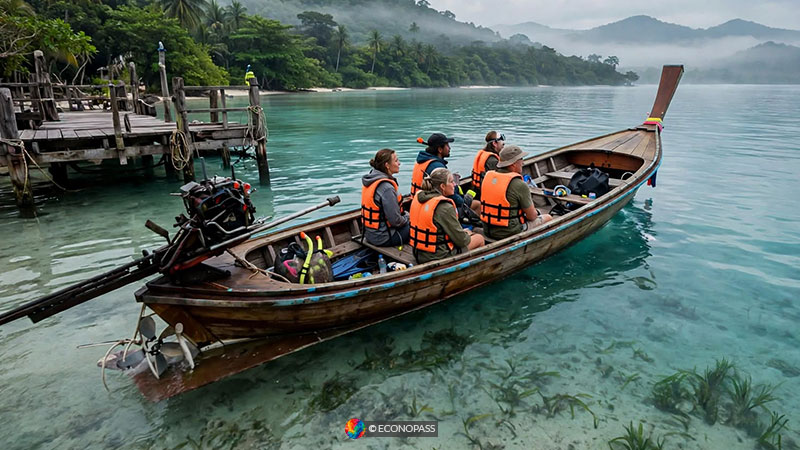
Ko Phi Phi Don pier at six in the morning. Boat engines warming up, life jackets sorted by size, a guide holding a laminated card with an underwater photograph: staghorn coral, a parrotfish, water so clear it looks constructed. The card is not dated. The tour operator who printed it did not mention when the photograph was taken. The booking platform that gave this experience four and a half stars did not mention it either. What none of the marketing said was that the reef in that photograph had been functionally dead for years before anyone stopped selling tickets to see it.
The marketing lasted longer than the coral
Maya Bay, on the uninhabited island of Ko Phi Phi Leh, became one of the most visited coastal sites in Southeast Asia after it appeared in Danny Boyle’s 2000 film The Beach. The bay had been a remote and largely undisturbed inlet. Within a few tourist seasons, it was receiving thousands of visitors per day. By 2017, the daily figure had reached approximately 5,000, arriving on longtail boats and speedboats from the main island and from the mainland pier at Krabi, each boat loaded with passengers who had been told, by the brochure and by the booking platform and by the cheerful guide at the front of the boat, that what awaited them was world-class snorkeling.
The coral had been declining for years before that figure was reached. Thailand’s Department of Marine and Coastal Resources conducted reef surveys throughout this period. The surveys documented the deterioration season by season. The brochures were not updated to reflect them. The boats kept leaving every morning, rain season or dry, with passengers equipped with rental masks and a mental image of what the reef was supposed to look like.
By the time the Thai Department of National Parks announced the closure of Maya Bay in June 2018, surveys had estimated that up to 77 percent of the bay’s coral had been damaged or destroyed. The tourists who had visited in the preceding years had, in most cases, been told they were snorkeling on a healthy reef. The booking platform that sent them there had maintained its rating throughout.

Amazon Smart Plug
Turn any outlet smart in seconds. Schedule lights, fans, coffee makers, no hub required, works with Alexa.
View on AmazonWhat kills a reef is arithmetic
The damage was not hidden. It was visible to any snorkeler who had also seen a healthy reef and had something to compare the experience to. Most visitors had not. The brochure set the expectation. The reality did not meet it. The guides said the visibility was good. It was. There was simply less to see than the photograph had suggested, and very few of the people emerging from the water knew enough to identify what was missing.
The mechanisms of destruction were not complex. Anchor chains from tour vessels dragged across the seafloor repeatedly over successive seasons, breaking coral structures that had taken decades to form. Physical contact from swimmers and divers removed what the anchors left standing. And the chemistry of the water changed around them. A 2016 study published in the Archives of Environmental Contamination and Toxicology found that oxybenzone, a compound present in most commercial sunscreen, caused coral bleaching at concentrations as low as 62 parts per trillion. At Maya Bay, with thousands of sunscreen-covered visitors entering the water each day, concentrations were not measured at 62 parts per trillion.
Coral bleaching is not, by itself, a death sentence for a reef ecosystem. What kills the reef is bleaching that recurs before the coral has time to recover, combined with the physical damage that removes the structure on which recovery depends. At Maya Bay, both conditions were present every day, for years, while the booking platform held its rating and the speedboats held their schedule.
The industry that runs on what the reef used to be
The economics of reef tourism are not built around reef health. They are built around reef reputation, which is a different thing and which decays at a different rate. A reef can lose the majority of its living coral and retain its reputation as a snorkeling destination for a decade or more, because reputation is maintained by marketing, by existing reviews, by the inertia of guidebooks, and by the fact that most visitors have no baseline for comparison. The star rating accumulates from reviews written by people who do not know what they did not see.
This is the gap that the Maya Bay case illustrated with unusual precision. The survey data showing the reef’s condition was available throughout the years the tours continued operating. It was published, accessible, and not reflected in a single piece of marketing material aimed at tourists. The tour operators were not required to disclose it. The booking platforms were not required to source it. The guides were not in a position to volunteer it, since their livelihood depended on the boats leaving full.
The pattern holds wherever snorkeling tours operate on reefs that are degrading faster than the reputation that markets them. The tourist arrives with expectations formed by photographs. The reef that greets them is a different reef. The guide says the fish are good today. Some of them are. The coral is gone, but the guide has learned not to call it that.
The closure that confirmed what the surveys already showed
On June 1, 2018, the Thai Department of National Parks announced that Maya Bay would be closed to all tourists for environmental rehabilitation. The initial projection was four months. The closure lasted until January 2022. When the bay reopened, the terms had changed: no boat mooring inside the bay, visitor numbers capped, sections of the reef designated off-limits for swimming. These were restrictions that the reef tourism industry had resisted as impractical for years. After the closure, they became the conditions of access.
What the closure made undeniable was not the reef’s condition, which had been documented throughout the preceding decade, but the gap between that documentation and what the booking platforms told their customers. The closure forced the marketing to catch up to the surveys, temporarily, by the simple mechanism of making the site inaccessible.
Marine biologists monitoring Maya Bay after the closure reported visible coral recovery within twelve months. New coral growth was documented in areas that had been bare seafloor during the peak tourism years. The reef had not been unable to recover. It had not been given the conditions required to do so.
The question the star rating was never designed to ask
Ko Phi Phi Don pier at four in the afternoon, the boats returning. Passengers climb back onto the dock, rinse their masks, are handed cold water. The experience has been rated. Stars have been assigned. Tomorrow, the boats will leave again at six.
The reef will be there, absorbing what it can and losing what it cannot. The surveys will continue to document its status. The brochures will continue to show the photograph. The booking platform will continue to report the rating. And somewhere, a traveler who does not know to look for the survey will book the snorkeling tours, pack the sunscreen, and arrive expecting what the photograph promised.
The island was real. The rating was real. The stars were earned by people who visited in good faith and left reviews in good faith. The reef in the photograph was real, once. What the booking platform was never designed to ask was whether the gap between those two realities was something a customer might want to know before they arrived.
It was not a failure of information. The surveys existed. The data was published. It was a failure of a system that has no mechanism for routing ecological reality into a star rating, and no incentive to build one.
Not the highlights reel. Not the itinerary. Just what actually happened.
Simon De Lafronde
Sources
- Downs et al. (2016). Toxicopathological Effects of the Sunscreen UV Filter Oxybenzone on Coral. Archives of Environmental Contamination and Toxicology
- Thailand Department of National Parks, Wildlife and Plant Conservation
- NOAA Coral Reef Watch, Global Reef Status Monitoring
- The Guardian: Thailand closes Maya Bay due to tourist damage (2018)
- BBC News: Thailand’s Maya Bay, made famous by The Beach, to be closed indefinitely (2018)

A Note from Simon de Lafronde
The advice and information in this article come from my experience and research. It’s intended to support your reading with evidence-based insights. If the article is covering wellness or any other health topics, this is not professional advice. Please consult appropriate professionals for your specific situation.
📖 Read MoreStill Curious? Don't Stop Here!
They Crossed Into Myanmar Through a Border Town Listed as Safe. The Forum Had Not Been Upd...

Mount Everest Has Over 200 Bodies on Its Slopes. Most Are Used as Landmarks. The Families ...
Venice Has Fewer Than 50,000 Residents for the First Time in Six Centuries. On Peak Days, ...

They Posted Their Itinerary on Instagram. By the Time They Arrived at the Guesthouse, It W...
The Ferry to the Island Left on Time. The Return Ferry Was Cancelled Due to Weather. They ...

He Rented a Scooter in Vietnam Without an International Licence. He Had an Accident. His T...

She Left Her Bag at a Café Table in Rome for Thirty Seconds. The Surveillance Footage Show...