
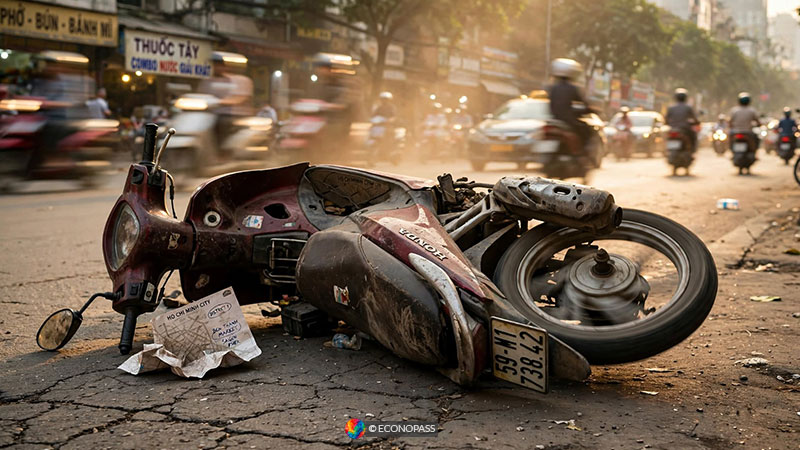
The rental takes roughly two minutes. A shop on Bui Vien Street in Ho Chi Minh City, or one of hundreds of similar operations in Hanoi’s Old Quarter, produces a scooter from a rack of identical machines, states a daily rate, takes a passport copy or a cash deposit, and hands over the key. No one asks whether the renter holds a valid licence for operating a motorized vehicle in Vietnam. The question is not part of the transaction. The shop has no commercial interest in the answer, and the tourist, having watched every other tourist on the same street navigate the same blocks on the same machines, has no particular reason to think it matters. It matters. When the accident happens, it is the first document the insurance company requests.
Vietnam has approximately 45 million registered motorbikes for a population of around 97 million people. In Ho Chi Minh City alone, an estimated 7.5 million motorbikes operate daily. The roads run on a logic that is entirely real and entirely different from what most Western visitors have encountered: traffic flows as a continuous mass rather than in lanes, with speeds adjusted by the density around each vehicle, and intersections negotiated through movement rather than through formal right of way. It works, for the people who know it. It does not work in the same way for someone who learned to drive in a country where lanes are enforced, indicators are used, and roundabouts follow a priority rule. The tourist does not always know which kind of driver they are until the moment the information becomes relevant.
The Rental That Takes Two Minutes
Scooter rental is embedded in the Vietnamese tourist economy at every price point. Tour operators recommend it. Hostels advertise it. Travel forums carry extensive advice on the best routes, the best machines, the most scenic roads from Hanoi south to Ho Chi Minh City. What the forums rarely convey, in enough detail to register, is the licencing requirement. Under Vietnamese law, riding a motorbike with an engine capacity above 50cc requires a Vietnamese driving licence or a valid International Driving Permit alongside a home-country licence. Most rental scooters have engines above 50cc. Most renters have neither document. The shop does not check and does not tell them. The insurance policy they purchased before departure has a clause about this. It is not in the section they read.
Andrew X. Pham, in Catfish and Mandala, cycled through Vietnam as a Vietnamese-American returning to the country of his birth, and his account of navigating Vietnamese roads is not a complaint but a close observation of a traffic system that has its own coherence, one that demands full attention and punishes assumptions carried from elsewhere. The gap he documents between the Vietnam of imagination and the Vietnam of the actual road is precise and physical. The tourist who rents a scooter after reading a forum post and the Vietnamese commuter who has been navigating the same intersection since adolescence are not operating in the same environment, even when they are on the same street. The machine is identical. The competence is not. And the moment they collide, the insurance company will establish exactly which category of operator was involved.

Amazon Fire TV Stick 4K Plus
4K streaming with Dolby Vision, AI-powered search, and Wi-Fi 6. The most trusted streaming stick on Amazon.
View on AmazonThe Clause That Was Always There
Travel insurance policies covering medical expenses and emergency evacuation typically include a standard exclusion for incidents occurring while the insured is operating a vehicle without a valid licence. The exclusion is not hidden. It is in the policy document the insured agreed to at purchase, in a paragraph between the section on lost baggage and the section on trip cancellation. The language is direct: coverage does not apply to accidents sustained during unlicensed operation of a motor vehicle. The rental shop not requiring a licence does not remove the exclusion. The prevalence of unlicensed riding among tourists does not remove it. The absence of a police citation at the scene does not remove it. The insurance company’s investigation after a claim is not focused on what the police did at the scene. It is focused on what the policy says and whether the conditions for coverage were satisfied.
They were not. The financial exposure runs in one direction from that finding. Medical treatment at a private hospital in Vietnam for a serious scooter accident, fractures, head trauma, and surgery, routinely reaches tens of thousands of dollars. Emergency medical evacuation to Singapore or Bangkok, which international policies often cover for serious cases, adds further costs. Third-party liability for damage to other vehicles or injury to other people involved in the accident is an additional layer entirely. When the policy does not respond, the renter pays out of pocket, in a country where they have no established credit, no local bank relationship, and a return flight already booked.
Bill Hayton, in Vietnam: Rising Dragon, examined how Vietnam functions as a modern state, tracing the consistent distance between its formal rules and their actual enforcement, between the law as written and the law as practised on any given street on any given day. His analysis is directly relevant here because tourists interpret enforcement gaps as permission. The rental shop does not check for a licence, so a licence must not be required. The police officer at the intersection waves traffic through, so the traffic must be operating legally. These interpretations are wrong in the specific way that matters: insurance policies are not subject to enforcement gaps. They are subject to the terms agreed at purchase. The gap between what Vietnam’s roads look like from the seat of a rented scooter and what a policy document says is exactly the gap that produces refusals.
What the Roads Actually Are
Vietnam’s road fatality rate is among the highest in Southeast Asia. The World Health Organization has consistently placed Vietnam in the upper tier of countries by road deaths per 100,000 population, with motorbikes involved in the majority of fatal accidents. The statistics cover Vietnamese nationals: people who have navigated these roads since childhood, who understand the flow, and who have built the reflexes the system requires over years of daily use. Tourists on rented machines have none of these advantages and all of the same physical exposure.
The pattern of tourist scooter accidents in Vietnam follows a documented curve. The first day or two rarely produces the serious incident. The tourist adjusts to the traffic, gains confidence, starts moving faster, starts taking larger and more complex roads. The accident tends to happen when confidence outruns competence. A roundabout in Hanoi with eight entry points and no yield signage is different from the quiet lane near the guesthouse where the tourist practiced on the first morning. The speed of response required is different. The machine performs identically in both situations. The rider does not.
Robert Pirsig, in Zen and the Art of Motorcycle Maintenance, built a philosophical argument around the relationship between a rider and a machine, contending that genuine competence requires not just technical skill but a quality of attention that cannot be imitated or shortcut, and that the motorcycle reflects back precisely the understanding the rider brings to it. The tourist who rents a scooter in Vietnam after two days on the road is not incompetent in an absolute sense. They are operating at the specific threshold where felt confidence and actual competence diverge, and Pirsig’s argument is that this is exactly where things go wrong, because the machine does not respond to what the rider believes they know. It responds to what they actually know. The two are not always the same, and the gap between them is what an accident report and an insurance refusal are both trying to describe.
What Changes When You Know
The International Driving Permit is not a complicated document to obtain. Most national automobile associations issue it on the same day for a small fee, with a valid home-country driving licence and two passport photographs. It requires no test, no examination of additional competence. It is administrative confirmation that the holder has already passed a licencing process recognised by the issuing country. For the purpose of travel insurance coverage, it is the threshold document. The rental shop will still not check for it. The insurance policy will still look for it first.
The tourist who wants to ride a scooter in Vietnam and have insurance coverage while doing so needs two things before departure: an International Driving Permit obtained from their home country’s automobile association, and a travel insurance policy reviewed specifically for its vehicle exclusions and their conditions. The first takes a day. The second takes twenty minutes of reading a document most people open once and scroll through without stopping. The accident is not inevitable. The refusal, in the absence of that preparation, is.
Not the highlights reel. Not the itinerary. Just what actually happened.
Simon De Lafronde


Sources
- Road traffic safety in Vietnam, Wikipedia
- International Driving Permit, Wikipedia
- Transport in Vietnam, Wikipedia
- Travel insurance, Wikipedia
- Ho Chi Minh City, Wikipedia

A Note from Simon de Lafronde
The advice and information in this article come from my experience and research. It’s intended to support your reading with evidence-based insights. If the article is covering wellness or any other health topics, this is not professional advice. Please consult appropriate professionals for your specific situation.
📖 Read MoreStill Curious? Don't Stop Here!
She Left Her Bag at a Café Table in Rome for Thirty Seconds. The Surveillance Footage Show...

The Maldives Is Sinking. The Government Has Already Bought Land in Australia. The Resorts ...
They Photographed the Military Checkpoint Without Reading the Sign. The Camera Was Confisc...
The Tour Bus to Machu Picchu Left Without Her. She Was in the Bathroom. The Next Bus Was T...
The Dead Sea Is Shrinking by One Metre Every Year. The Sinkholes Opening Around Its Shores...

Petra Was Not Lost. The Local Bedouin Knew Exactly Where It Was. The West Simply Had Not A...

They Hired a Local Guide in the Amazon. He Left Camp Before Dawn on Day Two. They Did Not ...