
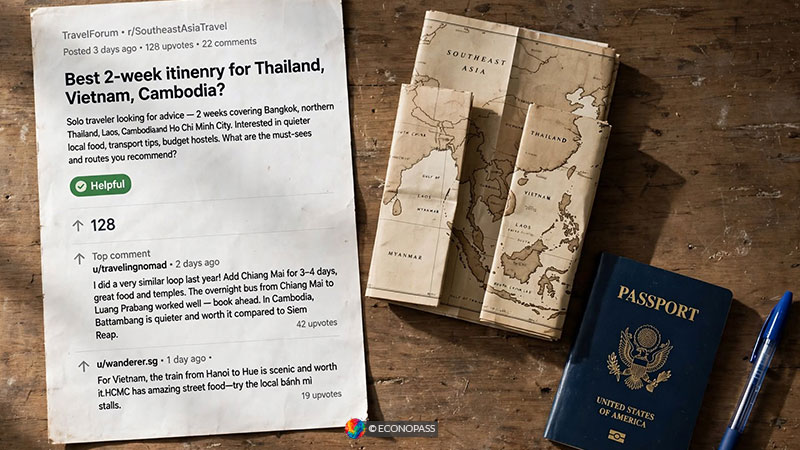
The post was dated March 2019. It had forty-seven upvotes and a green Helpful badge. The thread title read: Tachileik crossing from Mae Sai, everything you need to know. Someone had written it after a smooth morning: show your passport, pay a small border fee, day visa stamped, walk across the bridge. Easy. Come back before six. The whole thing took fifteen minutes.
They printed it out before leaving Bangkok.
What the post did not say, could not say, was that the author had crossed in 2019. That by the time these two travelers stood at the checkpoint in Mae Sai with their printed instructions and their carefully planned itinerary, Myanmar had undergone a military coup. The generals had taken power at dawn on February 1, 2021. The world had moved on. The forum had not.
The Route That Everyone Knew
For years, the Mae Sai crossing was one of the most reliable border crossings in Southeast Asia. Mae Sai is the northernmost town in Thailand, a frontier place with a main street of guesthouses and money changers that exists almost entirely because of what lies on the other side of the bridge. On the Myanmar side sits Tachileik, a market town in Shan State. For backpackers, it was the kind of crossing that had its own section in every Thailand guidebook published between 2005 and 2020.
The logic was simple. Thailand allowed visa-free entry for most nationalities. Myanmar allowed a day crossing from this specific point without a full tourist visa. You could walk across, change money, have lunch, buy jade and lacquerware, and return before sunset. Tour operators in Chiang Rai ran overnight packages. Budget travelers used it to reset their Thai visa. The border crossing safety record was essentially unblemished for a decade.
Between 2010 and 2020, the Mae Sai crossing processed millions of tourist entries. Forum posts from that period described it as the easiest border in Asia. The process was so well-documented that travelers treated it like a commute.
None of that survived February 2021.

Anker PowerCore 10,000mAh
Charges an iPhone 3× over. Dual USB-C ports, pocket-sized, no cables needed at the airport.
View on AmazonWhat Changed at Dawn
The Myanmar military coup was not ambiguous. Senior General Min Aung Hlaing moved on the government in the early hours of February 1, detained State Counsellor Aung San Suu Kyi along with the entire elected cabinet, and declared a state of emergency. Within days, protests erupted across the country. Within weeks, the military was opening fire on demonstrators in Yangon, Mandalay, and Myitkyina.
At border crossings, the change was immediate. Soldiers replaced civilian immigration officers at some checkpoints. Others closed entirely. Reports of arbitrary document checks, unexplained detentions, and travelers turned back without reason began reaching travel safety networks within months. The Foreign and Commonwealth Development Office in London upgraded its travel advisory to advise against all but essential travel to Myanmar. The US State Department issued a Level 4: Do Not Travel advisory. Australia, Canada, and virtually every other Western government followed within weeks.
The British government travel advisory stated explicitly: the security situation in Myanmar is volatile and unpredictable. Border areas may be affected by military operations, and the ability of consular staff to provide assistance is severely limited. This was published in February 2021 and updated repeatedly in the months that followed.
The forum post remained indexed, upvoted, and undated in its relevance.
The Problem With the Forum
Thomas Kohnstamm spent years writing for one of the world’s most recognizable travel guidebook series before writing Do Travel Writers Go to Hell?, an account of how travel guides actually get made. His argument was that the information inside a guidebook is often out of date before the book reaches the shelf. The economics of travel writing produce a systematic lag between reality and what the reader holds in their hands.
Forums are worse. A guidebook at least has a publication date printed on the spine. A forum post carries a timestamp that most users ignore. It carries a vote count that reflects how useful the information was at the time of writing. It carries Google authority because it has accumulated years of links and engagement. And it carries none of the flags that would tell a reader in 2022 that the person who wrote it was crossing into an entirely different country.
Thant Myint-U, whose River of Lost Footsteps remains the most thorough account of Myanmar’s political history available to general readers, described the country as one that has cycled through military control and brief openings for over sixty years. The opening that made the forum post possible, the decade of partial reform between 2010 and 2021, was an exception. The coup was a return. For anyone who understood the country’s history, the volatility was not a surprise. For a traveler relying on a 2019 forum post, it was invisible.
Emma Larkin traveled through Burma at a time when doing so required discretion and careful navigation of what could be said to whom. Her account, Finding George Orwell in Burma, documented a country that maintained two simultaneous realities: the one shown to outsiders, and the one its citizens lived. The border crossing after the coup operated on a similar logic. It was open, technically. The military checkpoint was staffed, technically. The visa process had not been formally suspended. It simply no longer worked the way the forum described.
What Happened at the Bridge
The two travelers presented their passports at the checkpoint. The officer looked at them for a long time. He asked questions they did not fully understand. He took the passports to a second officer. The second officer made a phone call. They waited forty minutes at the barrier without explanation.
They were turned back. The officer handed the passports across without a word and indicated Thailand with a movement of his hand.
They were lucky. Travel safety networks and human rights organizations monitoring Myanmar after the coup documented multiple cases of foreign nationals detained at border areas, with consular access delayed for days. The travelers who fared worst were those who had the most detailed pre-coup planning.
They were lucky. That is the accurate word for it. Travel safety organizations monitoring Myanmar after the coup documented multiple cases of foreign nationals detained at border areas for periods ranging from hours to days, with consular access delayed or denied. The travelers who fared worst were those who had the most detailed pre-coup information. They had planned carefully. Their plans were simply built on a world that no longer existed.
The Forum Is Still There
The original thread is still accessible. The post from March 2019 still has its upvotes. It still appears in search results for certain queries about the Mae Sai crossing. The thread accumulated a handful of comments after the coup asking whether the information is still current. Some went unanswered. One received a reply from the original poster saying they had not been back since but assumed it was probably fine.
The assumption was doing a great deal of work.
Travel forums operate on volunteer moderation. No one is paid to review old threads and add a warning when a country they describe undergoes a military takeover. No algorithm flags a post about a border crossing and cross-references it with a State Department travel advisory. The post stays live. The upvotes stay counted. The Helpful badge stays green.
The standard travel advisory is updated continuously by governments with staff whose sole job is monitoring conditions on the ground. The process for a traveler to find that advisory requires knowing it exists, knowing which government body publishes it, and thinking to check it before departure. The process for finding the forum post requires typing a question into a search engine. One of these is easier than the other. The easier one got forty-seven upvotes. The important one was two clicks away and nobody clicked it.
Not the highlights reel. Not the itinerary. Just what actually happened.
Simon De Lafronde
Sources
- 2021 Myanmar Coup, Wikipedia
- Myanmar Travel Advice, UK Foreign Commonwealth and Development Office
- Burma Travel Advisory, US Department of State
- Tachileik, Wikipedia
- Myanmar, Human Rights Watch World Report 2022

A Note from Simon de Lafronde
The advice and information in this article come from my experience and research. It’s intended to support your reading with evidence-based insights. If the article is covering wellness or any other health topics, this is not professional advice. Please consult appropriate professionals for your specific situation.
📖 Read MoreStill Curious? Don't Stop Here!
The Island Was Listed as a Premier Snorkeling Destination. The Reef Had Been Dead for Six ...
Mount Everest Has Over 200 Bodies on Its Slopes. Most Are Used as Landmarks. The Families ...
Venice Has Fewer Than 50,000 Residents for the First Time in Six Centuries. On Peak Days, ...
They Posted Their Itinerary on Instagram. By the Time They Arrived at the Guesthouse, It W...
The Ferry to the Island Left on Time. The Return Ferry Was Cancelled Due to Weather. They ...
He Rented a Scooter in Vietnam Without an International Licence. He Had an Accident. His T...
She Left Her Bag at a Café Table in Rome for Thirty Seconds. The Surveillance Footage Show...