

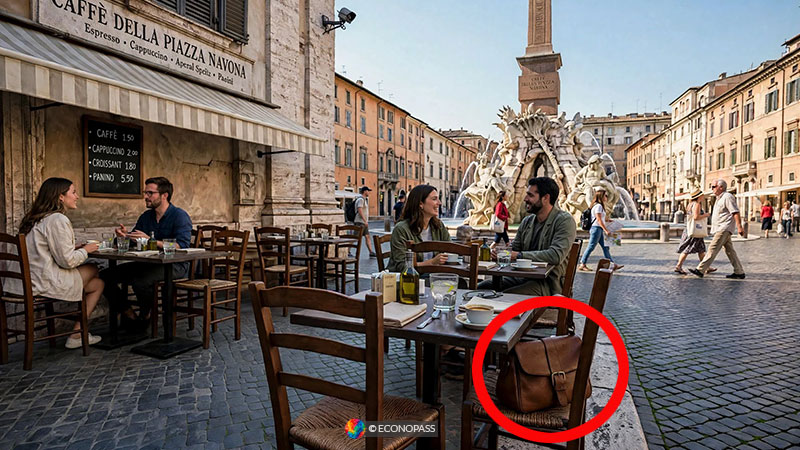
The bag was on the chair for thirty seconds. The tourist had turned to flag the waiter. The footage from the café’s outdoor camera was clear: a child, visibly under ten, moving at the edge of the frame with the specific unhurried efficiency that takes practice to acquire, lifting the bag from the chair back without breaking stride or looking at the table, and continuing down the Via della Croce without running. The tourist turned back. The carabinieri officer who reviewed the footage that afternoon recognised the technique. He had seen it many times. He noted in the report that the footage was insufficient for identification, which was technically accurate, and suggested the tourist file with the consulate. Then he smiled, not unkindly, in the manner of a person explaining something to someone who has just learned how a particular part of the world works.
Rome is one of the most visited cities on Earth and one of the most systematically robbed. The two facts are not unrelated. Tourism concentrates wealth, produces distraction, and creates a population of visitors who do not know the terrain, will not be present to testify in future proceedings, and have a finite window of stay that makes pursuing a complaint logistically impractical. These are ideal conditions. The people who understand this best are not criminologists. They are the people who have organised their working lives around it.
The Legal Architecture of Impunity
In Italy, the age of criminal responsibility is fourteen. A child under fourteen who commits a theft cannot be prosecuted in the criminal courts. They can be held temporarily, referred to social services, and released. The process generates paperwork and returns the child to the street the same day. This is not a loophole in Italian law. It is Italian law, consistent with broader European juvenile justice frameworks and the principle that children below a certain age cannot form criminal intent in the legal sense. It is also, in practice, the structural basis on which organised theft networks in Rome and other Italian cities deploy children as their primary operational layer.
The logic is straightforward. An adult pickpocket caught in the act faces arrest, charging, and potentially detention pending trial. A child caught in the act faces a temporary hold and release. The risk profile is different by an order of magnitude. Networks that understand this, and the ones operating in Rome’s tourist zones demonstrably do, assign the physical theft to children and keep adult coordinators at a distance sufficient to claim no connection. The coordinator who watches from across the piazza, who signals which tourist to approach, who collects the proceeds later is not on camera performing a crime. The child on camera is not legally chargeable for it. The system works.
Roberto Saviano, in Gomorrah, documented how the Camorra criminal organisation in Naples structured its operations specifically to maintain functional distance between decision-makers and prosecutable acts, distributing risk across layers of participants who could be sacrificed without exposing the network’s core. The parallel to Rome’s tourist theft economy is not a direct connection, the operations are distinct, but the structural principle is the same. The people who run organised theft operations in tourist cities do not steal. They manage. The theft is performed by participants whose capture does not damage the enterprise, because the enterprise is designed to continue operating regardless of who is temporarily removed from it.

Blink Mini 2 Indoor Camera
1080p HD indoor/outdoor security, motion alerts, two-way audio, works with Alexa. Full peace of mind for under $40.
View on AmazonThe Geography of the Operation
Rome’s highest-concentration theft zones are well documented and have not changed significantly in decades. The area around Termini station, where long-distance travellers arrive with luggage and orientation stress, is the densest. The Metro lines A and B, particularly the stretch between Termini and the Vatican on line A, are targeted constantly. The Colosseum queues, the Spanish Steps, the Trevi Fountain: anywhere that produces a standing crowd of distracted tourists with bags and cameras produces the conditions the operations require.
The technique varies by location. On the Metro, the standard approach involves a group creating a press of bodies at the doors during boarding, using the physical contact of a crowded carriage to mask the hand that moves. At street cafés, the chair-back bag lift that the tourist on Via della Croce experienced requires no contact at all. At monuments, the distraction method uses a clipboard or a request for directions to draw the target’s attention upward or forward while a second person moves behind them. These are not improvised. They are trained, practised, and refined. The children who perform them have been taught.
Tobias Jones, in The Dark Heart of Italy, examined the gap between Italy’s formal institutions and their actual operation, arguing that the country functions through a complex negotiation between official rules and the informal practices that substitute for them, a system in which the law exists as one factor among many rather than as the governing constraint on behaviour. This is relevant to Rome’s tourist theft economy not because Jones addresses it directly but because the institutional tolerance of a known, structured criminal operation targeting visitors requires exactly this kind of gap to persist. The police know where the operations concentrate. The legal mechanism that limits prosecution is understood. The operations continue at scale. The system accommodates this because the formal response to it would cost more than the informal tolerance of it.
What the Officer Already Knew
The carabinieri officer who smiled was not being callous. He was being honest, in a way that the report he filed was not. The honest version of the conversation would have included several facts he did not put in the paperwork: that the footage was not insufficient for identification but insufficient for prosecution, because the subject was a child and the Italian juvenile justice process would return them to the street before the report was processed; that the child on the footage was not acting independently; that the network operating in that part of the city was known and had been known for years; and that the tourist’s bag was gone and would not be recovered. The smile was the compressed version of all of this. It contained more information than the report.
Tourist theft in Rome is massively underreported, which is itself a known fact that everyone involved understands. Tourists who are robbed face a calculation: file a report, which requires going to a police station, waiting, completing paperwork in a foreign language, and producing a document they will never use, or accept the loss and continue the holiday. Most choose the second option. The low reporting rate produces official statistics that understate the scale of the problem, which are then cited in contexts where the official statistics are taken as a reasonable proxy for reality. They are not.
John Hooper, in The Italians, describes the concept of furbizia, the Italian cultural value placed on cleverness in navigating systems and rules, and distinguishes it from dishonesty: the furbetto is not a criminal but someone who has identified the gap between how a system is supposed to work and how it actually works, and has positioned themselves accordingly. Applied to the tourist theft economy, the people operating it are, by this framework, not violating the social order so much as operating within its actual structure rather than its stated one. The tourist who does not know that café chairs carry bags requires a different approach than the Roman resident who does not put a bag on a café chair. The gap between what the city presents to visitors and what residents know about it is itself a resource.
What Changes When You Know
The practical response to this information is straightforward and widely available: bag on the lap, not the chair. Inside coat pocket, not a camera bag. Metro hand on the door frame, bag in front. Phone in a front pocket during monument visits. None of this is complicated. All of it requires knowing that the problem exists at the scale it exists, which the tourist industry that markets Rome does not emphasise, because the information is not consistent with the product being sold.
What does not change is the structural situation. The legal framework governing juvenile prosecution is not going to change because tourists lose bags. The operations targeting tourist zones are not going to stop because a report was filed. The officer’s smile was an accurate assessment of the situation. Rome is a city of extraordinary beauty, genuine complexity, and a tourist theft ecosystem that has been operating at industrial scale for long enough to have developed its own professional practices and institutional accommodations. Visiting it on those terms is different from visiting it on the terms the booking page describes. It is also more honest.
Not the highlights reel. Not the itinerary. Just what actually happened.
Simon De Lafronde



Sources
- Pickpocketing, Wikipedia
- Age of criminal responsibility in Italy, Wikipedia
- Tourism in Rome, Wikipedia
- Carabinieri, Wikipedia
- Crime in Italy, Wikipedia

A Note from Simon de Lafronde
The advice and information in this article come from my experience and research. It’s intended to support your reading with evidence-based insights. If the article is covering wellness or any other health topics, this is not professional advice. Please consult appropriate professionals for your specific situation.
📖 Read MoreStill Curious? Don't Stop Here!

The Maldives Is Sinking. The Government Has Already Bought Land in Australia. The Resorts ...

They Photographed the Military Checkpoint Without Reading the Sign. The Camera Was Confisc...
The Tour Bus to Machu Picchu Left Without Her. She Was in the Bathroom. The Next Bus Was T...
The Dead Sea Is Shrinking by One Metre Every Year. The Sinkholes Opening Around Its Shores...

Petra Was Not Lost. The Local Bedouin Knew Exactly Where It Was. The West Simply Had Not A...

They Hired a Local Guide in the Amazon. He Left Camp Before Dawn on Day Two. They Did Not ...
The Backpack Was Switched at the Bangkok Airport. He Did Not Notice Until the Customs Dog ...