
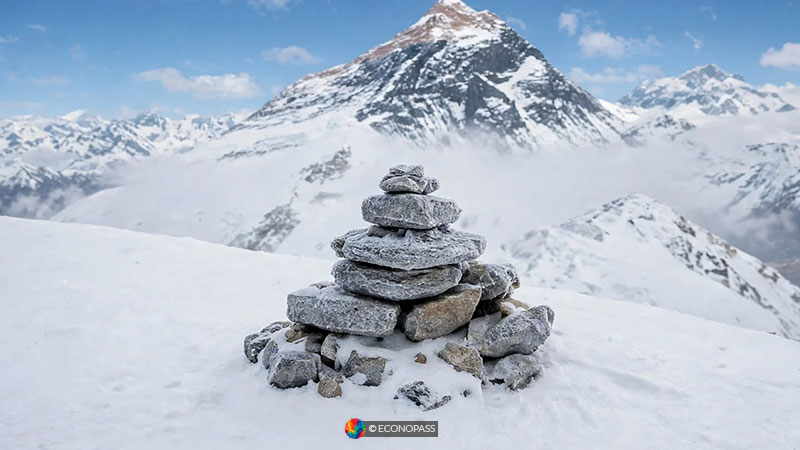
The mountain keeps its dead. This is not a metaphor. Above 8,000 metres on Mount Everest, in the zone climbers call the death zone, the cold is so absolute and the terrain so dangerous that recovering a human body is considered, by most expedition operators, an unacceptable risk to living climbers. So the bodies stay. They have been staying for decades. There are now more than 200 of them on the slopes, and many have been there so long that the climbing community has given them names.
The families, in many cases, were told that recovery was impossible. What they were not always told is that the bodies were being used as navigational reference points by subsequent expeditions, that their names had entered climbing guides and route descriptions, and that the mountain had incorporated their relatives into its infrastructure.
The Arithmetic of the Death Zone
Mount Everest has been attempted by thousands of climbers since the first recorded ascent in 1953. As of recent counts, more than 300 people have died on the mountain across its full history. The majority of those deaths occurred above 7,500 metres, where altitude, cold, and the physical reality of the terrain make conventional rescue and recovery essentially impossible. At those elevations, helicopter operations are limited by air density. Manual extraction requires teams large enough to constitute their own expeditions, with their own mortality risk. The logistics are not theoretical obstacles. They are real ones.
Above 8,000 metres, the body has already begun to die. The brain does not receive enough oxygen to function normally. Decisions become slow, then wrong, then absent. The climbers who have perished in the death zone were not necessarily reckless. Many were experienced. The mountain does not distinguish.
What makes Everest different from other high peaks is the sheer volume of traffic on its established routes. The Northeast Ridge and the Southeast Ridge see hundreds of summit attempts each season. This means that the bodies left in place are not in remote, rarely visited locations. They are on the path. Climbers pass them going up. They pass them again coming down. The same body, in the same position, season after season, sometimes for twenty or thirty years.

Amazon Echo Dot 5th Gen
Improved bass, temperature sensor, tap-to-snooze, and Alexa everywhere. The most-rated smart speaker on Amazon for good reason.
View on AmazonThe Names They Were Given
The climbing community assigned informal names to the most visible and long-standing bodies on the route. Green Boots was an Indian climber who died in 1996 in a limestone cave near the Northeast Ridge. His distinctive green mountaineering boots made him immediately identifiable. For years, his body in that cave served as a known waypoint for climbers descending from the summit. It appeared in expedition accounts, guidebooks, and training materials. His identity was not publicly confirmed for years after his death. His family, based in India, had not consented to his body becoming a landmark.
The names given to bodies on Everest were practical, not callous. Climbers needed to communicate clearly about locations on a mountain where confusion costs lives. The problem is that practicality was never explained to the people those names belonged to.
David Sharp died near the same cave in 2006 during a solo summit attempt. He was found by other climbers while still alive, but the consensus among those who passed him was that he was too far gone to save and that any rescue attempt would endanger the rescuers. He died there. The incident generated significant public controversy, with climbers and commentators debating what obligations exist between people on the mountain when one of them is dying. No formal resolution emerged. The body remained.
The Recovery Question
Attempts have been made to remove bodies from the upper slopes. In 1999, an expedition specifically organised to find George Mallory, who disappeared on Everest in 1924, located his body at around 8,155 metres on the North Face. The team documented the site carefully and buried Mallory’s remains in the mountain with a brief ceremony. It was considered a significant logistical achievement and required a dedicated, funded expedition to accomplish for a single body.
The economics of recovery are not incidental. Extracting a body from the death zone requires specialist teams, supplemental oxygen for all members involved, and expedition-level coordination. The cost estimates for recovering a single body from the highest reaches of the mountain run into the hundreds of thousands of dollars. No standard mechanism exists to fund this. Insurance policies held by climbers do not routinely cover it. The families, if they want their relative back, face a process that has no clear institutional pathway and no guarantee of success.
The mountain has never formally acknowledged what it has become: a graveyard that charges admission, where the dead are incorporated into the experience sold to the living. Summit attempts on the standard routes pass dozens of bodies. This fact does not appear prominently in any official communication from the governing bodies that issue climbing permits.
What the Families Were Told
The notifications sent to families after deaths on Everest vary considerably. Some families received detailed accounts of the circumstances. Others were told only that the body could not be recovered and that the location was inaccessible. The fact that inaccessible, in many cases, meant on a heavily trafficked route visible to hundreds of climbers per season was not part of the standard communication. The fact that the body had acquired a name used in climbing circles was not part of it either.
Nepal and China, which control access to the two main faces of the mountain, have periodically announced initiatives to address the bodies on the upper slopes. Some remains in the lower sections of the mountain, below the death zone, have been removed by organised efforts. The upper sections remain largely as they are. The permits that generate tens of millions of dollars in revenue annually for the Nepalese government do not include any dedicated allocation for body recovery. The situation is not the result of indifference in any single identifiable place. It is the result of a system that was never designed to address it and has not been redesigned since.
The bodies on Everest are a documentation of what happens when a commercial system grows up around a place that kills people and the infrastructure for dealing with death is never built into the model. The mountain did not change. The number of people attempting it changed. The bodies accumulated. The families asked questions. The answers have been, in most cases, incomplete.
Not the highlights reel. Not the itinerary. Just what actually happened.
Simon De Lafronde
Sources
- Mount Everest, Wikipedia
- List of people who died climbing Mount Everest, Wikipedia
- Death Zone, Wikipedia
- George Mallory, Wikipedia
- David Sharp, Wikipedia

A Note from Simon de Lafronde
The advice and information in this article come from my experience and research. It’s intended to support your reading with evidence-based insights. If the article is covering wellness or any other health topics, this is not professional advice. Please consult appropriate professionals for your specific situation.
📖 Read MoreStill Curious? Don't Stop Here!
Venice Has Fewer Than 50,000 Residents for the First Time in Six Centuries. On Peak Days, ...

They Posted Their Itinerary on Instagram. By the Time They Arrived at the Guesthouse, It W...
The Ferry to the Island Left on Time. The Return Ferry Was Cancelled Due to Weather. They ...
He Rented a Scooter in Vietnam Without an International Licence. He Had an Accident. His T...
She Left Her Bag at a Café Table in Rome for Thirty Seconds. The Surveillance Footage Show...
The Maldives Is Sinking. The Government Has Already Bought Land in Australia. The Resorts ...
They Photographed the Military Checkpoint Without Reading the Sign. The Camera Was Confisc...