In October 2009, the cabinet of the Maldives held a meeting underwater. Ministers in scuba gear gathered on the seafloor of a lagoon near the capital Male, signed a document calling on the world to cut carbon emissions, and surfaced for the cameras. The event was staged. The point behind it was not. The Maldives, an archipelago of roughly 1,200 islands spread across the Indian Ocean, sits at an average elevation of 1.5 metres above sea level. It is one of the lowest-lying nations on Earth. It is also one of the most visited. Those two facts are in direct and unresolved conflict.
The government of Mohamed Nasheed had already taken a step the year before that received less attention than the underwater cabinet meeting. In 2008, Nasheed announced that the Maldives would begin setting aside a portion of its tourism revenue into a sovereign fund intended for a specific purpose: the purchase of land in another country. The stated destinations under consideration were Australia, Sri Lanka, and India. The reasoning was explicit. If sea levels rise as projected, the Maldives will become uninhabitable. When that happens, the population will need somewhere to go. The government intended to buy it in advance.
What the Projections Actually Say
The Intergovernmental Panel on Climate Change projects sea level rise of between 0.3 and 1 metre by 2100 under various emissions scenarios. The upper end of that range, combined with storm surge during extreme weather events, would render most of the Maldivian islands uninhabitable well before the century ends. The 1.5-metre average elevation is a mean figure. Many of the outer islands are lower. Many of the inhabited ones are already experiencing regular flooding during king tides and cyclone events that did not reach them a generation ago.
The Maldivian government has responded to this not only with international advocacy but with internal relocation. The artificial island of Hulhumale, built by pumping sand from the ocean floor to raise land above the existing sea level, has been expanded progressively and now houses tens of thousands of people relocated from outer islands deemed too vulnerable to maintain. The project is ongoing. It is also, by its own designers’ admission, a medium-term solution. What it buys is time. The question of what comes after time runs out has not been officially answered.
Jeff Goodell, in The Water Will Come, documents the Maldives as a case study in what he calls “managed retreat”: the organized withdrawal of a population from land that will be surrendered to the sea. Goodell notes that the Maldives represents the first nation-state in history to treat relocation of its entire population as a planning scenario rather than a last resort. The land purchase announced under Nasheed was not completed before his government ended, but the logic behind it has not changed. What changes with each government is the willingness to say it aloud.

Apple AirPods Pro 3
2× better noise cancellation, heart rate sensing, Live Translation, and 10 hours battery. The earbuds most people end up choosing.
View on AmazonWhat the Resorts Say Instead
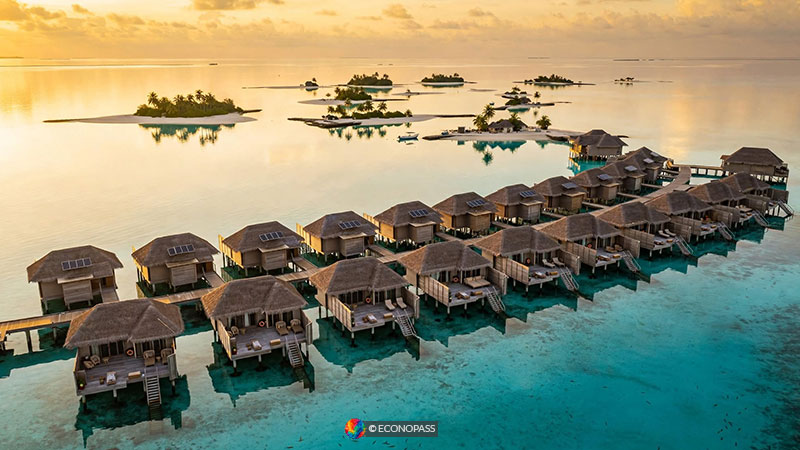
The marketing language for Maldives tourism does not mention sea level rise. It does not mention Hulhumale or managed retreat or sovereign relocation funds. It describes turquoise water, white sand, overwater villas, and seclusion. The Maldives is consistently ranked among the most desirable destinations on Earth. It generates more revenue per visitor than almost any other tourism market in the world. A standard overwater villa costs several hundred dollars per night at the lower end and several thousand at the higher end. The experience being sold is a version of the planet that exists now and will not exist in the same form later.
This is not a small irony. Tourism revenue funds the government. Government revenue funds climate adaptation. Climate adaptation buys time before the tourism infrastructure becomes unviable. The industry and the existential threat are economically entangled in a way that makes simple moral clarity difficult. The resorts cannot advertise the problem without undermining the product. The government cannot abandon the product without losing the revenue that funds the response to the problem. The result is a country that holds underwater cabinet meetings for the cameras and books overwater bungalows for the guests, simultaneously.
Elizabeth Rush, in Rising: Dispatches from the New American Shore, documents communities along the American coastline making the same calculation in smaller scale: whether to invest in adaptation, accept managed retreat, or continue as before while the evidence accumulates. The pattern she identifies is consistent across geographies and income levels. Communities facing submersion tend to split between those who acknowledge the timeline and those who treat it as a distant abstraction. In the Maldives, the government acknowledges the timeline and the industry treats it as a distant abstraction. Both operate simultaneously, in the same economy, funded by the same visitors.
The Islands Being Abandoned Now
The relocation to Hulhumale is not a future plan. It is current policy. Residents of outer islands designated as high-risk have been relocated to the artificial island over the past two decades. The process has not been uniformly welcomed. Many of the relocated families came from islands where their families had lived for generations. The island they moved to was built from sand pumped off the ocean floor. What was left behind was community, cemetery, the specific geography of a place, and in some cases the material remains of a life that could not be transported.
The outer islands being depopulated are not the ones tourists visit. The resort islands are separately administered and separately maintained. The parallel tracks of the Maldivian present, the luxury experience and the climate evacuation, rarely intersect in the same physical space. A visitor to a resort island will not see the relocation housing on Hulhumale. A resident of Hulhumale will not see the interior of an overwater villa. The country is running two stories at once and the two audiences for those stories are kept largely apart.
David Wallace-Wells, in The Uninhabitable Earth, argues that the most dangerous feature of accelerating climate change is not any single catastrophic event but the normalization of conditions that previous generations would have recognized as crisis, a background recalibration of what counts as tolerable that happens too gradually to trigger the response it deserves. The Maldives tourism industry is a demonstration of that argument in real time. The product being sold is a version of a place that is actively preparing for its own disappearance. The buyers do not know this. The sellers know it and have concluded that disclosure is not in their commercial interest. The ocean does not share that interest.
What Visiting Now Actually Means
The Maldives will not disappear next year. The tourism infrastructure will continue to function, the water will continue to be turquoise, and the experience of staying in an overwater villa will continue to be what the marketing says it is, for now and for a period of years that cannot be precisely specified. What a visitor chooses to do with that information is a personal decision. What the information is, is not in dispute.
The government has purchased land elsewhere. The population is being relocated from its most vulnerable islands. The sea level is rising. The projection period is measured in decades, not centuries. And the booking pages are open, the reviews are five stars, and the carbon footprint of the long-haul flight required to reach the destination contributes, in a small and statistically traceable way, to the process making the destination unsustainable.
None of this is hidden. It is documented, reported, stated in government policy, and available to anyone who looks for it. What the tourism industry has correctly identified is that most people who look for a Maldives holiday are not looking for it.
The underwater cabinet meeting was filmed and distributed globally. The footage exists. The land purchase was announced in public. The relocation program is ongoing. The resorts are booked. These facts coexist without contradiction, which is perhaps the strangest thing about the Maldives. It is not a place where the truth is hidden. It is a place where the truth and the product exist side by side, and the product continues to sell.
Not the highlights reel. Not the itinerary. Just what actually happened.
Simon De Lafronde
Sources
- Maldives, Wikipedia
- Mohamed Nasheed, Wikipedia
- Hulhumale, Wikipedia
- Climate change in the Maldives, Wikipedia
- 2009 Maldives underwater cabinet meeting, Wikipedia
A Note from Simon de Lafronde
The advice and information in this article come from my experience and research. It’s intended to support your reading with evidence-based insights. If the article is covering wellness or any other health topics, this is not professional advice. Please consult appropriate professionals for your specific situation.
📖 Read MoreStill Curious? Don't Stop Here!
They Photographed the Military Checkpoint Without Reading the Sign. The Camera Was Confisc...
The Tour Bus to Machu Picchu Left Without Her. She Was in the Bathroom. The Next Bus Was T...
The Dead Sea Is Shrinking by One Metre Every Year. The Sinkholes Opening Around Its Shores...
Petra Was Not Lost. The Local Bedouin Knew Exactly Where It Was. The West Simply Had Not A...
They Hired a Local Guide in the Amazon. He Left Camp Before Dawn on Day Two. They Did Not ...

The Backpack Was Switched at the Bangkok Airport. He Did Not Notice Until the Customs Dog ...
Chernobyl Has More Wildlife Now Than Before the Disaster. Removing the Humans Was the Best...