On the night of August 21, 1986, the villages of Nyos, Cha, Kam, and Subum in northwestern Cameroon went to sleep. Most of them never woke up.
There was no earthquake. No eruption. No fire. No sound that anyone survived to describe clearly. What happened was something so rare that scientists did not have a widely used name for it until after it occurred. A lake exploded. Not with heat or force in any conventional sense. With gas. And the gas killed 1,746 people and 3,500 animals before sunrise.
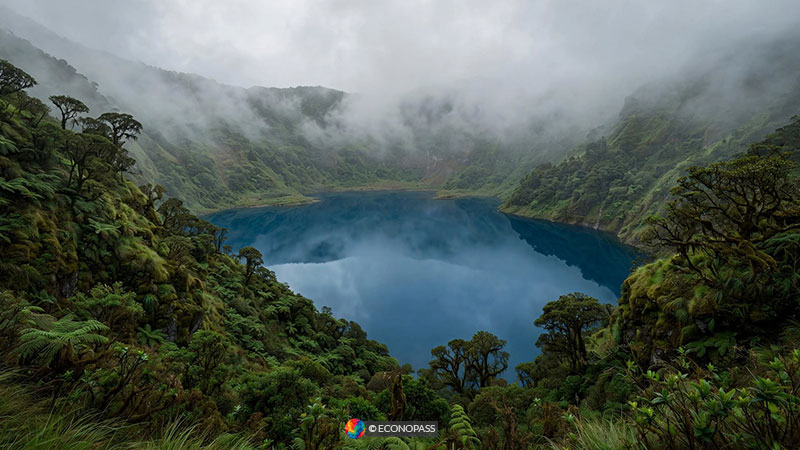
Lake Nyos is a crater lake in the volcanic highlands of northwestern Cameroon, approximately 315 kilometres from the capital Yaoundé. It sits above a pocket of magma that leaks carbon dioxide into the lake’s water continuously. Under normal conditions, water circulates, CO2 dissolves and disperses, and the lake behaves like a lake. Lake Nyos does not behave normally. Its waters are unusually still. Over decades and centuries, CO2 accumulated in the cold, dense lower layers of the lake, held down by the weight of the water above. By 1986, more than five gallons of carbon dioxide were dissolved in every gallon of the deepest water. Lake Nyos was a pressurised vessel.
Something triggered it on the night of August 21. Exactly what remains uncertain. The leading theories include a small landslide, a minor volcanic tremor, or possibly cold rain falling on the lake’s surface and disturbing the thermal stratification. Whatever the cause, the bottom layer of water, saturated beyond its capacity to hold the gas, overturned. The CO2 came out of solution the way carbonation explodes from a shaken bottle, except this bottle contained 1.6 million tonnes of gas.
A fountain of water and foam rose 91 metres above the lake’s surface. A wave at least 24 metres high scoured the shoreline. And then the gas cloud came. Carbon dioxide is heavier than air. It does not rise and disperse. It flows downhill, hugging the ground, displacing oxygen from every space it enters. The cloud moved at nearly 100 kilometres per hour down the valleys below the lake. Within a radius of 25 kilometres, it displaced all breathable air.
Joseph Nkwain from the village of Subum survived because he lost consciousness before he could inhale a fatal dose. He described waking later to find his daughter already dead. “I could not speak. I became unconscious… I heard my daughter snoring in a terrible way, very abnormal… I wanted to speak, my breath would not come out.” In the village of Nyos itself, which gave the lake its name, 800 people lived before that night. Six survived.
French volcanologist Haroun Tazieff was among the first scientists on the scene. What he found defied easy description. “There was no fire, no lava, no ash. It was as if the lake itself had exhaled a poisonous breath that rolled down and suffocated everything in its path.” The dead lay where they had been standing, sitting, sleeping. Animals lay in fields mid-stride. The catastrophe had been silent, invisible, and almost instantaneous.
Scientists gave the event a name: a limnic eruption. It had happened before, on a smaller scale. Two years earlier, in 1984, Lake Monoun, just 100 kilometres from Lake Nyos, had released CO2 in a similar event, killing 37 people. The warning had not been understood in time. After Lake Nyos, the scientific community began systematically identifying other lakes around the world with the same dangerous properties. They found two more: Lake Monoun again, and Lake Kivu, on the border between Rwanda and the Democratic Republic of Congo. Lake Kivu is significantly larger than Lake Nyos. It holds vastly more dissolved gas.
The engineering response to Lake Nyos was elegant in its simplicity. In 2001, a pipe was installed running from the lake’s surface to its deepest layers. The pressure difference causes the CO2-saturated water to rise and spray into the air at the surface, releasing gas gradually rather than catastrophically. The lake has been slowly degassing ever since. But engineers have noted that the current single pipe is insufficient to make the lake fully safe, and additional pipes are needed. The project has struggled for consistent international funding.
There is a second threat that receives less attention. Lake Nyos is held in place by a natural dam of volcanic rock. That dam is weakening. Engineers who have assessed it warn that a failure of the dam would be catastrophic in two ways simultaneously: a massive flood moving downhill through the valleys, and the sudden release of whatever CO2 remains dissolved in the lake. The two disasters would arrive together. Nobody knows when the dam might fail. Nobody knows exactly what would happen if it did.
Lake Nyos today looks serene. The water is blue. The hills around it are green. Visitors who go there describe the silence as remarkable.
That silence has a different meaning now.
The world is stranger than anyone told you. I am just keeping count. Marco Bellinari
Think that was strange? These books will finish the job.
Thank you for reading. Every fact in this article is documented and sourced. You will find the references at the bottom if you want to dig further. I hope it surprised you at least once. That is always the intention.
I would love to hear your thoughts. Follow Econopass on social media and share your reaction hereafter as a social comment. And if you do not want to miss the next story, hit follow. There is always another forgotten truth waiting to be told.
Disclosure: This article may contain affiliate links. This means we may earn a commission if you click on a link and make a purchase at no extra cost to you. This applies to featured Amazon products or any other Econopass's partners.
FediBack: There Is a Lake in Cameroon That Exploded and Killed 1700 People Overnight. It Can Happen Again.
🟢 A lake that looks completely peaceful has killed nearly 1,800 people in a single night. And the conditions that made it possible still exist. After reading this, what surprised you most? Tell me below.
🟢 A lake that looks completely peaceful has killed nearly 1,800 people in a single night. And the conditions that made it possible still exist. After reading this, what surprised you most? Tell me below.
🟢 A lake that looks completely peaceful has killed nearly 1,800 people in a single night. And the conditions that made it possible still exist. After reading this, what surprised you most? Tell me below.
These articles and stories are free because of a few ads. To support us, simply turn off your ad blocker for Econopass. It takes one click on the ad blocker icon in your browser. Thank you!
We use cookies to ensure that we give you the best experience on Econopass website. If you continue to use this site we will assume that you are happy with it.