
The Western Roman Empire fell in 476 AD. By that point, the trees in the Ancient Bristlecone Pine Forest in California’s White Mountains were already roughly 2,300 years old. They were already old when Julius Caesar was born. They were already old when the Parthenon was new.
They are still there.
Why This Place
The White Mountains sit in the high desert of eastern California, across the Owens Valley from the Sierra Nevada. At elevations above 10,000 feet, the air is thin, the winters are severe, and the growing season runs to perhaps six weeks. The soil is dolomite: alkaline, nutrient-poor, inhospitable. Almost nothing else grows at this altitude.
These are not conditions that appear hospitable to life, let alone to the oldest living organisms on Earth. They are, it turns out, precisely why the trees survive.
Growth is so slow that the wood becomes extraordinarily dense. The cold and dryness support almost no fungal pathogens or bark beetles, the two forces most reliably fatal to large trees. The trees grow at the edge of what their physiology allows, and that constraint is what preserves them. Stress, in the right form and the right quantity, appears to be the mechanism of extreme longevity.
Bristlecone pines at the highest elevations of the White Mountains may add less than an inch of girth over a century of growth. The density of the resulting wood makes it resistant to rot and insect damage to a degree no tree growing in more favorable conditions can match.

Blink Mini 2 Indoor Camera
1080p HD indoor/outdoor security, motion alerts, two-way audio, works with Alexa. Full peace of mind for under $40.
View on AmazonMethuselah and the Tree That Was Cut Down
In the 1950s, a dendrochronologist named Edmund Schulman began systematically coring bristlecone pines in the White Mountains, counting growth rings to determine their age. What he found changed the scientific understanding of tree longevity. Trees that appeared gnarled and largely dead, more dead wood than living, turned out to be not centuries old but millennia old.
The tree now known as Methuselah was identified by Schulman as the oldest known living organism. It was approximately 4,789 years old at the time of its discovery in 1957. Schulman died the following year, before publishing his full findings.
A parallel story ended differently. In 1964, a geography researcher named Donald Currey was working in the same mountain range in Nevada when he cored a bristlecone pine designated WPN-114. His corer broke inside the tree. He was granted permission to fell it to count the rings directly. When the count was done, WPN-114, later named Prometheus, was approximately 4,900 years old. It had been the oldest known living organism on Earth. It was now a stump.
Prometheus had germinated around 2900 BC, predating the construction of Stonehenge and the unification of Upper and Lower Egypt. It was destroyed in an afternoon in 1964 to confirm a fact that could not afterward be undone. The researcher later said he had not known what he was cutting.
What the Tree Actually Looks Like
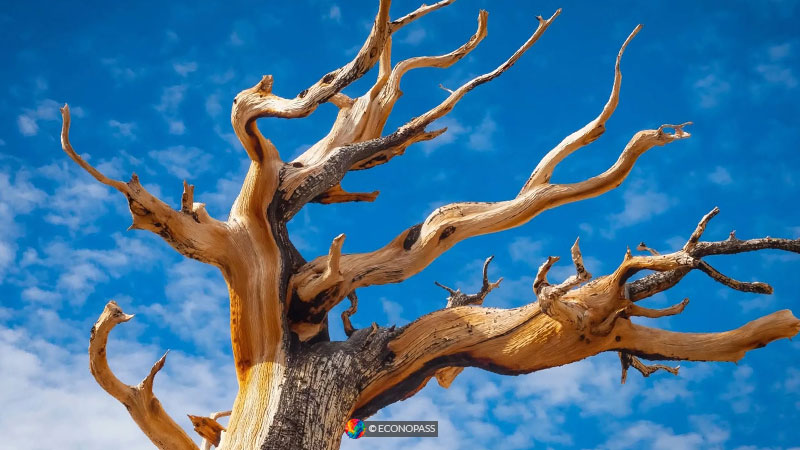
Visitors expecting something magnificent are sometimes surprised. The oldest bristlecone pines are not tall. They are not grand in the way a sequoia or a redwood is grand. They are low, gnarled, shaped by wind into forms that suggest catastrophe rather than endurance.
Most of the visible structure is dead. Living bristlecone pines at extreme age maintain only a narrow ribbon of living bark spiraling up the trunk, supplying just enough cambium to keep a few branches photosynthesizing. The rest is bleached, wind-polished wood that has hardened over centuries into something closer to stone than timber.
This is the adaptation. By concentrating life into the minimum necessary strip of living tissue, the tree reduces its vulnerability to any single event. A lightning strike, a fire, an exceptionally hard winter: any of these might kill a portion of the tree. The rest persists. Some of these trees have been persisting, by this method, since before recorded history began.
Some bristlecone pines are estimated to be more than half dead wood by volume while still producing viable seeds annually. The living portion of the tree has contracted over centuries to the minimum required to sustain reproduction, and that minimum has been enough for five thousand years.
The Location Is Kept Secret
Methuselah’s exact location within the Ancient Bristlecone Pine Forest is not disclosed to the public. The US Forest Service made this decision after damage to the tree following its identification and the publicity surrounding it. Visitors to the Schulman Grove walk a trail among trees thousands of years old without knowing which one is Methuselah.
This is, in its way, the most fitting arrangement possible. The tree survived this long without anyone knowing its name or its coordinates. The secrecy is recent. The tree is not.
The world is stranger than anyone told you. I am just keeping count.
Marco Bellinari
Sources
- Methuselah, Wikipedia
- Prometheus (tree), Wikipedia
- Ancient Bristlecone Pine Forest, Wikipedia
- US Forest Service, Ancient Bristlecone Pine Forest, Inyo National Forest
- Pinus longaeva, Wikipedia

A Note from Marco Bellinari
Thank you for reading. Every fact in this article is documented and sourced. You will find the references at the bottom if you want to dig further. I hope it surprised you at least once. That is always the intention.
I would love to hear your thoughts. Follow Econopass on social media and share your reaction hereafter as a social comment. And if you do not want to miss the next story, hit follow. There is always another forgotten truth waiting to be told.
Still Curious? Don't Stop Here!

There Is a Village in India Where Every House Is Built Without Doors. Nobody Has Ever Repo...

Clocks in Japan Run on Time to the Second. The Country Has Not Had a Train Delayed by More...
A Prison in Bolivia Has Its Own Economy, Hotels, and Restaurants. Families Move In With th...

The United States Accidentally Dropped Four Nuclear Bombs on Spain in 1966. Spain Found Ou...

A Costa Rican Beach Turns Completely Black at Night. What Causes It Happens Only a Few Tim...

The Longest War in History Lasted 335 Years. Not a Single Person Died.
A Pigeon Delivered a Military Message Faster Than Any Radio in World War I. It Lost a Leg ...