

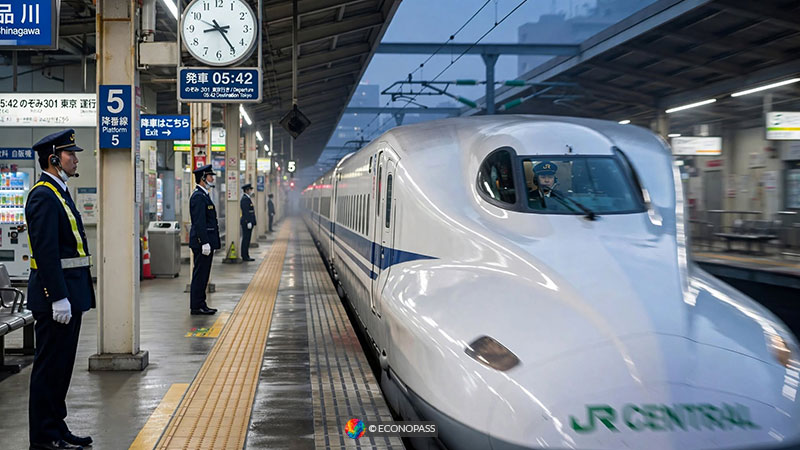
In November 2017, a commuter train on the Tsukuba Express line in Japan departed a station twenty seconds ahead of schedule. The railway company, Metropolitan Intercity Railway, issued a formal written apology to the public. The statement acknowledged that the early departure was unacceptable, that passengers who relied on the schedule had been failed, and that steps would be taken to prevent recurrence. Twenty seconds early. Formal apology. This is not an unusual response in Japan. It is the standard one.
The Shinkansen, Japan’s high-speed rail network, has been operating since October 1, 1964, when the first line opened in time for the Tokyo Olympics. In the decades since, the network has expanded to cover most of the country’s major corridors. The average delay across the Shinkansen system, calculated annually and reported publicly by Japan Railways, has consistently come in at under one minute. In years when the data has been published in English, the figure has been cited at approximately 36 to 54 seconds per train. This includes delays caused by natural disasters, which the reporting methodology does not exclude. When earthquakes, typhoons, and snowstorms are factored in, the average is still under a minute.
What One Minute Actually Means
To understand why this number is extraordinary, consider what it represents operationally. The Shinkansen carries hundreds of millions of passengers per year across thousands of daily departures. Each train runs on a fixed schedule timed to the second. Each platform must be cleared, boarded, and secured within a window that leaves no margin. Any ripple in the system, a passenger who takes ten extra seconds boarding, a door that hesitates, a signal that holds for one more moment, compounds down the line. In a network this dense, a single delay does not stay local. It propagates.
The standard response to this in most transit systems is to build buffer time into the schedule. Leave five minutes of slack at each major stop and delays absorb themselves. Japan’s railways do not do this. The schedules are real. The buffer is not in the timetable. It is in the execution. Every person in the system, from the platform attendants who push passengers into full carriages to the drivers who run the trains to the second, operates as though the schedule is not a guideline but a physical constraint.
Ezra Vogel, in Japan as Number One, argued that Japan’s postwar economic and organizational achievements were not accidental byproducts of industrialization but the result of deliberate social structures that embedded discipline, collective responsibility, and long-term thinking at every level of institutional life. His analysis of how Japanese institutions maintained quality was written in 1979 and was considered controversial by Western economists who believed market competition alone produced efficiency. The Shinkansen schedule is one of the cleaner empirical arguments for Vogel’s position. The discipline is structural. The result is consistent. The mechanism is not mysterious.
Weirdly Useful Things Under $25
Real stuff, real low prices. Amazon's best-kept budget finds, picked for everyday usefulness, not just novelty.
Browse the FindsHow the System Produces This
The technique that Japanese train drivers use to verify their position and status is called shisa kanko, or pointing and calling. Before each action, the driver points at the relevant instrument or signal and states aloud what it shows. The speed indicator is pointed at and read aloud. The signal is pointed at and its color spoken. The departure time is pointed at and confirmed. This is not a ceremony. It is an error-reduction protocol developed through operational research. Studies conducted by the Japanese railway system found that pointing and calling reduced mistakes by approximately 85 percent compared to silent verification. It is now standard across the rail network and has been adopted in other industries including aviation and manufacturing.
Station clocks are synchronized to a national time standard. Platform staff carry precision watches. The boarding window for each departure is timed and enforced. Doors close at the scheduled second regardless of stragglers on the platform. This last point is worth holding: the train does not wait. The system is designed on the assumption that it will not wait, which means every passenger and every staff member operates accordingly. The constraint produces the behaviour that makes the constraint viable.
Jeffrey Liker, in The Toyota Way, documented how Toyota’s production philosophy, known as the Toyota Production System, embedded the principle that quality is not inspected into a product at the end but built into the process at every step, with any worker empowered to stop the line the moment a defect appears rather than passing it forward. The same logic runs through Japan’s rail operations. A delay is not absorbed and hidden. It is acknowledged, logged, and reported. The apology for twenty seconds early is not public relations. It is the same mechanism as stopping the production line: the system treats deviation from standard as a problem to be surfaced, not managed away.
The Apology for Twenty Seconds
The 2017 Tsukuba Express incident attracted international attention because it illustrated the gap between Japanese punctuality standards and those of every other rail system in the world. In most countries, a train that departs twenty seconds early would not trigger a report. In Japan, it triggered a formal written apology published to the public, an internal review, and coverage across the national press. The story was covered internationally because it was perceived as extreme. In Japan, the response was considered proportionate.
This is not a recent cultural development. It predates the Shinkansen. Japanese railway companies began issuing delay certificates in the early twentieth century, documents given to passengers whose trains arrived late, which they could present to employers as proof that the delay was the railway’s fault and not their own tardiness. The practice persists today. A passenger on a Japanese commuter line can receive an official stamped certificate for a delay of five minutes or more. The certificate assumes that the passenger’s employer will want documentation. It assumes, in other words, that the standard of punctuality applies not just to the railway but to the society it serves.
Roger J. Davies and Osamu Ikeno, in The Japanese Mind, examine the cultural concepts that govern social behaviour in Japan, including the distinction between tatemae (the public face, the stated position) and honne (the genuine feeling underneath), and the concept of amae, the expectation of indulgence or accommodation within relationships of trust. The relationship between the railway and its passengers in Japan is one of those trusted relationships. The railway’s obligation is not merely to run trains. It is to maintain the conditions under which the people who rely on it can organize their lives. A delay certificate is an acknowledgment of that obligation. An apology for an early departure is its extension.
What Precision Requires
The Japanese rail system is not perfect. Delays do occur, particularly during the typhoon season and when earthquakes trigger automatic speed restrictions across the network. The annual average of under one minute includes these events. What it does not include, because they do not occur, are the routine operational delays that characterize rail systems elsewhere: signals held too long, platforms not cleared in time, connections missed because a train ran six minutes late for no particular reason.
The absence of routine delay is not a function of better technology. The Shinkansen runs on purpose-built track with no level crossings and its own dedicated signal infrastructure, but the commuter lines that issue delay certificates run on the same urban network as every other city’s subway system. The difference is not the hardware. It is the operating standard and the degree to which every person in the system internalizes it as a real constraint rather than a target.
In the rest of the world, a train schedule is an approximation. In Japan, it is a commitment. The gap between those two things is not a cultural mystery. It is a decision about what the standard is and what happens when it is not met. Japan decided. The apology for twenty seconds is what that decision looks like in practice.
The world is stranger than anyone told you. I am just keeping count.
Marco Bellinari


Sources
- Shinkansen, Wikipedia
- Tsukuba Express, Wikipedia
- Pointing and calling, Wikipedia
- Japanese work environment, Wikipedia
- Rail transport in Japan, Wikipedia

A Note from Marco Bellinari
Thank you for reading. Every fact in this article is documented and sourced. You will find the references at the bottom if you want to dig further. I hope it surprised you at least once. That is always the intention.
I would love to hear your thoughts. Follow Econopass on social media and share your reaction hereafter as a social comment. And if you do not want to miss the next story, hit follow. There is always another forgotten truth waiting to be told.
Still Curious? Don't Stop Here!

A Prison in Bolivia Has Its Own Economy, Hotels, and Restaurants. Families Move In With th...

The United States Accidentally Dropped Four Nuclear Bombs on Spain in 1966. Spain Found Ou...

A Costa Rican Beach Turns Completely Black at Night. What Causes It Happens Only a Few Tim...

The Longest War in History Lasted 335 Years. Not a Single Person Died.

A Pigeon Delivered a Military Message Faster Than Any Radio in World War I. It Lost a Leg ...

A Bridge in Scotland Kills Dogs. Over 600 Have Jumped From the Same Spot Since 1960. Nobod...

The Moon Is Slowly Moving Away From Earth. In About 600 Million Years Solar Eclipses Will ...