

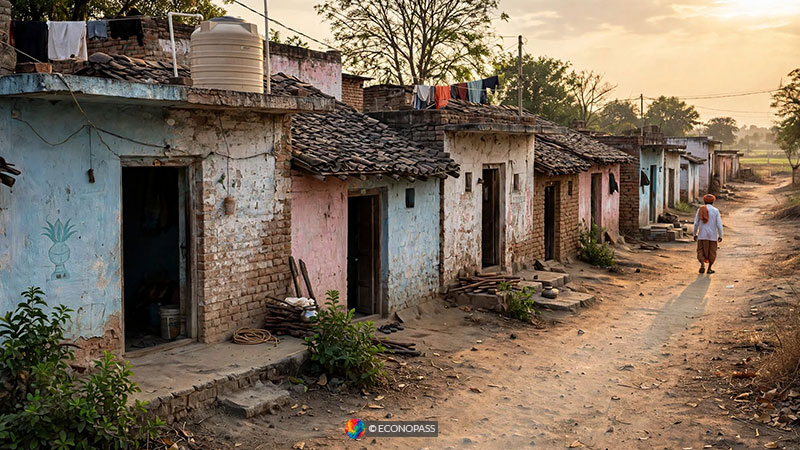
The house has walls, a roof, and an open doorway. No door. No frame to hang one on. No lock, because there is nothing to lock. Inside, the family’s possessions are visible from the street: furniture, appliances, the accumulated objects of a household. This is not poverty. It is a choice, made by this family and by every other family in Shani Shingnapur, a village of roughly four thousand people in the Ahmednagar district of Maharashtra, India. The choice has been made for centuries. And in all that time, according to the village’s own records and the accounts of its residents, no burglary has ever been reported.
The outside world tends to reach for the obvious explanations first. Extreme poverty, so there is nothing worth stealing. Social pressure so intense that theft is functionally impossible. A romanticized account that does not survive contact with reality. Each of these explanations gets tested against the facts and fails. Shani Shingnapur is not poor. It has a functioning bank branch, opened by UCO Bank in 2011, which became the first branch in India built without a vault or locks on its doors. The social pressure explanation has more to it, but it does not capture what residents themselves describe when asked why they do not lock their doors. What they describe is something older and more specific than social pressure.
The Deity at the Center
The village is built around a temple to Shani, the Hindu deity associated with the planet Saturn, with justice, and with the consequences of human actions. Shani is understood in the Hindu tradition as a figure who delivers the results of karma: punishment to wrongdoers, protection to the righteous. The black stone idol at the center of the Shani Shingnapur temple sits in the open air, without a roof over it, and has done so for as long as anyone in the village can trace the practice. The idol is not inside a building. Neither, by extension, are the homes of those who live under its protection.
The founding story of the doorless tradition, as it has been passed down through generations of Shani Shingnapur residents, holds that the black stone of the deity was discovered in the village long ago and that Shani appeared in a dream to a local shepherd, instructing that the stone be left in the open and promising protection to all who lived nearby without enclosing their homes. Whether or not one accepts the supernatural framework, the behavioral outcome has been real and measurable for generations: the village does not lock its doors, and the village does not report crime.
Robert Putnam, in Bowling Alone, developed the concept of social capital as the networks of trust, norms, and reciprocity that enable communities to function effectively, arguing that high social capital communities exhibit lower crime, better health outcomes, and more effective collective action than low social capital ones. Shani Shingnapur is an extreme case of what Putnam describes: a community whose shared belief system generates an exceptionally dense network of mutual observation and accountability. The absence of doors is not just a religious practice. It is a physical expression of the social compact the village operates under. When everyone can see into every home, the conditions for opportunistic theft are structurally eliminated.

eufy E25 Robot Vacuum & Mop
Powerful suction, mop combo, smart navigation, works with Alexa. Set it, forget it, come home to clean floors.
View on AmazonWhat the Bank Branch Proved
When UCO Bank opened its Shani Shingnapur branch in 2011, the decision to build without a vault was understood by some observers as a publicity stunt or a concession to local custom. It turned out to be a reasonable business decision. The branch operated for years without incident. Cash was stored in standard cash boxes rather than a vault. The branch was, by conventional banking logic, an open invitation to robbery. The robbery did not come.
The bank branch matters as evidence because it removes the objection that the doorless tradition applies only to residential property or only to items of modest value. A bank holds cash. A bank in a rural Indian village holds cash that is meaningful relative to local income levels. If the absence of locks was simply a tradition maintained by inertia in a community where nothing worth stealing existed, the bank branch would have been targeted. It was not. The protective logic that governs the houses appears to govern the bank as well, not through supernatural mechanism but through the same social enforcement that makes the houses untouchable.
Gurcharan Das, in India Unbound, traces how Indian communities have historically developed parallel systems of social order that operate alongside and sometimes independent of formal state institutions, with religious authority functioning as a binding force that formal law cannot replicate. Shani Shingnapur illustrates this dynamic precisely. The village does not rely on police presence, surveillance technology, or formal legal deterrence to maintain its crime-free record. It relies on the belief, held by every resident and every visitor familiar with the tradition, that theft in this village carries a divine consequence. That belief, shared consistently enough, produces behavioral compliance that formal institutions struggle to achieve even with far greater resources.
When the Outside World Arrived
Shani Shingnapur’s reputation attracted tourists, pilgrims, and journalists in growing numbers through the early twenty-first century. With outside visitors came outside behavior. In 2016, a theft was reported at the temple itself: items were allegedly stolen from the sanctum. The incident sent shockwaves through the village and through the broader community of devotees, not because theft had never been attempted before but because it had never been reported. The village’s response was ritual purification and a reaffirmation of the tradition. It was also, implicitly, a recognition that the protective system works through shared belief and shared accountability, and that people who do not share the belief are not bound by the accountability.
The 2016 incident did not break the tradition. The houses remain without doors. The bank branch continued operating. What it illustrated is the mechanism behind the record: Shani Shingnapur’s zero-burglary history is not a function of geography or poverty or luck. It is a function of a community that has constructed and maintained, over centuries, a social environment in which theft is understood as an act with consequences severe enough to deter it. The consequences are framed in religious terms. The behavioral effect is entirely material.
Steven Pinker, in The Better Angels of Our Nature, examines the long-term decline in human violence and argues that the most effective forces driving this decline are not formal institutions alone but internalized norms that make violence and predatory behavior feel genuinely wrong to the person contemplating them. Shani Shingnapur is a local, compressed demonstration of Pinker’s argument at the community scale. The norm against theft here has been internalized so completely, reinforced so consistently by religious belief and social observation, that the external enforcement mechanisms that most communities consider essential have never been necessary. The lock is redundant when the person who might pick it has already decided not to.
What It Means Beyond the Village
Criminologists studying Shani Shingnapur tend to frame it as a case study in informal social control: the capacity of communities to regulate behavior through shared norms and mutual surveillance without relying on formal law enforcement. The village has what criminologists call a very high degree of collective efficacy, the combination of social cohesion and willingness to intervene in deviant behavior that research consistently identifies as a stronger predictor of low crime rates than either police presence or economic conditions.
The doorless tradition is a physical signal of that collective efficacy. Building without a door is an act of faith, but it is also an act of community commitment: a statement that the household trusts its neighbors and that the household accepts the obligation to be a neighbor that can be trusted. Each doorless house is a contribution to the social infrastructure that makes all the other doorless houses safe. The village has been making this contribution, house by house, for centuries. The result is not miraculous. It is the entirely logical outcome of a community that has built, through shared belief and long practice, exactly the conditions under which locks are unnecessary.
The world is stranger than anyone told you. I am just keeping count.
Marco Bellinari


Sources
- Shani Shingnapur, Wikipedia
- BBC News, Shani Shingnapur: The Indian village with no doors, 2016
- The Hindu, Shani Shingnapur: Village without doors
- Guido Tabellini, Civic Capital as the Missing Link, Harvard
- Sampson, Raudenbush, Earls, “Neighborhoods and Violent Crime”, Science, 1997

A Note from Marco Bellinari
Thank you for reading. Every fact in this article is documented and sourced. You will find the references at the bottom if you want to dig further. I hope it surprised you at least once. That is always the intention.
I would love to hear your thoughts. Follow Econopass on social media and share your reaction hereafter as a social comment. And if you do not want to miss the next story, hit follow. There is always another forgotten truth waiting to be told.
Still Curious? Don't Stop Here!

Clocks in Japan Run on Time to the Second. The Country Has Not Had a Train Delayed by More...
A Prison in Bolivia Has Its Own Economy, Hotels, and Restaurants. Families Move In With th...

The United States Accidentally Dropped Four Nuclear Bombs on Spain in 1966. Spain Found Ou...

A Costa Rican Beach Turns Completely Black at Night. What Causes It Happens Only a Few Tim...

The Longest War in History Lasted 335 Years. Not a Single Person Died.

A Pigeon Delivered a Military Message Faster Than Any Radio in World War I. It Lost a Leg ...

A Bridge in Scotland Kills Dogs. Over 600 Have Jumped From the Same Spot Since 1960. Nobod...