

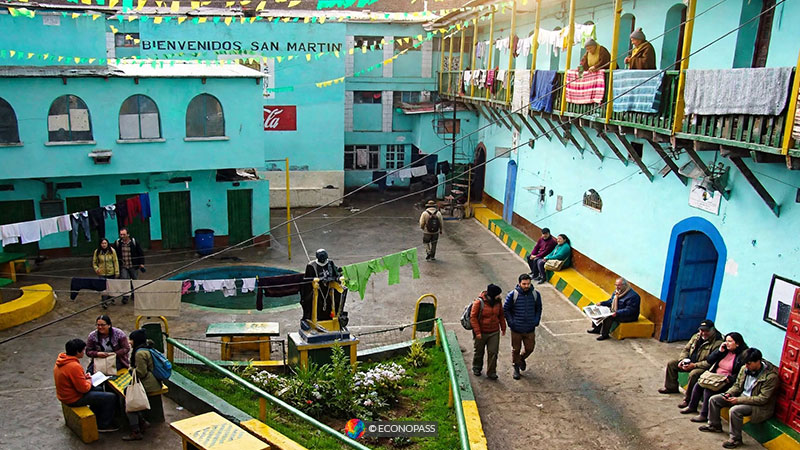
San Pedro Prison is located in the centre of La Paz, Bolivia, one block from Plaza San Pedro. It is not on the edge of the city. It is not hidden behind walls in a remote district. It sits in a residential neighbourhood, and from the outside it looks like a building. What happens inside is not like any other prison in the world, and what makes it unusual is not violence or chaos. It is commerce.
Inmates at San Pedro purchase their own cells. Not rent them, not get assigned to them: purchase. The price depends on the section of the prison. The best section, Pinos, has cells that have sold for thousands of dollars. The worst sections have cells that cost almost nothing. The difference between them is what you would expect in any real estate market: space, light, insulation, proximity to communal areas, and the kind of neighbours you get. San Pedro has a property market. It has had one for decades.
How the Economy Works
Once inside, an inmate who cannot afford a cell works. San Pedro has a labour economy that functions on its own terms. Inmates cook food and sell it inside the prison. They run small shops. They offer services. Some run restaurants that serve other inmates and, for a period that lasted through much of the 1990s and 2000s, paying visitors from outside. The prison had a tourist trade. Guards at the entrance could be paid to let outsiders in. What followed was a guided tour of an operational prison economy, led by an inmate who knew the place better than anyone.
Families are part of the system. Wives and children of inmates can live inside San Pedro if they choose to. Many do. The logic is straightforward: the inmate cannot come out, the family has limited resources outside, and the economic activity inside the prison offers more opportunity than what is available to a family without an income earner in La Paz. Children have grown up inside San Pedro. They attend school outside during the day and return to the prison at night with their mothers.
Rusty Young, in Marching Powder, spent time inside San Pedro himself while researching the story of Thomas McFadden, a British drug trafficker who was arrested at La Paz airport and spent years inside the prison before his case was resolved. McFadden became one of the most successful unofficial tour guides in San Pedro’s history, charging tourists for access to a world that had no equivalent anywhere else. The prison’s internal economy is documented in granular detail: the cell prices, the section hierarchies, the businesses, the families. It reads like a city district with unusual entry requirements.
What Everyone's Buying on Amazon Right Now
Thousands of people bought this today. Amazon's live bestseller list, updated hourly, always worth a look.
See What's HotThe Sections and What They Cost
San Pedro is divided into sections with names. Pinos is the most desirable. It has better infrastructure, more space, and a population that has the money to maintain its position. Alamos is mid-range. The lower sections are cheaper and have less of everything. The section you end up in depends entirely on what you can pay when you arrive. Arrive with nothing and the options are the worst cells in the cheapest sections, or working off a debt to someone who can front the cost.
The elected section representatives manage internal order. Guards patrol the perimeter and the entry. Inside, the residents govern themselves. This is not an informal arrangement that emerged over time and was tolerated: it is the operational structure of the prison. The Bolivian state maintains the building. The inmates maintain everything that happens inside it. The two systems exist in parallel, mostly without conflict, because conflict is bad for business.
Sudhir Venkatesh, in Gang Leader for a Day, spent years embedded with a Chicago gang that ran a parallel economy inside a public housing project: dues, protection rackets, food sales, and an internal governance structure that operated independently of and alongside the formal institutions that nominally controlled the building. The parallel to San Pedro is not incidental. Both systems emerged because the formal institution withdrew from the interior of the space while maintaining its exterior claim. San Pedro’s guards control the gate. Inside the gate, the market controls everything else.
The Cocaine Dimension
San Pedro became internationally known in part because of what it produced. The prison contained people convicted of drug offences, and drug production did not stop at the gate. For a period that is well documented, cocaine was produced inside San Pedro and sold inside and outside the prison. The product that reached tourists on guided tours was real. The supply chain that made it available was run by the same inmates who ran the restaurants and rented the cells.
This is not a minor detail. It is the reason San Pedro attracted international attention and eventually international pressure. The tourist trade in prison cocaine was reported in newspapers across Europe and North America. The Bolivian government responded over time by tightening access and removing families from the population. The process of normalization, of bringing San Pedro closer to the structure of a standard prison, happened slowly and was resisted from inside because the economy that would be disrupted was the only economic structure many inmates had.
Tom Wainwright, in Narconomics, examines the economics of the drug trade across Latin America and argues that the drug market operates by the same principles as any other commodity market: supply, demand, pricing, competition, and adaptation to enforcement. San Pedro is a compressed version of that argument. It had supply, it had demand, it had a distribution system, and it had customers willing to pay for access. The fact that the production facility was also a prison was, from a market logic perspective, largely irrelevant. The constraints were different. The economics were the same.
What It Tells You About Prisons
San Pedro is an extreme case but not an isolated one. Prisons that fail to provide for the basic material needs of inmates produce informal economies to fill the gap. San Pedro went further than most because the Bolivian state’s withdrawal from the interior of the prison was more complete than in other systems. When a prison does not feed its inmates adequately, does not provide housing or employment or structure, and does not maintain internal order through its own mechanisms, the inmates build systems that do. San Pedro built a city.
The tourist trade ended. The families were removed in waves of reform. The cocaine production was disrupted. The basic economic structure persists because it cannot be removed without replacing it with something else. Remove the cell market without providing alternative housing and the inmates have nowhere to live. Remove the food economy without providing meals and the inmates do not eat. San Pedro’s economy exists because someone has to run a prison, and when the state does not, the inmates do.
It is located one block from a public square in the capital city of Bolivia. The wall is the only thing that separates it from the neighbourhood on the other side. For years, that wall was permeable. People went in. Products came out. Families lived there. Restaurants served lunch. The world kept not believing it, so the books kept having to explain it.
The world is stranger than anyone told you. I am just keeping count.
Marco Bellinari


Sources
- San Pedro Prison, Wikipedia
- Thomas McFadden, Wikipedia
- Marching Powder, Wikipedia
- La Paz, Bolivia, Wikipedia
- Prison economy, Wikipedia
A Note from Marco Bellinari
Thank you for reading. Every fact in this article is documented and sourced. You will find the references at the bottom if you want to dig further. I hope it surprised you at least once. That is always the intention.
I would love to hear your thoughts. Follow Econopass on social media and share your reaction hereafter as a social comment. And if you do not want to miss the next story, hit follow. There is always another forgotten truth waiting to be told.
Still Curious? Don't Stop Here!
The United States Accidentally Dropped Four Nuclear Bombs on Spain in 1966. Spain Found Ou...

A Costa Rican Beach Turns Completely Black at Night. What Causes It Happens Only a Few Tim...
The Longest War in History Lasted 335 Years. Not a Single Person Died.
A Pigeon Delivered a Military Message Faster Than Any Radio in World War I. It Lost a Leg ...
A Bridge in Scotland Kills Dogs. Over 600 Have Jumped From the Same Spot Since 1960. Nobod...

The Moon Is Slowly Moving Away From Earth. In About 600 Million Years Solar Eclipses Will ...
There Is a Tiny Country in the Middle of Italy That Has Its Own Army, Its Own Passport and...