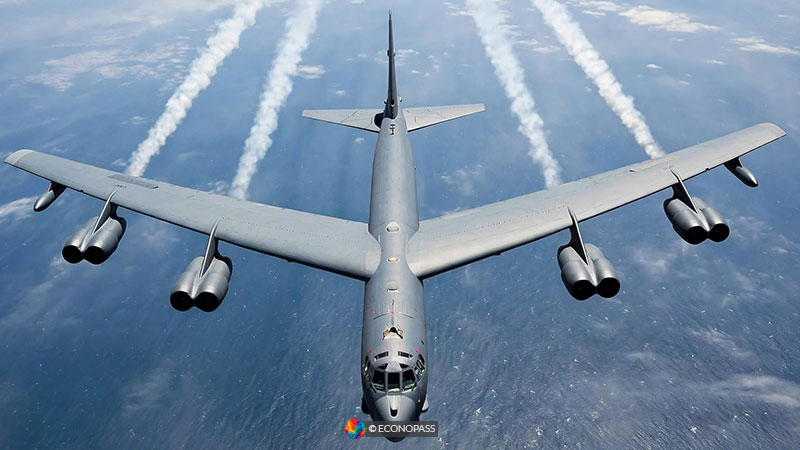
On the morning of January 17, 1966, a United States Air Force B-52G bomber was conducting a routine aerial refueling operation at approximately 31,000 feet above the southeastern coast of Spain. The refueling tanker, a KC-135, made contact with the bomber. Something went wrong. Both aircraft broke apart and fell from the sky over the village of Palomares, in the province of Almeria. Seven of the eleven crew members died. The other four survived by ejecting.
The B-52 had been carrying four B28 thermonuclear bombs. Each one had a yield estimated at 1.1 megatons, roughly seventy times the destructive power of the bomb dropped on Hiroshima. All four fell on or near Spanish territory. This was not a war. This was a Tuesday morning in peacetime.
What Landed Where
Two of the bombs landed on agricultural land near Palomares. Their conventional explosives, the non-nuclear triggers that initiate a nuclear detonation, detonated on impact. The nuclear cores did not detonate, which is the only reason southeastern Spain still exists as a populated area. But the conventional explosions scattered plutonium across approximately 2.6 square kilometres of farmland. The contamination was immediate, invisible, and significant.
A third bomb landed intact in a dry riverbed. It was recovered without incident.
The fourth bomb fell into the Mediterranean Sea. It took eighty days to find it. The United States Navy deployed thirty-three ships, submarines, and a small fleet of deep-sea research vessels to locate a single hydrogen bomb somewhere on the seafloor off the Spanish coast. It was eventually found at a depth of approximately 869 metres, tangled in its parachute, by the deep-sea submersible Alvin. The recovery operation was the largest naval search in American history to that point.
Eric Schlosser, in Command and Control, documents the Palomares incident as one of the most significant nuclear accidents of the Cold War era, notable not only for its scale but for the near-total absence of any public emergency protocol. The American military’s response was shaped less by safety planning than by improvisation and an overriding priority to prevent the word “nuclear” from appearing in Spanish newspapers.

Amazon Smart Plug
Turn any outlet smart in seconds. Schedule lights, fans, coffee makers, no hub required, works with Alexa.
View on AmazonWhat Spain Was Told
The Spanish government of Francisco Franco was an authoritarian regime with a controlled press. The United States had maintained military bases on Spanish soil since the Pact of Madrid in 1953, an arrangement that gave Franco international legitimacy and gave the United States strategic positioning during the Cold War. Neither government had any interest in a public scandal involving hydrogen bombs on Spanish farmland.
The problem was that Palomares was a village. There were witnesses. There were farmers who had seen objects fall from the sky. There were pieces of aircraft scattered across their land. The conventional explosions had been heard for kilometres. By the time American military personnel arrived on the scene, the event was already common knowledge locally.
Spanish newspapers reported the crash before any official statement had been issued by either the American or Spanish government. The Franco regime, which controlled domestic media, found itself in the position of having to respond to reporting it had not authorised on an incident it had not been officially informed about through diplomatic channels. The sequence, crash, press coverage, government acknowledgment, is not the sequence either party had planned for. Fred Kaplan, in The Bomb, traces how nuclear weapons policy during this period operated on the assumption that accidents could be contained and managed before public awareness became a factor. Palomares demonstrated the assumption’s limits.
The official American position, maintained for several days, was that no nuclear weapons had been involved. This position was eventually abandoned when it became impossible to sustain against the volume of local reporting and the visible presence of a large naval search operation just offshore.
The Cleanup That Was Not Quite a Cleanup
The United States military removed approximately 1,400 tonnes of radioactively contaminated soil and vegetation from the Palomares site and transported it to a nuclear storage facility in Aiken, South Carolina. The operation was conducted under a bilateral agreement with the Spanish government and was presented publicly as a complete remediation of the contamination.
It was not complete. Subsequent surveys conducted decades later found residual plutonium contamination at levels above internationally accepted safety thresholds in areas adjacent to the original cleanup zone. The Spanish government and the American government negotiated repeatedly over the following decades about responsibility for further remediation. As of the most recent assessments, sections of the Palomares site remain fenced and subject to ongoing monitoring.
The residents of Palomares were never formally evacuated during the contamination event. They continued farming the land during the period when American personnel in protective equipment were removing topsoil around them. Serhii Plokhy, in Nuclear Folly, examines how the management of nuclear risk during the Cold War systematically prioritised strategic and political concerns over the welfare of civilian populations who happened to be in proximity to military infrastructure. Palomares is one of the cleaner examples of that priority structure made visible.
The Ambassador Who Swam
To demonstrate that the Mediterranean waters off Palomares were safe following the recovery of the fourth bomb, the American Ambassador to Spain, Angier Biddle Duke, went swimming at a nearby beach in front of assembled press photographers. He was accompanied by the Spanish Minister of Tourism, Manuel Fraga. The photographs were widely distributed. The diplomatic gesture was considered a success.
The swimming demonstration took place approximately eighty days after four hydrogen bombs had fallen on the same stretch of coastline. The logic was not scientific. It was theatrical. And it worked, in the specific sense that it produced photographs of a smiling American ambassador in the water, which was the intended output.
The contamination question was not resolved by the swim. It is still not resolved. The village of Palomares is still there. The farmland is still partially fenced. The agreement over what the United States owes for the cleanup is still, depending on which government’s most recent statement you read, either nearly finalised or under continuing discussion.
Four hydrogen bombs fell on Spain in 1966. The Spanish government read about it in the newspaper. The sea is very blue there in January. The ambassador said so himself.
The world is stranger than anyone told you. I am just keeping count.
Marco Bellinari
Sources
- 1966 Palomares B-52 crash, Wikipedia
- Palomares, Wikipedia
- B28 nuclear bomb, Wikipedia
- DSV Alvin, Wikipedia
- Angier Biddle Duke, Wikipedia
A Note from Marco Bellinari
Thank you for reading. Every fact in this article is documented and sourced. You will find the references at the bottom if you want to dig further. I hope it surprised you at least once. That is always the intention.
I would love to hear your thoughts. Follow Econopass on social media and share your reaction hereafter as a social comment. And if you do not want to miss the next story, hit follow. There is always another forgotten truth waiting to be told.
Still Curious? Don't Stop Here!

A Costa Rican Beach Turns Completely Black at Night. What Causes It Happens Only a Few Tim...
The Longest War in History Lasted 335 Years. Not a Single Person Died.
A Pigeon Delivered a Military Message Faster Than Any Radio in World War I. It Lost a Leg ...
A Bridge in Scotland Kills Dogs. Over 600 Have Jumped From the Same Spot Since 1960. Nobod...

The Moon Is Slowly Moving Away From Earth. In About 600 Million Years Solar Eclipses Will ...
There Is a Tiny Country in the Middle of Italy That Has Its Own Army, Its Own Passport and...

The Country That Accidentally Invented Halloween Spent Centuries Trying to Kill It