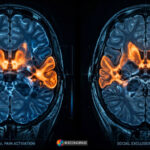
Somewhere between thirty and fifty percent of people have never felt what you feel when the right song hits at the right moment. The hairs rise on your arms. A wave moves through your chest. Something is happening in your body that has nothing to do with temperature. The people sitting next to you at the concert may be experiencing nothing at all, and they have no idea what they are missing, because the experience is not available to them the way it is to you. This is not a matter of taste or emotional sensitivity. It is a matter of how your brain is wired.
The phenomenon has a name: frisson. It comes from the French word for shudder, and researchers who study it describe it as an aesthetic chill, a psychophysiological response to music that produces goosebumps, a shiver along the spine, or a sensation of something moving through the chest. It is measurable. It is reproducible under controlled conditions. And roughly half the population does not experience it at all, which raises the obvious question of why.
What the Chill Actually Is
Frisson is a dopamine event. When music triggers it, the brain releases dopamine, the same neurotransmitter involved in pleasure, motivation, and reward. The release is not random. It tends to cluster around moments of musical anticipation and surprise: the moment before a choir enters, the beat before a key change, the resolution of a harmonic tension that has been building for several bars. The brain that is deeply engaged with music is making predictions about what comes next, and the chills arrive at the moment those predictions are confirmed, violated, or transcended in a way that feels significant.
Frisson is not caused by beautiful music. It is caused by the brain’s response to the gap between what it predicted and what it heard. The chills are the physical signature of that gap being closed in a way that registers as meaningful.
Daniel Levitin’s work in This Is Your Brain on Music documents the neuroscience of musical pleasure in detail, tracing how the auditory cortex interacts with the limbic system and the reward circuitry to produce emotional responses to sound. The book is grounded in decades of research, and one of its central arguments is that music is not a cultural ornament but a system that hijacks the brain’s deepest reward mechanisms. Frisson is one of the most visible expressions of that hijack.
Our Pick
Ring Video Doorbell
1080p HD video, motion detection, two-way talk, works with Alexa. See who is at the door from anywhere in the world.
A study published in 2017 by researchers at the University of Southern California and Oxford found a structural difference between people who experience frisson and people who do not. Those who get chills from music have a higher density of nerve fibres connecting the auditory cortex to the areas of the brain that process emotion. The connection is literally thicker. More information passes between the part of the brain that processes sound and the part that generates emotional responses. The result is a more intense coupling between what the ear hears and what the body feels.
People who experience frisson have a measurably different brain structure from those who do not. The auditory cortex is more densely connected to the emotional processing areas. The difference is physical, not a matter of sensitivity or attentiveness.
Oliver Sacks spent decades documenting the relationship between music and the nervous system, and Musicophilia is full of cases that illuminate how differently music registers in different brains. The book is primarily about neurological conditions that alter the perception of music, but its underlying argument is consistent with the frisson research: the brain’s relationship with music is not uniform, and the range of human responses to the same sounds is wider than most people assume.
Why Not Everyone Gets It
The personality research on frisson is almost as interesting as the neuroscience. People who experience chills from music consistently score higher on one dimension of the Big Five personality model: openness to experience. This trait captures curiosity, aesthetic sensitivity, imagination, and a general tendency to engage deeply with ideas and sensory experiences. It is not correlated with emotional reactivity in general. People who cry easily at films do not necessarily experience frisson. People who rarely show emotion in other contexts sometimes experience it intensely during music.
The implication is that frisson is not an index of emotional depth or sensitivity as those terms are commonly understood. It is something more specific: a capacity for deep cognitive and emotional engagement with structured sound, and a nervous system that is wired to translate that engagement into a physical response. The people who do not experience it are not less emotional. They are differently wired at the point where auditory processing meets the reward system.
Openness to experience predicts frisson more reliably than emotional sensitivity does. The chills are not a sign that someone feels more deeply than others. They are a sign of a specific kind of cognitive-emotional engagement with music that not all brains support.
Elena Mannes spent years investigating how music affects the body and brain for The Power of Music, and one of the recurring findings in her research is that the same piece of music produces radically different physiological responses in different listeners. Heart rate, skin conductance, hormone levels, and brain activity all vary substantially from person to person in response to the same stimulus. Frisson is one point on a much wider spectrum of individual variation in how sound registers in the body.
What Triggers It
The triggers for frisson are fairly consistent among people who experience it. Musical expectation plays the largest role: passages where the harmonic or rhythmic pattern sets up a strong prediction and then delivers something slightly different from what was expected. The entry of a new instrument or voice into a texture that has been established. A sudden shift in dynamic from quiet to loud, or the reverse. A melody that resolves in a way that is both surprising and, in retrospect, inevitable.
The brain is doing prediction work constantly when it listens to music, running models of where the sound is going and updating them as new information arrives. The deeper the engagement with the musical structure, the more precise those predictions become, and the more intense the response when the predictions are resolved in a way the brain registers as significant. This is why the same piece of music can produce frisson on the fiftieth listen. The brain has not become bored. It has become more precise, and the resolution registers more clearly because the prediction was more accurate.
About half the people reading this have experienced what is described here. The other half have read a description of something they cannot access and may never be able to access. That asymmetry is worth sitting with. The music is the same. The brains receiving it are not.
Now you know. The question is what you do with it. Marco Bellinari
Want to understand yourself a little better? These books will help.
Thank you for reading. Every fact in this article is documented and sourced. You will find the references at the bottom if you want to dig further. I hope it surprised you at least once. That is always the intention.
I would love to hear your thoughts. Follow Econopass on social media and share your reaction hereafter as a social comment. And if you do not want to miss the next story, hit follow. There is always another forgotten truth waiting to be told.
Disclosure: This article may contain affiliate links. This means we may earn a commission if you click on a link and make a purchase at no extra cost to you. This applies to featured Amazon products or any other Econopass's partners.
These articles and stories are free because of a few non-intrusive ads. To support us, simply turn off your ad blocker for Econopass. It takes one click on the ad blocker icon in your browser. Thank you!
We use cookies to ensure that we give you the best experience on Econopass website. If you continue to use this site we will assume that you are happy with it.