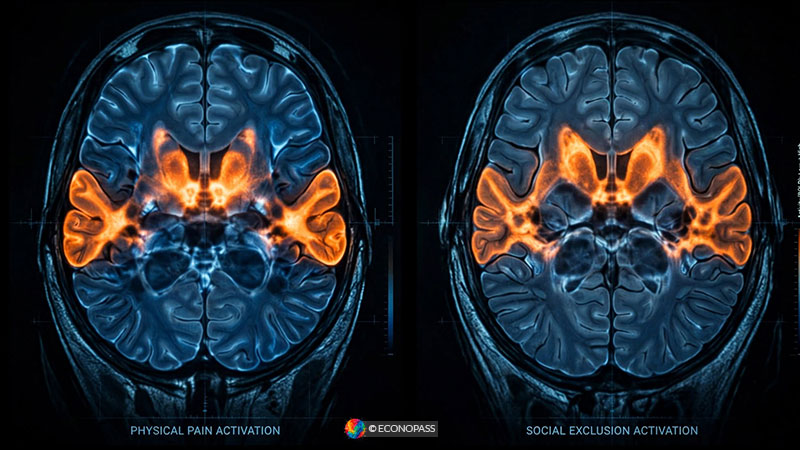
In 2003, researchers at UCLA put people inside an fMRI scanner and had them play a video game. The game was simple: three players tossed a virtual ball to one another. At some point in the game, the other two players stopped throwing the ball to the person in the scanner. They just excluded them. No explanation. No confrontation. A video game snub. The brain scans showed activity in the dorsal anterior cingulate cortex, the same region that processes the distress component of physical pain. Being left out of a video game produced measurable neural activity indistinguishable in its location from the signal produced by physical injury. The researchers were not expecting that. Neither was anyone else.
The Experiment That Confirmed It
The study was led by Naomi Eisenberger and Matthew Lieberman, published in Science in 2003. The paradigm was called Cyberball. Participants were told they were playing a virtual ball-tossing game with two other people connected via the internet. In the exclusion condition, the other two players gradually stopped including the participant. The social exclusion was trivial by any conventional measure. There were no real relationships at stake. There was no actual rejection from anything that mattered. And yet the dorsal anterior cingulate cortex, the region associated with the unpleasantness of pain rather than its location or intensity, activated consistently. The brain was treating a video game slight the same way it would treat damage to the body.
Subsequent research extended the finding. The insula, another region involved in physical pain processing, also showed overlap with social exclusion signals. The ventral prefrontal cortex, a region associated with emotional regulation, activated in inverse proportion to the dACC response, suggesting that the brain has a system for dampening social pain just as it has systems for managing physical pain. Matthew Lieberman’s Social: Why Our Brains Are Wired to Connect goes through the full architecture of what the imaging research revealed and what it implies about the evolutionary function of the social brain.
A 2003 fMRI study published in Science found that social exclusion activates the dorsal anterior cingulate cortex, the same brain region that processes the distress component of physical pain. The study used a trivial video game snub as the exclusion stimulus. The neural response was not trivial.
Our Pick
Kindle Paperwhite 2026
New 7″ flush-front aluminum design, weeks of battery, glare-free in any light. The e-reader that stays on your nightstand permanently.
The overlap is not an accident of neural architecture. It is an evolutionary solution to a survival problem. For social mammals, exclusion from the group has historically meant death. No shelter, no food sharing, no protection from predators, no reproductive access. The individual expelled from the group in a pre-modern environment faced a threat as immediate and lethal as a physical wound. The brain that treated social rejection with urgency, that generated a pain signal strong enough to demand attention and behavioral response, was the brain more likely to motivate the behavior needed to repair the social bond or find a new group. The brain that shrugged at rejection did not survive to pass on that indifference.
This is the argument that Cacioppo and Patrick develop at length in Loneliness: social connection is not a luxury the organism pursues when other needs are met. It is a primary biological need, monitored by dedicated neural systems that signal its absence the same way hunger signals the need for food. The pain of loneliness and rejection is the alarm. Dismissing it as weakness or oversensitivity is the equivalent of telling someone their hunger is irrational.
For social mammals, exclusion from the group historically meant death. The brain evolved to treat social rejection as a survival threat, generating a pain signal that demanded behavioral response. What looks like emotional oversensitivity is an evolutionary alarm system doing exactly what it was built to do.
The Tylenol Study
If social pain and physical pain share neural substrates, a reasonable question follows: can the drugs that reduce physical pain also reduce social pain? In 2010, a team led by C. Nathan DeWall ran exactly that experiment. Participants took either acetaminophen or a placebo daily for three weeks. Those taking acetaminophen reported significantly fewer hurt feelings over the course of the study. When the same Cyberball exclusion paradigm was run under fMRI at the end of the three weeks, the acetaminophen group showed reduced activity in the dACC and the insula, the same regions identified in the original Eisenberger study. Tylenol, taken daily for three weeks, measurably reduced the neural response to social exclusion. This is not an endorsement of self-medicating emotional pain with over-the-counter analgesics. It is evidence that the two pain systems are not merely analogous. They are, at least in part, the same system.
What Language Already Knew
There is a detail that neuroscientists find difficult to dismiss: language got there first. In virtually every language, the vocabulary for emotional pain is borrowed from the vocabulary for physical pain. People describe rejection as crushing, wounding, cutting, bruising, shattering. They say their feelings were hurt. They describe heartbreak. The metaphors are so embedded that they no longer read as metaphors. Lisa Feldman Barrett’s How Emotions Are Made argues that the brain does not have separate systems for physical and emotional experience that then get described in overlapping language by coincidence. The body budget that the brain manages is a unified system. The language reflects the architecture.
The word hurt is doing the same job in both sentences: my knee hurts and her words hurt me. Speakers of English did not decide on that usage by committee. It emerged because the brain the speakers were using does not cleanly separate the two experiences. The neuroscience caught up to the grammar several thousand years later.
A 2010 study found that participants who took acetaminophen daily for three weeks reported fewer hurt feelings and showed reduced activity in the dorsal anterior cingulate cortex and insula during social exclusion. The drug that blunts physical pain blunted social pain by the same neural measure. The two systems are not analogous. They are, at least in part, the same system.
What This Changes
The practical implications run in two directions. The first is personal. The instinct to minimize social pain, whether your own or someone else’s, by labeling it as irrational or disproportionate is not supported by the biology. The person who is devastated by a social slight is not catastrophizing. Their brain is running the same alarm system that runs when the body is damaged. Telling them it is not a big deal is medically equivalent to telling someone with a broken arm that bones are just calcium and they should stop overreacting.
The second direction is social. Institutions that produce chronic social exclusion, whether through ostracism, public humiliation, systematic isolation, or the engineered exclusion of certain groups from belonging, are producing measurable pain by a neurological standard. That is not a rhetorical claim. It is a description of what the imaging data shows. The pain is not metaphorical. It never was.
Now you know. The question is what you do with it. Marco Bellinari
Want to understand yourself a little better? These books will help.
Thank you for reading. Every fact in this article is documented and sourced. You will find the references at the bottom if you want to dig further. I hope it surprised you at least once. That is always the intention.
I would love to hear your thoughts. Follow Econopass on social media and share your reaction hereafter as a social comment. And if you do not want to miss the next story, hit follow. There is always another forgotten truth waiting to be told.
Disclosure: This article may contain affiliate links. This means we may earn a commission if you click on a link and make a purchase at no extra cost to you. This applies to featured Amazon products or any other Econopass's partners.
FediBack: Your Brain Treats Rejection the Same Way It Treats a Broken Bone. The Pain Is Not Metaphorical.
These articles and stories are free because of a few non-intrusive ads. To support us, simply turn off your ad blocker for Econopass. It takes one click on the ad blocker icon in your browser. Thank you!
We use cookies to ensure that we give you the best experience on Econopass website. If you continue to use this site we will assume that you are happy with it.