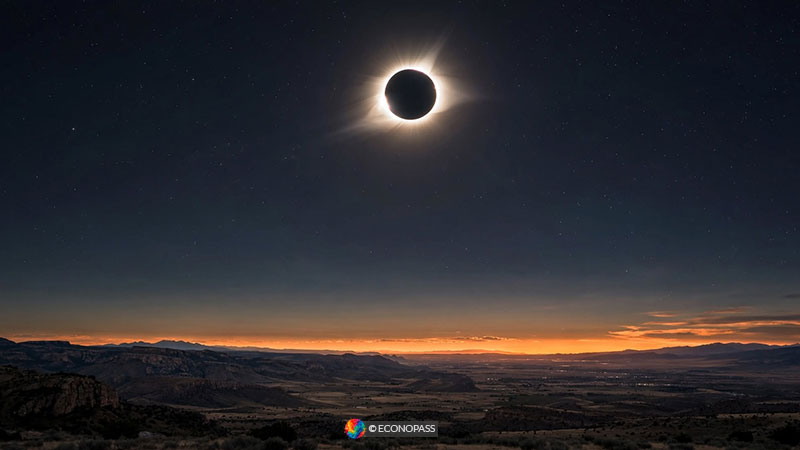
The sun is approximately 400 times larger than the moon and approximately 400 times farther away from Earth. The result of that near-perfect ratio is that when the moon passes directly between Earth and the sun, it covers it almost exactly. Not roughly. Not approximately. The disk of the moon fits over the disk of the sun with a precision that allows the sun’s outer atmosphere to become visible, that lets observers watch the corona flare in real time, and that produces a darkness in the middle of the day unlike anything else that exists in nature. It is the kind of coincidence that looks designed. It is not. It is temporary. And scientists can measure, to the centimeter, how quickly it is ending.
The Coincidence Nobody Talks About
The alignment works because two numbers happen to cancel: the sun is roughly 400 times the diameter of the moon, and it sits roughly 400 times farther away. The result is that both objects subtend approximately 0.5 degrees of arc as seen from Earth’s surface. No other planet in the solar system has a moon in this relationship with its star. Mars has two small moons, neither capable of producing totality. Jupiter and Saturn have large moons but orbit as gas giants without solid surfaces from which to observe an eclipse of their sun. Earth happens to have one large moon at one specific distance, and that distance places us in a window. That window is open right now. It was not open in the same way before, and it will not remain open forever.
The sun is approximately 400 times larger in diameter than the moon. It is also approximately 400 times farther from Earth. The angular sizes these two objects present from Earth’s surface are therefore nearly identical. This coincidence is geometrically unique among the planets of the solar system and is not a permanent feature of Earth’s sky.
We Know Exactly How Fast It Is Leaving
Retroreflectors placed on the lunar surface by Apollo astronauts in 1969 have allowed scientists to measure the Earth-moon distance with extraordinary precision. A pulse of laser light fired from Earth bounces off the reflector and returns. The round-trip travel time converts directly to distance. The data collected over more than five decades shows that the moon is receding from Earth at an average rate of approximately 3.8 centimeters per year. The mechanism is tidal friction: Earth’s rotation drags tidal bulges slightly ahead of the moon’s position in its orbit, and the gravitational interaction between those bulges and the moon transfers angular momentum outward, pushing the moon into a slightly wider path each year.
As Oliver Morton details in The Moon: A History for the Future, the moon was once dramatically closer. Approximately 1.4 billion years ago, a day on Earth lasted around 18 hours because the planet was spinning faster and the moon’s tidal forces were stronger. The current arrangement, in which tides are moderate and the moon’s apparent diameter matches the sun’s closely enough to produce totality, is a specific chapter in Earth’s geological biography. Before this chapter, the moon was too large in the sky and eclipses covered the corona too deeply for the geometry to function the same way. After this chapter, the moon will be too small and total eclipses will become physically impossible.
What a Total Solar Eclipse Actually Shows
The solar corona is the sun’s outer atmosphere. It extends millions of kilometers into space and reaches temperatures of one to three million degrees Celsius. The sun’s visible surface, the photosphere, is approximately 5,800 degrees. Why the outer layer is dramatically hotter than the surface it surrounds is a question solar physicists have not fully resolved, and it remains an active area of research. Under ordinary conditions, the corona is invisible: the photosphere is billions of times brighter and overwhelms it completely. During totality, with the photosphere blocked, the corona appears to the naked eye as a pale, structured halo shaped by the sun’s magnetic field.
In 1919, Arthur Eddington led an expedition to observe a total solar eclipse with a specific scientific objective: to measure the deflection of starlight passing close to the solar limb. General relativity predicted that the sun’s gravity would bend the path of light by a measurable amount. Newtonian mechanics predicted a different, smaller amount. The measurement was only possible during totality, when the moon’s disk had covered the photosphere precisely enough that stars near the edge of the sun became visible. Eddington’s result matched Einstein’s prediction. It was the first experimental confirmation of general relativity. David Baron’s American Eclipse reconstructs the culture of eclipse expeditions, the scientists who organized their careers around those few minutes of shadow, and what the science of totality has produced over the past two centuries.
Arthur Eddington’s 1919 measurement of starlight deflection near the solar limb during a total eclipse provided the first observational confirmation of general relativity. The experiment required the moon’s disk to cover the photosphere while leaving the adjacent sky accessible. That geometric coincidence is a product of the moon’s current distance from Earth, and it expires in approximately 600 million years.
The Window Is Closing
In approximately 600 million years, the moon’s apparent angular diameter will have shrunk below the sun’s. From that point forward, the moon will no longer be capable of covering the solar disk completely. The eclipses that result will be annular: the moon’s disk centered on the sun but smaller, leaving a bright ring of photosphere visible around the edge. Annular eclipses already occur today whenever the moon is near apogee, the farthest point of its elliptical orbit, where its apparent size is slightly smaller than the sun’s. The ring of light they produce is visually striking. It is not totality. The photosphere remains visible. The corona stays hidden. The stars near the solar limb remain inaccessible.
Annular eclipses already occur today when the moon is at apogee and its apparent size falls slightly below the sun’s. In roughly 600 million years, the moon will be far enough that no eclipse can ever produce totality again. The corona will become permanently invisible to any observer on Earth’s surface. The transition is already underway at 3.8 centimeters per year.
What this means in practical terms is that the observation Eddington performed in 1919 becomes impossible. The corona research conducted during every total eclipse of the past two centuries becomes impossible. The phenomenon of standing inside a shadow cast by a rock 384,000 kilometers away and watching the sun’s outer atmosphere appear around it becomes impossible. Not because the physics changes. Because the geometry shifts by 3.8 centimeters per year until the margin is gone.
What Comes Before the End
The transition will not be abrupt. The ratio of total to annular eclipses will shift gradually as the moon recedes. The path of totality, already narrow at roughly 160 to 270 kilometers wide, will narrow further as the moon’s disk shrinks toward the sun’s apparent size. Eventually, even observers positioned directly on the centerline of a central eclipse will see only an annular ring. The number of people on Earth who will ever stand in totality in any given century will fall, then reach zero permanently.
Katie Mack’s The End of Everything (Astrophysically Speaking) covers the full spectrum of cosmic endings, from the geologically near-term to the unimaginably distant. The end of total solar eclipses does not rank among the more dramatic conclusions on that list. But it is among the soonest. Six hundred million years is a long time by human standards. It is a modest interval by geological ones. The Earth is 4.5 billion years old. The window in which the moon’s apparent size matches the sun’s closely enough to produce totality occupies a fraction of that span. The fraction that includes this moment. This particular arrangement of rock and shadow, which made Eddington’s measurement possible and which still produces that specific darkness in the middle of the day, is already in the process of ending. It is ending at 3.8 centimeters per year. Slowly enough that most people never think to notice. Not slowly enough that it does not end.
The world is stranger than anyone told you. I am just keeping count. Marco Bellinari
Think that was strange? These books will finish the job.
Thank you for reading. Every fact in this article is documented and sourced. You will find the references at the bottom if you want to dig further. I hope it surprised you at least once. That is always the intention.
I would love to hear your thoughts. Follow Econopass on social media and share your reaction hereafter as a social comment. And if you do not want to miss the next story, hit follow. There is always another forgotten truth waiting to be told.
Disclosure: This article may contain affiliate links. This means we may earn a commission if you click on a link and make a purchase at no extra cost to you. This applies to featured Amazon products or any other Econopass's partners.
FediBack: The Moon Is Slowly Moving Away From Earth. In About 600 Million Years Solar Eclipses Will No Longer Be Possible.
🟢 The moon fits over the sun almost perfectly right now. In 600 million years it won't anymore. Does knowing we're in a unique window change how you'd feel watching a total eclipse?
🟢 The moon fits over the sun almost perfectly right now. In 600 million years it won't anymore. Does knowing we're in a unique window change how you'd feel watching a total eclipse?
🟢 The moon fits over the sun almost perfectly right now. In 600 million years it won't anymore. Does knowing we're in a unique window change how you'd feel watching a total eclipse?
These articles and stories are free because of a few non-intrusive ads. To support us, simply turn off your ad blocker for Econopass. It takes one click on the ad blocker icon in your browser. Thank you!
We use cookies to ensure that we give you the best experience on Econopass website. If you continue to use this site we will assume that you are happy with it.