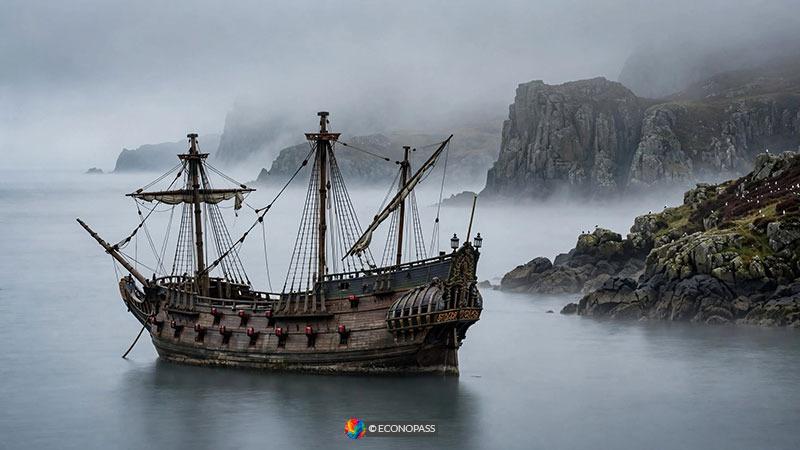
In 1986, a Dutch ambassador travelled to a small archipelago off the coast of Cornwall to sign a peace treaty ending a war that had begun in 1651. The war had lasted three hundred and thirty-five years. Not one person had died in it. Not one shot had been fired. The conflict had simply been forgotten, sitting on the record books as a live declaration of hostilities between the Dutch Republic and eight square miles of island off the southwestern tip of England, until a local historian thought to ask whether the Dutch were still technically their enemies.
The answer, it turned out, was yes. Technically. And so the Dutch ambassador came to the Isles of Scilly, signed a peace declaration, and ended the longest war in recorded history. The islanders reportedly joked that they could sleep easier now. The Dutch had presumably forgotten they were at war with anyone at all.
How a War Starts Without Anyone Firing a Shot
The year is 1651. The English Civil War has effectively ended. The Royalist cause has collapsed on the mainland, and what remains of the Royalist fleet has retreated to the one place still available to it: the Isles of Scilly, a cluster of small islands in the Atlantic with deep harbours and enough distance from the mainland to be defensible. The Dutch Republic has been allied with the Parliamentarians, the winning side. This matters because the Royalist fleet, now operating from Scilly, has spent the preceding months attacking Dutch merchant shipping as a form of revenue generation. The Dutch have lost ships. They want compensation.
The Dutch admiral Maarten Tromp sailed to the Isles of Scilly in March 1651 and demanded reparations from the Royalist commander for the losses inflicted on Dutch shipping. The Royalists declined. Tromp, having no other diplomatic instrument available, declared war on the Isles of Scilly on behalf of the Dutch Republic. Then, with the Royalist cause collapsing around him and no realistic prospect of a battle that would resolve anything, he sailed away. The Royalists surrendered to Parliamentary forces a few months later. The Dutch, having made their point and recovered the political situation on the mainland, never bothered to formally end the conflict with eight islands that no longer had an army or a functioning government to fight them.
A war requires two parties capable of fighting. When the Royalist fleet surrendered to Parliament in 1651, the Isles of Scilly lost both their army and their government. The Dutch declaration of war remained on the record because nobody thought to cancel it. There was nobody left to cancel it with.
Our Pick
Apple AirPods Pro 3
2× better noise cancellation, heart rate sensing, Live Translation, and 10 hours battery. The earbuds most people end up choosing.
The fact that the 335 Years’ War existed at all is not particularly surprising once you understand how formal declarations of war work. A declaration is a legal instrument. It does not expire on its own. It requires an explicit act of termination, either a peace treaty, a surrender, or a formal cessation agreement, to cease being legally operative. Without that act, the state of war technically continues, regardless of whether anyone is actively fighting or even aware that they are supposed to be enemies.
What is more interesting is how thoroughly this particular conflict disappeared from awareness. James Loewen’s examination of what gets omitted from historical education in Lies My Teacher Told Me applies as much to the edges of European diplomatic history as it does to the American curriculum he focuses on. The wars and conflicts that make it into the record are the ones with battles, casualties, and resolutions that fit the shape of a story. A non-war between a major naval power and a cluster of Atlantic islands, ending in mutual silence rather than a treaty, fits no story shape at all. It was not forgotten because it was unimportant. It was forgotten because it had no ending.
Historical memory is shaped by narrative. A war with no battles, no casualties, and no conclusion does not fit the template. The 335 Years’ War vanished from the record not because it was trivial but because it had no story arc anyone could follow.
What a 335-Year War Actually Looks Like
From 1651 to 1986, the state of war between the Dutch Republic and the Isles of Scilly had precisely no effect on anything. The Netherlands and England were sometimes allies, sometimes rivals, and sometimes at actual war with each other during those three centuries, but the Scilly conflict ran beneath all of it, unnoticed and irrelevant. Trade continued. People moved between the islands and the mainland. Dutch vessels passed through the waters around Scilly without incident. The declaration sat in whatever archive held the diplomatic records of the seventeenth-century Dutch Republic, unread and unacted upon.
The category of things that exist on paper but have no connection to reality is larger than most people assume. John Lloyd and John Mitchinson built an entire book around this principle: The Book of General Ignorance documents case after case of facts that are accepted as true, arrangements that are assumed to be current, and situations that everyone believes have been resolved when in fact they remain technically open. The 335 Years’ War is an extreme example, but it is an example of a pattern, not an anomaly.
The Peace That Nobody Knew Was Needed
The resolution came in 1986 when Roy Duncan, a historian and the chairman of the Council of the Isles of Scilly, wrote to the Dutch embassy in London to enquire whether the two parties were still technically at war. The question was treated as a curiosity rather than a crisis, which was the appropriate response. The Dutch ambassador Rein Huydecoper visited the islands on April 17, 1986, and signed a peace declaration alongside the island’s officials. Three hundred and thirty-five years after Tromp sailed away from Scilly without firing a shot, the war was over.
Huydecoper reportedly joked that it must have been terrifying for the Scillonians, living under the threat of Dutch invasion for all those centuries. The islanders, for their part, noted that it was probably the friendliest war in recorded history. Charles Mackay’s study of collective human behaviour in Extraordinary Popular Delusions and the Madness of Crowds is largely about the ways in which groups of people maintain beliefs and practices long after any rational basis for them has dissolved. The 335 Years’ War is a different kind of case, but it illustrates the same principle: institutional inertia is powerful enough to keep a war alive for three and a half centuries without anyone noticing.
The war ended not because anyone decided it should end, but because one historian thought to ask whether it already had. The answer was no. The peace took one afternoon. The war had taken three hundred and thirty-five years.
The Isles of Scilly have a population of around two thousand people. They have no standing army. They are, by most measures, among the least threatening entities in the history of European geopolitics. The Dutch Republic, which became the Kingdom of the Netherlands, is a country with a long history of serious military and diplomatic engagement across the world. The fact that these two parties were technically at war for longer than the United States has existed as a country is not a footnote. It is a precise illustration of how the machinery of formal conflict outlasts the conflict itself, and how the records we trust to tell us what is happening can quietly stop reflecting reality without anyone being the wiser.
The world is stranger than anyone told you. I am just keeping count. Marco Bellinari
Think that was strange? These books will finish the job.
Thank you for reading. Every fact in this article is documented and sourced. You will find the references at the bottom if you want to dig further. I hope it surprised you at least once. That is always the intention.
I would love to hear your thoughts. Follow Econopass on social media and share your reaction hereafter as a social comment. And if you do not want to miss the next story, hit follow. There is always another forgotten truth waiting to be told.
Disclosure: This article may contain affiliate links. This means we may earn a commission if you click on a link and make a purchase at no extra cost to you. This applies to featured Amazon products or any other Econopass's partners.
These articles and stories are free because of a few non-intrusive ads. To support us, simply turn off your ad blocker for Econopass. It takes one click on the ad blocker icon in your browser. Thank you!
We use cookies to ensure that we give you the best experience on Econopass website. If you continue to use this site we will assume that you are happy with it.