
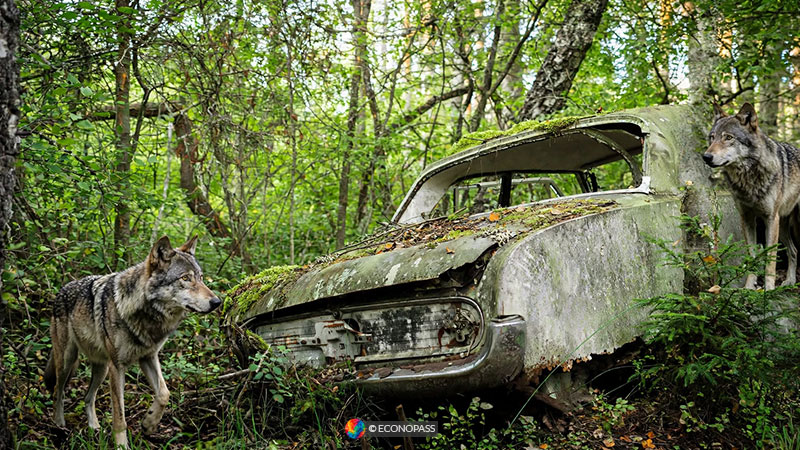
The city of Pripyat was evacuated on April 27, 1986, the day after reactor four at the Chernobyl Nuclear Power Plant exploded. Roughly fifty thousand people left within hours. They were told to take documents and enough clothes for three days. Most never returned. The apartment blocks, the schools, the amusement park with its Ferris wheel that had never completed a single operating day, all of it was left exactly as it was. Within months, the trees began to move in. Within years, the animals followed. Forty years later, the Chernobyl Exclusion Zone is one of the most biodiverse regions in Europe, home to populations of wolves, brown bears, lynx, and Przewalski’s horses that have not been seen in the surrounding territory for generations. The radiation did not do this. The absence of humans did.
The Chernobyl Exclusion Zone covers approximately 2,600 square kilometres straddling the border of Ukraine and Belarus. It is one of the most studied ecosystems on Earth, for reasons that have nothing to do with wildlife. The initial scientific attention was directed at radiation levels, human health effects, and the long-term behaviour of radioactive isotopes in soil and water. The wildlife came later, and when it did, what researchers found forced a reassessment of assumptions that had been treated as settled science.
What the Evacuation Actually Created
The exclusion zone is not a nature reserve in any formal sense. It was not managed, planted, or curated. The Soviet authorities who established the thirty-kilometre cordon around the plant were not thinking about ecological corridors or predator reintroduction. They were managing a nuclear disaster. What they inadvertently created was one of the largest no-go zones for human activity in Europe, and what that produced, over the following decades, was a demonstration of what European landscapes looked like before intensive agriculture, roads, hunting, and urban development compressed and fragmented the habitat into the margins where wildlife currently survives.
Brown bears had been functionally absent from Ukraine outside protected areas for decades before the disaster. They are now documented regularly in the exclusion zone. Eurasian lynx, also absent from the region’s broader landscape, have established a resident population. Beavers have dammed the rivers that run through the zone. Wild boar, elk, and roe deer are present in numbers that support the predator populations that have moved in to hunt them. Mary Mycio, who documented the zone’s ecological transformation in Wormwood Forest, walked and observed across the exclusion zone over multiple years and found a landscape that had reorganised itself around the absence of the species that had previously dominated it: people.
Brown bears, Eurasian lynx, and populations of large ungulates have established themselves in the Chernobyl Exclusion Zone in the decades since evacuation. None of these were reintroduced. They moved in because the humans moved out and did not come back.

Apple AirPods Pro 3
2× better noise cancellation, heart rate sensing, Live Translation, and 10 hours battery. The earbuds most people end up choosing.
View on AmazonThe Wolf Density Finding
In 2015, a study published in Current Biology by Tatiana Deryabina and colleagues presented data on large mammal populations in the exclusion zone that generated significant attention in the ecological community. The researchers compared population densities of elk, roe deer, wild boar, and wolves in the Chernobyl zone with those in four uncontaminated nature reserves in the surrounding region. The mammal populations in the exclusion zone were, by the study’s findings, comparable to or higher than those in the protected reserves. Wolf density in the Chernobyl zone was estimated at roughly seven times higher than in the surrounding uncontaminated reserves.
The interpretation the study offered was direct: the negative effects of radiation on wildlife populations were being outweighed by the positive effects of removing human pressure. Hunting, habitat fragmentation, agricultural encroachment, road mortality, and the general displacement effect of human settlement were suppressing populations in the surrounding landscape more severely than radiation was suppressing them inside the zone. The exclusion zone had become, inadvertently, a refuge.
Wolf density in the Chernobyl Exclusion Zone is estimated at roughly seven times higher than in surrounding uncontaminated nature reserves. The radiation is not the variable explaining this. The absence of human activity is.
What the Science Actually Argues About
The picture is not uncomplicated. A separate body of research, conducted primarily by Timothy Mousseau of the University of South Carolina and Anders Moller, has found measurable negative effects of radiation on wildlife in areas of highest contamination within the zone. Their work, conducted over many years and covering birds, insects, and small mammals, documents reduced population density, elevated rates of mutation, and shortened lifespans in species living closest to the most contaminated areas. The scientific literature on Chernobyl wildlife is not a consensus; it is an ongoing argument between researchers who find the effects of radiation to be serious and those who find the effects of human removal to be more significant.
What is not disputed is the presence of large mammals at population levels that would not exist if the zone were inhabited. The argument is about mechanism and about which effects dominate at which radiation levels. George Monbiot’s examination of rewilding science in Feral addresses exactly this kind of case: what happens when a landscape is left alone, and whether the result can be described as recovery or as something more complicated than that word implies. The exclusion zone does not fit a simple before-and-after narrative. It fits the more useful and more accurate observation that the worst thing wildlife in Europe has faced for centuries has not been industrial pollution but the relentless expansion of human land use into every available space.
The Horses Nobody Planned For
In 1998, a Ukrainian nature management organisation released a small herd of Przewalski’s horses into the exclusion zone. The species had been extinct in the wild since the 1960s, surviving only in captivity. The exclusion zone, uninhabited and largely ungrazed, offered an opportunity to establish a free-ranging population with no predator management, no feeding programme, and no veterinary intervention. The original herd of thirty-one horses was released and then left alone.
By the early 2020s, the population had grown to more than two hundred animals. They are not strictly wild in the genetic sense that the original steppe horses were wild, but they are free-ranging, self-sustaining, and living without human management in a landscape that provides everything they need. Camera traps and aerial surveys have documented them across large sections of the zone, grazing in the meadows that have replaced the agricultural fields that were cultivated before 1986. The exclusion zone was not designed as a rewilding experiment. It became one anyway.
Przewalski’s horses, extinct in the wild since the 1960s, were released into the Chernobyl zone in 1998. By the early 2020s the population had grown to over two hundred free-ranging animals with no management, no supplemental feeding, and no veterinary programme. The zone provided what they needed.
What the Zone Is Now
Before the Russian invasion of Ukraine disrupted access, tours to the Chernobyl Exclusion Zone had become a significant industry, operating daily from Kyiv and carrying thousands of visitors per year to Pripyat and the plant site. The HBO dramatisation of the disaster in 2019 produced a measurable surge in booking enquiries. Visitors came for the urban decay, the preserved Soviet architecture, and the documentation of nuclear catastrophe. Many left having seen something they had not expected: a functioning, dense, and apparently thriving ecosystem growing through and around the ruins of the city that was left behind.
Elizabeth Kolbert’s survey of species loss in The Sixth Extinction makes the argument, supported across multiple case studies and continents, that the defining driver of extinction in the modern era is habitat destruction caused by human activity. The Chernobyl zone is not a refutation of that argument. It is an illustration of the inverse: when human activity is removed from a landscape, even a landscape contaminated by the worst civilian nuclear disaster in history, the ecological response is recovery at a pace that surprises the researchers studying it. The animals did not need the zone to be clean. They needed it to be empty.
Not the highlights reel. Not the itinerary. Just what actually happened.
Simon De Lafronde
Sources
- Abundance of wildlife in Chernobyl, Deryabina et al., Current Biology 2015
- Long-term census data reveal abundant wildlife populations at Chernobyl, Deryabina et al., Scientific Reports 2016
- Wildlife thriving around Chernobyl nuclear plant, BBC Science
- Chernobyl Has Become a Wildlife Haven, National Geographic
- Przewalski’s Horse, IUCN Red List
A Note from Simon de Lafronde
The advice and information in this article come from my experience and research. It’s intended to support your reading with evidence-based insights. If the article is covering wellness or any other health topics, this is not professional advice. Please consult appropriate professionals for your specific situation.
📖 Read MoreStill Curious? Don't Stop Here!
The Aral Sea Was the Fourth Largest Lake in the World. You Can Now Walk to the Rusting Shi...

She Tipped Generously at Every Stop in Japan. Every Single Person Looked Uncomfortable. No...

They Posed Naked on a Sacred Mountain in Malaysia. Three Days Later, an Earthquake Killed ...

She Asked for the Pyramids. The Driver Had Other Plans.

He Accepted a Drink from a Stranger at a Rooftop Bar in Bogota. He Woke Up in His Hotel Ro...

She Booked a Bali Villa Online. The Real Owner Showed Up on Day Three and Asked Her to Lea...
He Fell into a Geyser at Yellowstone While Walking Off-Trail. The Water Was 93 Degrees. Hi...