

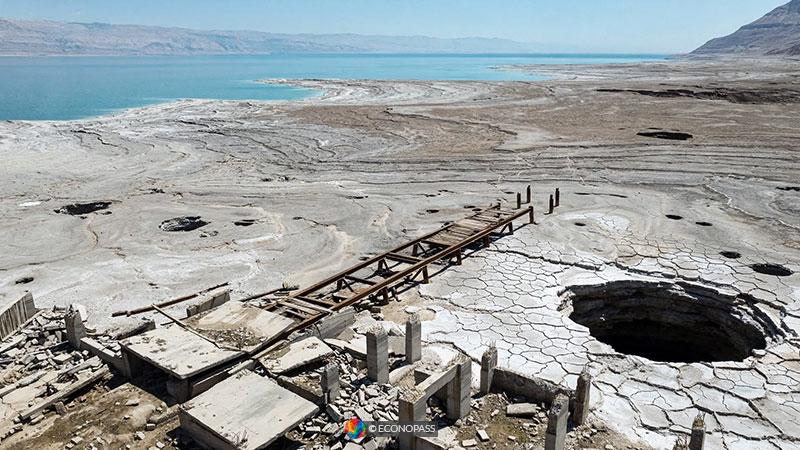
The jetties at Ein Gedi once extended into the Dead Sea. They no longer reach the water. The sea has retreated so far from its old shoreline that the jetties now end above dry, cracked ground, pointing at nothing. The changing rooms, the walkways, the beach infrastructure: all of it was closed years ago. Not because the resort failed. Because sinkholes opened under the access road and swallowed it.
The Dead Sea is losing approximately one metre of surface elevation every year. It has been doing this for decades. The shoreline has retreated by more than three kilometres in some sections since the 1960s. What was once the lowest body of water on Earth is becoming smaller, saltier, and surrounded by increasingly unstable ground.
What the Shoreline Looks Like Now
Visitors who arrive expecting the classic images, the ones where people float effortlessly in blue water while reading newspapers, often need to walk considerably further than they anticipated. The former shoreline is now a wide expanse of white salt flats, mineral deposits left behind as the water receded. It is photogenic in a stark way. It is also riddled with holes.
The sinkholes along the Dead Sea’s Israeli and Jordanian shores now number in the thousands. Most open suddenly, without warning, within seconds. Some are small enough to step over. Others are large enough to swallow a vehicle. The ground beneath the former shoreline is, in places, structurally unreliable in ways that are not visible from the surface.
The mechanism is straightforward once you understand the geology. As the Dead Sea recedes, it leaves behind thick layers of salt deposited on the former lakebed. Freshwater from underground aquifers then seeps into this newly exposed ground and dissolves the salt layers from beneath. The dissolution creates cavities. The cavities collapse without warning. The resulting holes can appear anywhere along a stretch of several kilometres, and their location cannot be predicted in advance.
Warning signs have been erected along sections of the former beach. Fences mark areas where access is prohibited. In several locations, the signs themselves have shifted as the ground moved beneath them.

Anker PowerCore 10,000mAh
Charges an iPhone 3× over. Dual USB-C ports, pocket-sized, no cables needed at the airport.
View on AmazonWhere the Water Went
The Dead Sea has no outflow. It has always been a terminal lake, fed primarily by the Jordan River, which carries water from the Sea of Galilee southward through one of the most politically contested river valleys on Earth. The water level has historically been maintained by the balance between inflow and evaporation in the extreme desert heat.
That balance no longer exists. Israel, Jordan, and Syria collectively divert more than ninety percent of the Jordan River’s natural flow before it reaches the Dead Sea. What remains when it arrives, in years when anything arrives at all, is a reduced stream heavily affected by agricultural runoff and treated wastewater discharge. Fred Pearce, in When the Rivers Run Dry, documents how the river that once sustained the Dead Sea has been reduced, in sections, to a trickle of polluted water flowing through a landscape of irrigation channels and diversion infrastructure.
The northern basin of the Dead Sea is what remains of the historical lake. The southern basin, which appears in many photographs and maps as part of the same body of water, is largely a managed industrial evaporation pond. Israel’s Dead Sea Works and Jordan’s Arab Potash Company operate large-scale potash extraction facilities there, using the southern basin’s water for mineral processing. The evaporation from these industrial operations accelerates water loss further. The two basins are connected by a canal that pumps water southward from the northern to the southern section.
Steven Solomon, in Water: The Epic Struggle for Wealth, Power, and Civilization, traces how the allocation of the Jordan River’s water became embedded in the political agreements between Israel and Jordan, and how those allocations, designed for populations and agricultural demands of the mid-twentieth century, now govern a river that can barely sustain them. The Dead Sea’s recession is, in part, a consequence of agreements made before anyone calculated what the cumulative effect on the lake would be.
What Has Already Been Swallowed
Ein Gedi beach was one of the main public swimming areas on the Israeli side of the Dead Sea. It operated for decades, drawing visitors who came to float in the hyper-saline water and use the facilities. Access was eventually closed due to sinkhole formation along the approach. The infrastructure remains, visible from a distance: the building, the former walkways, the corroded jetties extending over dry ground. Getting to the water from that location now requires crossing several hundred metres of cracked salt flat on foot, through terrain that is not uniformly stable.
Roads along the Israeli shore have required repeated rerouting as sinkholes opened under or beside them. The highway that runs along the western shore has been affected in multiple sections. In Jordan, agricultural land that once extended to the former shoreline has been abandoned as the sinkhole risk made cultivation impractical. Date palm plantations, which require consistent access to their irrigation infrastructure, have been left as the ground beneath them became unreliable.
Charles Fishman, in The Big Thirst, describes the broader pattern of which the Dead Sea is one of the most visible examples: water bodies that have been treated as inexhaustible are exhausting. The Aral Sea in Central Asia. Lake Chad in sub-Saharan Africa. The Dead Sea in the Jordan Valley. Each shrinking at a rate that was documented and measured and then, for decades, not acted upon.
The Proposed Solution
A canal connecting the Red Sea to the Dead Sea has been under discussion for years. The plan would pipe water from the Red Sea southward through Jordan to the Dead Sea, replenishing the northern basin and generating hydroelectric power along the elevation drop. It would also produce desalinated water as a byproduct, which Jordan needs badly.
Environmental assessments have raised concerns. Red Sea water introduced into the Dead Sea would bring different mineral compositions and potentially different microbial life. The effects on the Dead Sea’s existing chemistry, which supports the specific halophilic bacteria that give the lake its distinctive properties, are not fully understood. A feasibility study completed in 2013 found the project viable but recommended further environmental review. As of the most recent assessments, the canal has not been built.
The jetties at Ein Gedi are still there. The sea is not.
Not the highlights reel. Not the itinerary. Just what actually happened.
Simon De Lafronde


Sources
- Dead Sea, Wikipedia
- Dead Sea sinkholes, Wikipedia
- Jordan River, Wikipedia
- Red Sea-Dead Sea Canal, Wikipedia
- Dead Sea Declining at Rapid Pace, IUCN

A Note from Simon de Lafronde
The advice and information in this article come from my experience and research. It’s intended to support your reading with evidence-based insights. If the article is covering wellness or any other health topics, this is not professional advice. Please consult appropriate professionals for your specific situation.
📖 Read MoreStill Curious? Don't Stop Here!
Petra Was Not Lost. The Local Bedouin Knew Exactly Where It Was. The West Simply Had Not A...
They Hired a Local Guide in the Amazon. He Left Camp Before Dawn on Day Two. They Did Not ...

The Backpack Was Switched at the Bangkok Airport. He Did Not Notice Until the Customs Dog ...

Chernobyl Has More Wildlife Now Than Before the Disaster. Removing the Humans Was the Best...
The Aral Sea Was the Fourth Largest Lake in the World. You Can Now Walk to the Rusting Shi...

She Tipped Generously at Every Stop in Japan. Every Single Person Looked Uncomfortable. No...
They Posed Naked on a Sacred Mountain in Malaysia. Three Days Later, an Earthquake Killed ...