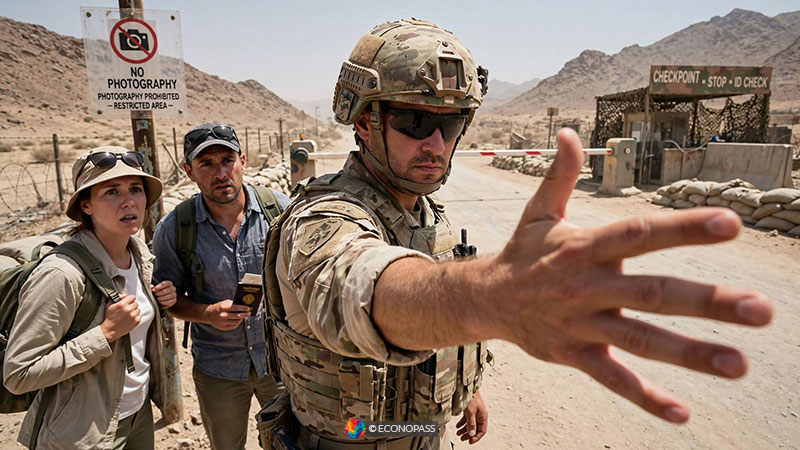
The sign was there. It had been fixed to a metal post at the edge of the checkpoint zone for years, its text printed in two languages, standard issue, unremarkable. The tourists who raised their cameras did not read it. Or they read it and assumed it did not apply to them, which produces the same result. The soldiers who approached were professionally courteous. The confiscation of the camera was immediate. The nine hours that followed were not in any itinerary.
This is not an unusual story. Variations of it are filed with foreign ministries and consular offices every year. The countries involved change. The checkpoints change. The duration of detention changes. The fundamental sequence does not: a traveler with a camera, a sign they did not register, and a legal situation they were entirely unprepared for.
The Sign Was There
Photography restrictions at military installations, border crossings, government infrastructure, and strategic sites are not unusual legal provisions. They exist across dozens of jurisdictions, from the Gulf states to Central Asia to parts of Africa and Southeast Asia. In many of these places, the prohibition extends beyond the installation itself to a defined perimeter that is not always obvious to the untrained eye. A checkpoint on a public road. A bridge with a guard post at one end. A communications tower visible from a tourist viewpoint. The legal restriction does not require the site to look restricted.
What most travelers do not understand is that posted notices at these locations carry legal weight. They are not advisory. A no-photography sign at a military checkpoint in Egypt, the UAE, or Morocco is a statement of law, not a preference. Reading it and proceeding anyway is a violation. Not reading it is not a defense.
Rick Steves, in Travel as a Political Act, argues that the most dangerous assumption a traveler can make is that the world beyond their own border operates by the same norms and expectations they carry from home. The assumption that a camera is a neutral object, that photographing what is visible is always permissible, that posted signs are suggestions rather than legal notices: these are home-country assumptions transported into jurisdictions where they have no standing. The sign was there. The assumption was what failed.

Amazon Echo Dot 5th Gen
Improved bass, temperature sensor, tap-to-snooze, and Alexa everywhere. The most-rated smart speaker on Amazon for good reason.
View on AmazonWhat the Law Actually Says
Egypt’s Law 394 of 1954 prohibits photographing military establishments, bridges, railway stations, ports, and other designated strategic locations. Enforcement is inconsistent, which is part of the problem: years of uneventful photography in a given area can produce a false baseline. The law has not changed. The enforcement decision on any given day belongs to whoever is present.
The UAE’s Federal Law No. 3 of 1987 restricts photography of government buildings, royal palaces, military installations, and certain public facilities. Multiple documented cases of tourist detention exist, most involving a checkpoint or government building photographed from a vehicle or on foot, in full public view, with no apparent awareness that the act was legally problematic. Morocco, Jordan, China, and several Central Asian republics operate under similar frameworks.
The common feature is not the restriction itself, which is straightforward, but the gap between what is legally prohibited and what tourists assume is acceptable because it is visible and in public space. Visibility does not equal permission. This is a distinction that costs some travelers several hours of their itinerary and others considerably more.
Tim Marshall, in Prisoners of Geography, traces the military and strategic logic behind the locations that states choose to protect, and why the sensitivity of a checkpoint, a bridge, or a mountain pass is often invisible to the outsider who sees only scenery. A border crossing in a mountain range is a natural choke point that armies have contested for centuries. The checkpoint there is not arbitrary bureaucracy. It reflects a logic the traveler arriving by tour bus has no context to read. What looks like a photogenic scene of uniforms and mountains is, from another perspective, a militarily significant installation that the host government has very specific feelings about being documented.
Nine Hours: What Checkpoint Detention Actually Involves
Detention at a military checkpoint for photography is not, in most documented cases, a criminal proceeding in the formal sense. It is an administrative hold. The soldiers or border officials involved are waiting for authorisation from someone above them to release the travelers, and that authorisation moves at the pace of military bureaucracy rather than tourist itineraries.
The camera or device is examined. In some cases the images are deleted on-site. In others the memory card is retained. The travelers are asked to wait, usually in a vehicle or a designated holding area adjacent to the checkpoint. Consular notification is technically the right of any detained foreign national but in practice is often delayed, inconsistently applied, or contingent on the traveler knowing to ask for it and having the embassy number available. Most do not.
The nine hours in this account is not an outlier. It is roughly consistent with documented cases across multiple jurisdictions. The release, when it comes, is typically unconditional: the travelers are free to continue, without charge, without formal documentation of the incident, and without any record accessible to them. The camera may or may not be returned. The images are almost certainly gone.
Rory Stewart, in The Places in Between, describes crossing Afghanistan on foot in 2002, navigating checkpoints staffed by local commanders and soldiers of uncertain affiliation, each with their own interpretation of who was permitted to pass and under what conditions. The specific geography is extreme. The underlying dynamic is not: at a checkpoint, the person with the uniform holds all procedural authority, and the traveler’s assumptions about their own rights, their innocence, and the speed at which the situation should resolve are entirely irrelevant to how it actually proceeds. Time at a checkpoint runs on a different clock.
What to Check Before You Raise a Camera
Foreign ministry travel advisories for most destinations include photography restrictions as a standard advisory item. They are rarely read in full. The UK Foreign, Commonwealth and Development Office, the US State Department, and their equivalents in most Western countries publish destination-specific guidance that explicitly names categories of location where photography is prohibited. The advisory is updated when incidents are reported. It is available before departure. It is almost never consulted at the checkpoint.
The practical procedure for any destination with active military presence, border infrastructure, or government installations in areas tourists visit is straightforward: look for posted signs before raising a camera, treat any uniformed presence as a signal to verify rather than assume, and understand that the right to photograph something visible from a public space is a jurisdiction-specific legal question, not a universal principle.
The tourists in this account were released without charge after nine hours. Their camera was returned. The memory card was not. They missed their connection, rebooked at their own expense, and left with a story they tell at dinner parties. They were the fortunate version of this sequence. In other documented cases the camera stays, the charges are filed, and the dinner party story takes years to become funny.
Not the highlights reel. Not the itinerary. Just what actually happened.
Simon De Lafronde
Sources
- Photography and the law, Wikipedia
- Military checkpoint, Wikipedia
- Consular assistance, Wikipedia
- Travel warning, Wikipedia
- Detention, Wikipedia
A Note from Simon de Lafronde
The advice and information in this article come from my experience and research. It’s intended to support your reading with evidence-based insights. If the article is covering wellness or any other health topics, this is not professional advice. Please consult appropriate professionals for your specific situation.
📖 Read MoreStill Curious? Don't Stop Here!
The Tour Bus to Machu Picchu Left Without Her. She Was in the Bathroom. The Next Bus Was T...
The Dead Sea Is Shrinking by One Metre Every Year. The Sinkholes Opening Around Its Shores...
Petra Was Not Lost. The Local Bedouin Knew Exactly Where It Was. The West Simply Had Not A...
They Hired a Local Guide in the Amazon. He Left Camp Before Dawn on Day Two. They Did Not ...
The Backpack Was Switched at the Bangkok Airport. He Did Not Notice Until the Customs Dog ...
Chernobyl Has More Wildlife Now Than Before the Disaster. Removing the Humans Was the Best...
The Aral Sea Was the Fourth Largest Lake in the World. You Can Now Walk to the Rusting Shi...