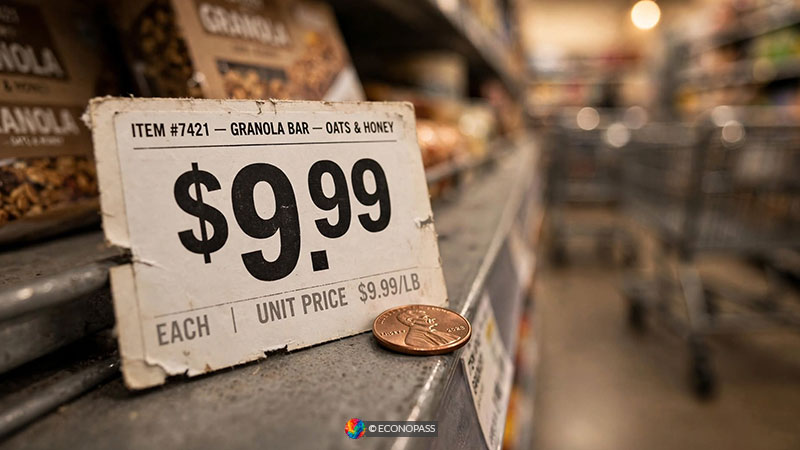
You are standing in a supermarket aisle. The item costs $9.99. You are an adult with a functioning brain. You know, with complete certainty, that $9.99 is one cent away from ten dollars. You buy it anyway, and somewhere in the back of your mind, you file it under “under ten dollars.” This is not a failure of intelligence. It is a feature of the way human cognition processes numbers, and it has been running without your permission since the first time you learned to read a price tag.
The practice of charm pricing, as researchers call it, dates to the late 19th century in the United States. The most common origin story credits Melville Stone, the founder of the Chicago Daily News, who priced his paper at one cent in 1875 to drive sales, then lobbied for the import of cheap Canadian pennies to ensure customers always had change. Another version connects it to early cash registers and the deliberate use of odd pricing to force cashiers to open the drawer and make change, reducing the opportunity for theft. The precise origin is disputed. What is not disputed is that the effect is real and remarkably durable.
In a study published in the journal Marketing Science, researchers found that demand for an item actually increased when its price was raised from $34 to $39. Not decreased. Increased. The $39 price, ending in a nine, outsold the lower $34 price. The researchers called it the “left-digit effect.” Your brain reads the leftmost digit first and anchors to it. $34 starts with a three. $39 starts with a three. But $40 starts with a four, and $39 feels categorically different from $40 in a way that $34 does not.
This is the core mechanism. Human number processing is not linear and it is not fully conscious. When you see $9.99, your brain encodes the leading digit, the nine, before it finishes reading the rest of the number. The nine registers as belonging to the category “nine-something,” which your brain files as “closer to nine than to ten,” even though the arithmetic says otherwise. The process happens in milliseconds, before your reflective, deliberate thinking has a chance to intervene.
Daniel Kahneman’s framework for this is the distinction between System 1 and System 2 thinking. System 1 is fast, automatic, associative. System 2 is slow, deliberate, effortful. Charm pricing works on System 1. By the time System 2 shows up to note that $9.99 is essentially ten dollars, the initial encoding has already happened. Knowing about the trick does not disable the trick, because the trick operates at a level below conscious awareness. You can watch a magician’s hands and still not see the card move.
A separate line of research links .99 pricing to the perception of a deal. Prices ending in nine have become so thoroughly associated with discounts and sales that they trigger a deal-seeking heuristic independent of any actual reduction. You see $9.99 and your brain pattern-matches to “sale price” before you have processed any information about the original price. Retailers have trained this association over decades, and it now runs automatically.
The effect is not universal. Luxury goods often avoid .99 endings deliberately. A $10,000 watch is not priced at $9,999. The round number signals quality, permanence, and the absence of discount-hunting. Pricing communicates positioning, and the .99 ending has acquired a specific set of associations that luxury brands work to avoid. The same cognitive quirk that makes $9.99 feel like a bargain makes $9,999 feel slightly downmarket when placed next to $10,000.
There is also a threshold effect worth noting. The left-digit anchoring is strongest at round-number boundaries. The gap between $9.99 and $10.00 is psychologically enormous relative to the one cent of actual difference. The gap between $9.49 and $9.50 is trivial by comparison. Retailers know this, which is why prices cluster just below round numbers rather than being distributed evenly across the range.
William Poundstonespent years documenting how deeply pricing psychology shapes behavior that people believe is purely rational. The conclusion his research points to is uncomfortable: most people’s sense of whether something is fairly priced is almost entirely constructed from context, comparison, and cognitive shortcuts rather than any objective assessment of value. The price itself is often less important than the frame around it.
Knowing all of this does not make you immune. Research on debiasing, the attempt to correct cognitive biases by educating people about them, shows modest effects at best and negligible effects in real purchasing situations. The gap between knowing how something works and being unaffected by it is one of the more humbling findings in behavioral economics. You can read every study ever published on charm pricing and still feel, when you pick up the $9.99 item, that you are getting something just under ten dollars.
The one cent is not the point. The left digit is the point. And your brain learned to read left digits before it learned anything else about numbers.
Now you know. The question is what you do with it. Marco Bellinari
Want to understand yourself a little better? These books will help.
Thank you for reading. Every fact in this article is documented and sourced. You will find the references at the bottom if you want to dig further. I hope it surprised you at least once. That is always the intention.
I would love to hear your thoughts. Follow Econopass on social media and share your reaction hereafter as a social comment. And if you do not want to miss the next story, hit follow. There is always another forgotten truth waiting to be told.
Disclosure: This article may contain affiliate links. This means we may earn a commission if you click on a link and make a purchase at no extra cost to you. This applies to featured Amazon products or any other Econopass's partners.
FediBack: The Reason Prices Ending in .99 Still Work on You. Even When You Know They Are Doing It.
These articles and stories are free because of a few ads. To support us, simply turn off your ad blocker for Econopass. It takes one click on the ad blocker icon in your browser. Thank you!
We use cookies to ensure that we give you the best experience on Econopass website. If you continue to use this site we will assume that you are happy with it.