

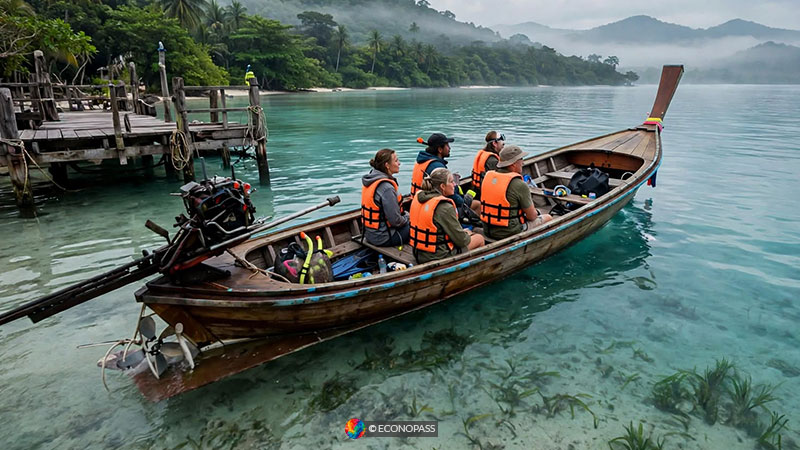
The first boat leaves the pier at a quarter past seven. Twelve tourists from the resort, four more from the guesthouse strip along the beach road. Snorkeling masks around their necks, underwater cameras charged, expectations built from photographs that are, in several cases, more than a decade old. The island ranks among the region’s premier snorkeling destinations, a designation it has carried in every tourism catalog printed in the past thirty years, a designation it still carries now. The captain knows the route by memory. Twenty minutes offshore, he cuts the engine. This is the reef.
What the tourists enter is not a reef in the living sense of the term. It is the architecture of one: calcium carbonate structures in coral shapes, overgrown with filamentous algae in shades of brown and grey, populated by a fraction of the fish species the photographs implied and by none of the staghorn formations that earned this site its reputation. The tourists are in the water for forty minutes. Some of them ask the guide if the reef always looks this way. The guide says yes, more or less. The boat returns to the pier. The rating on the booking platform remains four and a half stars.
The reef beneath those tourists has been dead for six years.
According to the Global Coral Reef Monitoring Network, approximately 50 percent of the world’s shallow-water coral reefs have been degraded or lost since the 1950s. The rate of loss has accelerated significantly since 2016.
The mass bleaching event of 2016 is the benchmark by which marine ecologists now measure modern reef decline. Driven by an El Nino cycle of unusual intensity combined with rising baseline sea surface temperatures, the event caused severe thermal stress across the Indo-Pacific, the Indian Ocean, and the Caribbean simultaneously. In affected regions, water temperatures held between one and two degrees Celsius above the seasonal average long enough to trigger mass coral bleaching across ecosystems that had survived centuries of natural variation. Recovery from a bleaching event of that magnitude requires, under favorable conditions, ten to fifteen years. Many of the reefs affected in 2016 have not had favorable conditions since. Some have experienced subsequent events that prevented any recovery from beginning.
This island’s main snorkeling site was surveyed by researchers from the regional marine science institute in 2021. Live coral cover measured at eleven percent. A follow-up survey in 2023 found eight percent. The surveys were published. They were not circulated to tour operators, referenced in the island’s tourism materials, or reflected in any update to the booking platform listings. The boats have continued leaving the pier at seven fifteen every morning since.
What the Surveys Recorded
Benthic surveys measure the composition of the seafloor by percentage: live coral, dead coral, algae, rubble, sand. A healthy reef in this region would show live coral cover above forty percent, with structural complexity provided by multiple coral genera at different depths. What the 2021 survey documented was a site where dead coral and algae together accounted for over eighty percent of the substrate. The remaining live coral was concentrated in a small area of slightly deeper water where thermal conditions had been marginally less extreme during the 2020 bleaching event, which compounded damage already inflicted in 2016.
The 2020 event was the fourth mass bleaching event on reefs across the Indo-Pacific in five years. Each successive event affected corals already weakened by the previous one. The window for recovery between events was shorter than the recovery process itself. What marine biologists describe as a recovery gap means that reefs which had been bleaching and recovering in earlier decades are now bleaching and dying, because the intervals of thermal stress have become too frequent to allow the structural rebuilding the ecosystem requires.
Live coral cover at the island’s primary snorkeling site measured 11 percent in 2021 and 8 percent in 2023. A reef considered functional in this region would show 40 percent or above. No tourism materials have been updated to reflect the surveys.
The monitoring data exists across dozens of sites in this region. It is collected by university researchers, volunteer dive programs, and regional coral monitoring networks that report to international conservation bodies. The data is not secret. It is published, archived, and in several cases publicly accessible online. It is simply not the data that informs what tourists are told before they board the boat.

Kindle Paperwhite 2026
New 7″ flush-front aluminum design, weeks of battery, glare-free in any light. The e-reader that stays on your nightstand permanently.
View on AmazonHow Reef Tourism Continues
The word deception implies intention, and the picture here is more complicated than that. The tour operator who runs the morning snorkeling tours did not kill the reef. He runs a family business that employs six people. His grandfather started the tours in the 1980s when the reef was exceptional. His booking platform profile was built in 2019 from photographs taken in 2017, before the 2020 bleaching event completed the damage. He has not had the funds, the expertise, or the platform access to revise it since, and no authority has required him to.
What reef tourism looks like in practice at a site of this kind is not a coordinated lie so much as a system with no mechanism for updating itself. Booking platforms aggregate reviews over years. A site that received four hundred strong reviews between 2012 and 2019 carries those reviews forward. New visitors who cannot distinguish a living reef from a dead one add their own qualified reviews: the fish were beautiful, good value for money, the water was clear. These reviews are not false. They are simply not about a reef.
Booking platforms aggregate reviews across years. A site that earned strong snorkeling ratings during peak reef health between 2012 and 2018 carries those ratings into the present unchanged, regardless of what surveys have found in the years since.
The national tourism board has not updated its materials. The island is a cornerstone of the country’s dive and snorkel tourism marketing, contributing significantly to the industry’s annual visitor numbers. Revising the classification would require acknowledging the reef’s condition publicly, which would trigger questions the board is not positioned to answer: who is responsible, what will be done, and when the site might return to the state being sold. It is easier, institutionally, to continue.
The Beautiful Nothing
What tourists are buying on the morning boats is not entirely misrepresented, in the strict sense. The water is clear. The boat ride is pleasant. Fish are present in a degraded reef system, though the species diversity is a fraction of what a healthy system supports. The experience is in the water. The experience is real. What has been silently substituted is the reef itself: the living architecture that made the site worth visiting, replaced by its dead calcium skeleton without any announcement that the substitution occurred.
Some visitors notice. The ones with previous snorkeling experience, the ones who have read the monitoring reports, the occasional marine science student who boards expecting what the catalog described. They say something to the guide, or they write a note in their review. Those reviews are present, buried in the aggregate of several hundred more positive ones, visible only to someone who reads far enough down the list to find them and knows what they are looking for.
Critical reviews noting reef degradation exist on major booking platforms for affected sites. They are statistically diluted by older reviews written when the reef was healthy, and rarely surface without deliberate filtering by the reader.
This island is not exceptional. It is representative. The same pattern plays out across reef tourism destinations from the Caribbean to the Coral Triangle, wherever a living reef that sustained a tourism industry has died or declined significantly and the marketing infrastructure has not adjusted to reflect it. The boats still leave every morning. The brochures still use photographs from better years. The tourists still board expecting to see something that no longer exists, and they come back to the pier having seen something they cannot quite name: a clear and silent water column, the structural memory of a reef that someone is still selling them tickets to visit, without anyone having made a formal announcement that the reef itself is gone.
Not the highlights reel. Not the itinerary. Just what actually happened.
Simon De Lafronde
Sources
- Global Coral Reef Monitoring Network (GCRMN)
- Coral bleaching, Wikipedia
- Coral Reef Threats, NOAA Ocean Service

A Note from Simon de Lafronde
The advice and information in this article come from my experience and research. It’s intended to support your reading with evidence-based insights. If the article is covering wellness or any other health topics, this is not professional advice. Please consult appropriate professionals for your specific situation.
📖 Read MoreStill Curious? Don't Stop Here!
Mount Everest Has Over 200 Bodies on Its Slopes. Most Are Used as Landmarks. The Families ...

Venice Has Fewer Than 50,000 Residents for the First Time in Six Centuries. On Peak Days, ...

They Posted Their Itinerary on Instagram. By the Time They Arrived at the Guesthouse, It W...
The Ferry to the Island Left on Time. The Return Ferry Was Cancelled Due to Weather. They ...

He Rented a Scooter in Vietnam Without an International Licence. He Had an Accident. His T...

She Left Her Bag at a Café Table in Rome for Thirty Seconds. The Surveillance Footage Show...
The Maldives Is Sinking. The Government Has Already Bought Land in Australia. The Resorts ...