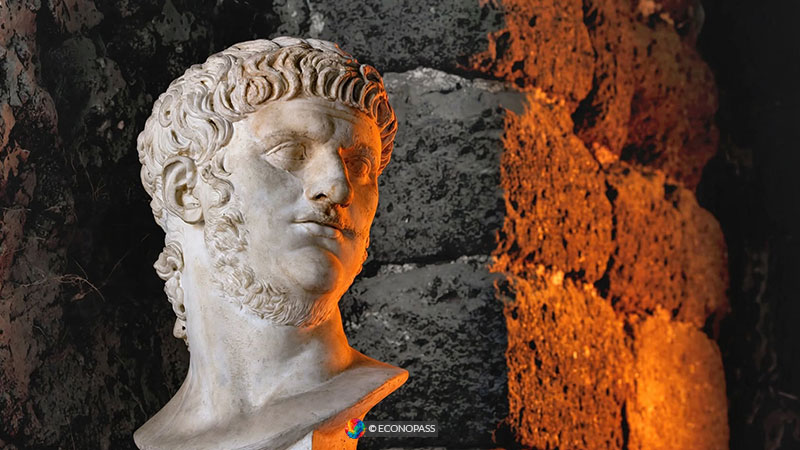
The phrase has lasted nearly two thousand years. Nero fiddled while Rome burned. It is used to describe leaders who do nothing during a crisis, who occupy themselves with trivialities while everything around them collapses. It is a vivid image. It is also impossible. The fiddle did not exist.
The violin, and its family of bowed string instruments, was developed in northern Italy in the early sixteenth century. Nero died in 68 CE. The gap between them is approximately fourteen hundred years. Whatever Nero was doing during the Great Fire of Rome in July of 64 CE, he was not playing an instrument that would not be invented for another millennium and a half.
This is not a technicality. It is the entire story.
What the Instrument Actually Was
Nero played the cithara. This was a large, resonant form of the lyre, held upright against the body and plucked with the fingers or a plectrum. It was the prestige instrument of the ancient Roman world, associated with Apollo, demanding years of training to master. Nero took his musicianship seriously to an extent that embarrassed the Roman aristocracy considerably. He performed publicly. He competed in Greek music festivals. He trained with professional voice coaches and submitted himself to regimens designed to protect his vocal range.
The Roman senatorial class considered public performance beneath the dignity of an emperor. That Nero disagreed, and acted on the disagreement, was held against him by the writers who documented his reign. Those writers were not neutral observers. They were members of a class that Nero had humiliated by appearing on stage, and they wrote after his death, when he had no defenders left.
The cithara and the violin share no meaningful connection beyond the general category of stringed instruments. One is plucked; the other bowed. One is ancient; the other Renaissance. The phrase that has defined Nero for two thousand years contains an instrument that did not exist in his century, used to describe behavior that the primary sources do not confirm.
Where Nero Actually Was
The Great Fire broke out on the night of July 18 or 19, 64 CE, near the Circus Maximus. It burned for six days, was briefly controlled, then broke out again for three more. When it was over, ten of Rome’s fourteen districts had been damaged or destroyed. It was one of the worst urban fires in ancient history.
Tacitus, writing his Annals approximately fifty years after the event, is the most detailed source. His account states that Nero was at Antium, the coastal town now called Anzio, when the fire began. He returned to Rome as the fire spread. He organized emergency relief: opened his own gardens on the Esquiline Hill to the homeless, arranged food supplies, lowered the price of grain from Ostia. Tacitus notes these measures while also recording the rumors, circulating at the time, that Nero had ordered the fire set to clear land for his building projects.
Tacitus is careful to distinguish between what he knows and what people said. He reports the rumor of Nero’s arson without endorsing it. He then reports that Nero blamed the Christians for the fire, and that the subsequent persecution was severe. Tacitus finds the Christians guilty of “hatred of the human race” but considers Nero’s response excessive even by the standards of his time. This is not the account of a man who watched Rome burn while performing a concert.
Suetonius, writing even later, claims Nero watched the fire from the Tower of Maecenas and sang about the fall of Troy, dressed in his stage costume. Suetonius is the less reliable of the two historians, prone to collecting scandalous anecdotes without evaluating them. His Nero is a creature of rumor and court gossip assembled into biography. The tower performance, if it happened at all, was not confirmed by contemporary witnesses Suetonius could have interviewed.
Who Wrote the Story and When
None of the principal ancient sources were contemporaries of Nero in the sense that matters. Tacitus was born around 56 CE and would have been a child during the fire. Suetonius was born around 69 CE, the year after Nero died. Cassius Dio, the third major source, wrote his Roman History in the early third century, more than a hundred and thirty years after the fire.
All three wrote under dynasties that had come to power after overthrowing Nero’s line. The Flavians, who followed the chaos of 69 CE, had political reasons to emphasize the degeneracy of their predecessors. The senatorial class, whose memoirs and records formed the basis of later histories, had personal reasons to despise an emperor who had humiliated them by performing publicly and who had executed several of their members.
Edward Champlin’s analysis in Nero examines the sources systematically and finds a pattern: the most dramatic stories about Nero, the matricide confirmed, the artistic vanity real, the arson unproven, were assembled and amplified by writers working after his fall, drawing on a tradition of hostile gossip that began with his enemies while he was still alive. History did not record Nero. It prosecuted him, in absentia, for two thousand years.
The fiddle itself entered the phrase in English during the sixteenth century, precisely when the violin was new and fashionable. The expression “to fiddle” also meant to occupy oneself with trifles. The phrase merged the anachronism with the idiom and produced something that sounded ancient but was assembled entirely from modern parts.
What the Fire Actually Produced
Nero’s response to the fire was substantial enough that it became its own scandal. He used the cleared land to build the Domus Aurea, a vast palace complex with an artificial lake where the Colosseum now stands. The grounds covered somewhere between one and three hundred acres in the heart of Rome. Romans who had lost their homes to the fire watched an emperor build a private pleasure complex on the ruins.
Mary Beard traces in SPQR the permanent tension in Roman political life between the emperor’s accumulation of personal magnificence and the public’s expectations of shared benefit. Nero’s building program after the fire pushed that tension past its limits. Tom Holland’s Dynasty places this moment in the arc of the Julio-Claudian collapse: an emperor who had survived the rumors of arson could not survive the spectacle of what he built on the aftermath.
The fiddling story survived because it contained a truth about perception, even if it contained nothing true about events. A leader building a palace while citizens camped in the open was doing something. Whether it was fiddling is the wrong question. What it was, was enough.
Every story has a version. I am sharing mine. Marco Bellinari
The rabbit hole goes deeper. Go further. It is worth it.
Thank you for reading. Every fact in this article is documented and sourced. You will find the references at the bottom if you want to dig further. I hope it surprised you at least once. That is always the intention.
I would love to hear your thoughts. Follow Econopass on social media and share your reaction hereafter as a social comment. And if you do not want to miss the next story, hit follow. There is always another forgotten truth waiting to be told.
Disclosure: This article may contain affiliate links. This means we may earn a commission if you click on a link and make a purchase at no extra cost to you. This applies to featured Amazon products or any other Econopass's partners.
FediBack: Nero Did Not Fiddle While Rome Burned. The Instrument Had Not Been Invented Yet.
These articles and stories are free because of a few non-intrusive ads. To support us, simply turn off your ad blocker for Econopass. It takes one click on the ad blocker icon in your browser. Thank you!
We use cookies to ensure that we give you the best experience on Econopass website. If you continue to use this site we will assume that you are happy with it.