Every year, the country that invented Halloween imports Halloween merchandise from the United States. Ireland does not find this strange. It has had centuries to forget the original version.
Samhain was not a holiday. It was a boundary. The Celtic calendar placed the end of the year at the close of October, and on that night the separation between the living and the dead was understood to thin. Not dissolve. Thin. The Celts did not celebrate the dead returning; they acknowledged the dead moving through. The distinction was precise and intentional. It no longer matters to anyone selling plastic skulls.
The Catholic Church noticed Samhain early. What it did next took over a thousand years.
The Fire Before the Holiday
Ronald Hutton’s The Stations of the Sun places Samhain within the full architecture of the Celtic ritual year. It was the most significant transition on their calendar: the moment when the pastoral year ended, cattle came down from summer pastures, and the community prepared for winter. Fires were lit on hills. Food was left outside. The living marked the boundary between what had been and what was coming.
Samhain fell on November 1, with its eve on October 31. The night before the new year was the liminal moment when the categories of living and dead blurred. It was not a festival of horror. It was a festival of transition, and the Celts treated transitions with ritual precision because transitions were dangerous. What they feared was not the dead returning. It was the boundary being crossed wrong.
The practices that grew around this boundary were specific. Disguise was one of them: not costume for entertainment, but disguise as protection, a way to move through a dangerous night without being recognized by whatever had crossed through. The logic was entirely practical, given what the Celts believed was happening on that night.
A Thousand Years of Trying to Kill It
Pope Gregory III moved All Saints’ Day to November 1 in the 730s. Pope Gregory IV extended it as a liturgical obligation to the whole Church in 837. The calculation was straightforward: place a major Christian feast on top of the pagan one and the pagan one disappears underneath it. It was a strategy the Church had used before, with variable success.
Success here was partial at best. Nicholas Rogers documents in Halloween: From Pagan Ritual to Party Night the centuries of ecclesiastical pressure applied to Samhain-adjacent practices across Ireland, Scotland, and Wales. Church councils named the customs explicitly. Priests were instructed to discourage them. The vocabulary changed over generations, nobody called it Samhain after a certain point, but the practices continued with remarkable fidelity: the fires, the disguises, the food left out, the acknowledgment that something happened at the end of October.
The Church added All Souls’ Day on November 2, creating a three-day liturgical structure called Hallowtide, designed to absorb and redirect the practices it could not eliminate. The popular response was to observe Hallowtide while continuing the older practices alongside it. The Church had given the customs a Christian frame. The customs ignored the frame and kept the content. By the 16th century, Protestant reformers were condemning the same practices the earlier Church had tried to absorb.
The Reformation made suppression harder, not easier. Protestant reformers in Scotland condemned the customs not as pagan remnants but as Catholic superstition, a second round of suppression from an opposing direction. The practices survived this too, largely intact, waiting for an exit route.
The Famine Did What the Church Could Not
Between 1845 and 1852, one million Irish people died and two million emigrated. The largest movement of population out of Ireland in the 19th century carried the full range of Irish cultural practice to the United States, Canada, and Australia. Not as a preservation project. As luggage.
Halloween traveled with the Irish diaspora without anyone deciding to bring it. The name Samhain was not in general use by 1845; Hallowtide vocabulary had replaced it centuries earlier. But the practices were intact: the dressing up, the ritualized movement through neighborhoods, the fire, the food left out, the acknowledgment of October 31 as a night that required attention.
America absorbed the Irish Halloween and began modifying it almost immediately. By the late 19th century it had merged with Scottish and English autumn customs brought by other immigrant groups. By the 1920s, Halloween was a recognizable American holiday. By the 1950s, the confectionery industry had reorganized it around candy distribution. By the 1970s, trick-or-treating was standard practice across American suburbs. The Church had spent a thousand years unable to redirect it. American consumer culture redirected it in fifty.
The Irish original had no candy industry, no costume market, no retail calendar. What it had was a precise understanding of why October 31 was different from every other night. That understanding did not survive the American transformation intact. Something else did.
America Sold It Back
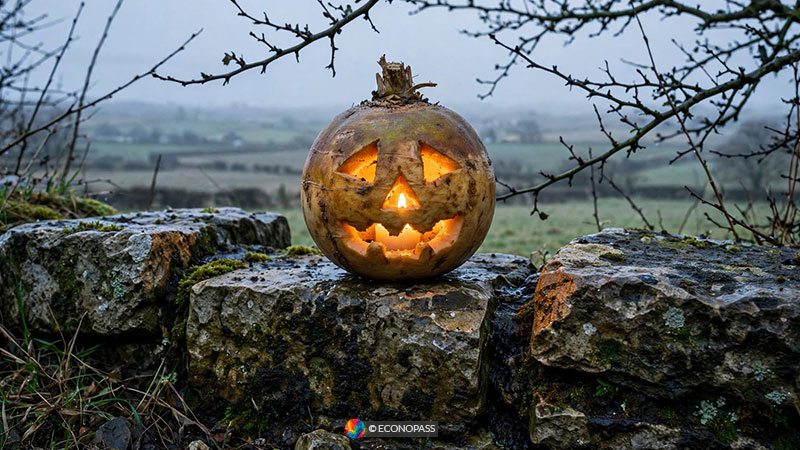
Ireland began noticing Halloween again in the late 20th century. The version arriving was not Samhain. It was not even the Irish-American hybrid of the early 20th century. It was the fully commercialized American product: the orange and black color scheme, the carved pumpkins (the Irish original used turnips, harder to carve, closer to what the night required), costumes drawn from American cinema and television.
David J. Skal traces in Death Makes a Holiday the mechanisms by which Halloween became a ten-billion-dollar American industry. The candy companies, the costume manufacturers, the greeting card industry, the retail calendar that built the holiday into a predictable annual revenue event. The commercial machine that produced this product was entirely American. The raw material it processed was Irish.
Ireland is now a net importer of Halloween. The country that originated the ritual purchases the American commercial version of it: the plastic skulls, the orange lights, the pre-packaged costumes. The turnip lanterns that Irish emigrants carved in America before pumpkins became the standard have been largely forgotten even in Ireland. The Church tried suppression for a thousand years. The market accomplished a more complete transformation in two generations.
The Church could not kill Samhain. The famine could not kill it either; it carried it further than it had ever traveled. American consumer culture did not kill it. It repackaged it, priced it, and sold it back to the country that started the fire. Ireland is still buying.
The world is stranger than anyone told you. I am just keeping count. Simon De Lafronde
Think that was strange? These books will finish the job.
The advice and information in this article come from my experience and research. It’s intended to support your reading with evidence-based insights. If the article is covering wellness or any other health topics, this is not professional advice. Please consult appropriate professionals for your specific situation.
Disclosure: This article may contain affiliate links. This means we may earn a commission if you click on a link and make a purchase at no extra cost to you. This applies to featured Amazon products or any other Econopass's partners.
FediBack: The Country That Accidentally Invented Halloween Spent Centuries Trying to Kill It
These articles and stories are free because of a few non-intrusive ads. To support us, simply turn off your ad blocker for Econopass. It takes one click on the ad blocker icon in your browser. Thank you!
We use cookies to ensure that we give you the best experience on Econopass website. If you continue to use this site we will assume that you are happy with it.