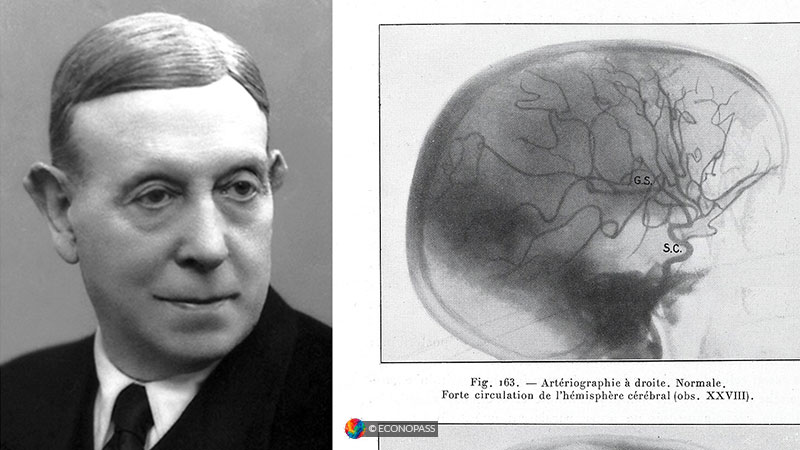
In 1949, the Nobel Committee awarded the Prize in Physiology or Medicine to a Portuguese neurologist named Antonio Egas Moniz. The citation recognized his development of the prefrontal leucotomy as a therapeutic intervention for certain psychoses. The medical establishment responded with approval. What the citation did not mention was what the procedure involved, what it did to the people who received it, or what was already known about its outcomes by the time the prize was awarded.
The Nobel Committee has never revoked the prize.
What the Procedure Actually Was
Egas Moniz performed the first prefrontal leucotomy in 1935. The operation severed the connections between the prefrontal cortex and the rest of the brain by inserting an instrument through small holes drilled in the skull. The theory was that by disrupting these pathways, the emotional disturbances associated with certain psychiatric conditions could be reduced. The theory was not based on a detailed understanding of brain function. It was based on limited animal experiments and the observation that patients who survived seemed calmer afterward.
Calmer was doing a great deal of work in that sentence.
The reduction in disturbing behavior that psychiatrists observed after the procedure was, in many cases, not recovery but the elimination of the patient’s capacity to experience and express distress. The agitation was gone. So, in many patients, was much of what had made them themselves.
Egas Moniz published his results in 1936. The response from parts of the medical community was immediate and enthusiastic. Here, at last, was something that appeared to work on conditions that had resisted every other intervention. The fact that it worked by removing a portion of human function rather than restoring it was a distinction that received less attention than it deserved.
The Man Who Industrialized It
In the United States, a neurologist named Walter Freeman became the procedure’s most energetic advocate. Freeman modified the technique into what he called the transorbital lobotomy, using a thin instrument inserted through the eye socket rather than through the skull. The modification required no operating room, no neurosurgeon, and no general anesthesia. Freeman performed the procedure in his office. He took it on the road, traveling across the country and performing operations in state psychiatric hospitals.
According to records documented by his biographer Jack El-Hai in The Lobotomist, Freeman personally performed approximately 3,500 lobotomies over the course of his career. He kept photographs. He tracked his patients. He believed he was helping them.
Freeman’s road trips to state hospitals were not secret. They were covered in local newspapers. Psychiatrists and hospital administrators watched him work and sent their own patients. The procedure was not being hidden from the medical establishment. It was being celebrated by it.
Between the late 1930s and the mid-1950s, an estimated 40,000 to 50,000 lobotomies were performed in the United States alone. Similar numbers were carried out in the United Kingdom and across Europe. The patients included people diagnosed with schizophrenia, depression, and anxiety. They included people who had been committed by family members. They included Rosemary Kennedy, the sister of the future president, who was lobotomized in 1941 at the age of 23 at her father’s direction, and who spent the rest of her life in an institution.
The Prize They Never Took Back
The Nobel Prize was awarded in 1949, fourteen years after the first procedure and eight years after Rosemary Kennedy’s operation. By that point, the outcomes of lobotomy were not unknown. Published studies had documented the range of results, which included not only reduced agitation but personality changes, loss of initiative, cognitive impairment, and in some cases death. The prize was awarded anyway.
The nomination and selection process at the time did not require the kind of long-term outcome data that would later become standard in medical research. The committee operated on the evidence available and the judgments of the nominators. Egas Moniz had been nominated repeatedly before winning. He was a figure of genuine scientific standing who had also made earlier contributions to cerebral angiography. The leucotomy was not his only work. It was simply the one the committee chose to honor.
The Nobel Prize for the lobotomy was not an aberration of a corrupt system. It was the product of a medical culture that had not yet developed the mechanisms to distinguish between a treatment that reduced symptoms and one that actually improved patients’ lives. The distinction seems obvious in retrospect. It was not obvious then, or the prize would not have been given.
Egas Moniz himself had been shot by a patient in 1939, a decade before the prize, and was partially paralyzed for the remainder of his life. He did not travel to Stockholm for the ceremony. He accepted the award in absentia. He died in 1955.
What Finally Ended It
The lobotomy was not discredited by a single study or a public scandal. It was displaced by a pill. In 1952, French researchers developed chlorpromazine, the first antipsychotic drug. It was approved in the United States in 1954. For the first time, the behavioral symptoms of certain psychoses could be reduced without surgery, without permanent damage, and without removing the patient’s capacity for independent thought. The comparison was not favorable to the knife.
Howard Dully, who received a transorbital lobotomy at age twelve in 1960, spent decades trying to understand what had been done to him. His account, documented in My Lobotomy, written with Charles Fleming, is one of the clearest records of what the procedure’s advocates were never required to confront: the person on the other side of the instrument. Robert Whitaker’s Mad in America traces the broader pattern of how American psychiatry adopted and then abandoned radical physical interventions, lobotomy among them, without ever fully accounting for the harm done in the process.
The Nobel Committee reviewed calls to revoke the prize in subsequent decades. It declined. The committee’s position has been that the prize recognizes the science as it was understood at the time of the award, not as it came to be understood later. That position is defensible as a matter of institutional policy. It does not change what was done to the patients.
Forty to fifty thousand people in one country alone. The records are incomplete. Many of the patients had no one to speak for them before the procedure, and no capacity to speak for themselves afterward. The prize still stands.
The world is stranger than anyone told you. I am just keeping count. Marco Bellinari
Think that was strange? These books will finish the job.
Thank you for reading. Every fact in this article is documented and sourced. You will find the references at the bottom if you want to dig further. I hope it surprised you at least once. That is always the intention.
I would love to hear your thoughts. Follow Econopass on social media and share your reaction hereafter as a social comment. And if you do not want to miss the next story, hit follow. There is always another forgotten truth waiting to be told.
Disclosure: This article may contain affiliate links. This means we may earn a commission if you click on a link and make a purchase at no extra cost to you. This applies to featured Amazon products or any other Econopass's partners.
FediBack: The Man Who Invented the Lobotomy Won a Nobel Prize for It. The Medical World Celebrated.
These articles and stories are free because of a few non-intrusive ads. To support us, simply turn off your ad blocker for Econopass. It takes one click on the ad blocker icon in your browser. Thank you!
We use cookies to ensure that we give you the best experience on Econopass website. If you continue to use this site we will assume that you are happy with it.