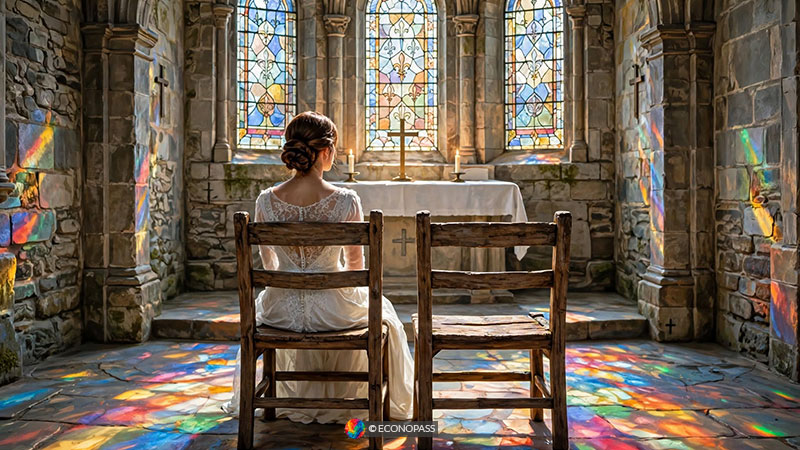
Article 171 of the French Civil Code states that the President of the Republic may authorise the celebration of a marriage if one of the future spouses has died, provided that certain conditions are met.
This is not a historical curiosity. It is current law. Between 60 and 100 people request it every year. About half are approved. President Macron has personally signed the authorisation at least four times.
And the requirements to make it happen are considerably more demanding than you might expect from a law that sounds, on first reading, like something invented for a gothic novel.
The law exists because of a dam that collapsed in 1959, a pregnant woman who refused to let her fiancé’s death end their plans, and a president’s wife who was moved enough to intervene. France built a legal framework around that single case, and it has been used hundreds of times since.
The story begins on December 2, 1959, when the Malpasset Dam in southern France failed catastrophically. More than 400 people died in the flood. Among them was Frédéric André Capra, engaged to a woman named Irène Jodart, who was pregnant with his child. In France in 1959, a child born outside of marriage carried significant social and legal consequences. Irène wanted to marry her fiancé. Her fiancé was dead.
She wrote to the government. Her case reached Yvonne de Gaulle, the wife of President Charles de Gaulle, who was moved by it and brought it to her husband’s attention. De Gaulle authorised the marriage. Within months, the French parliament had drafted a law making it possible for others to do the same. Article 171 entered the Civil Code in 1959, and it has remained there ever since.
The law traces its origins even further back, to Napoleon, who in 1803 created a mechanism for recognising the marriages of soldiers killed in battle before the ceremony could take place. The 1959 legislation extended and formalised that principle for civilian life. France had, in effect, spent a century and a half building the legal architecture for this moment.
To apply for a posthumous marriage in France, the surviving partner sends a request to the President of the Republic. It passes through the Ministry of Justice, the Directorate of Civil Affairs, the Attorney General of the relevant Court of Appeal, and the local prosecutor. Only once all of those stages are cleared does the President issue or refuse the decree. A love letter is not sufficient. A pregnancy alone is not sufficient. Even a formal engagement does not guarantee approval.
What the law requires is proof that the deceased clearly consented to the marriage while alive. This is the central and most demanding element of the application. The deceased can no longer confirm their intentions. The application must do it for them.
Acceptable evidence includes purchased wedding rings, signed prenuptial agreements, wedding invitations already sent, formal engagement announcements, and testimony from credible witnesses who can attest to the couple’s shared plans. The documentary record must be convincing enough that the authorities are satisfied the deceased would have said yes had they survived long enough to say it.
The family of the deceased plays a significant role. If the family objects, the application faces serious difficulty. If a credible witness disputes the claim that the couple planned to marry, that testimony alone can derail the process. The application is not simply a bureaucratic form. It is closer to a legal argument made on behalf of someone who is no longer present to make it themselves.
The marriage, once approved, is retroactive to the day before the death. The surviving spouse becomes legally a spouse as of that date. But Article 171 is careful about what this does and does not create: there is no right of inheritance from the deceased’s estate, and no matrimonial property is deemed to have existed between them. What the marriage provides is legal recognition, the ability to claim widow’s benefits, pension entitlements, and the right to be described as a spouse rather than a partner.
The cases that tend to be approved most easily involve soldiers, police officers, and firefighters who died in the line of duty while a wedding was being planned. Etienne Cardiles married Xavier Jugelé, a police officer killed on the Champs-Elysées in 2017, in a ceremony that drew significant public attention. Emilie Lassus David married Jonathan, a firefighter who died in a blaze in 2018. Alexandra married Maxime Blasco, a military corporal killed in Mali in 2021. In each case, the institutional context made the evidentiary requirements more straightforward to meet.
In civilian cases, the process is more complex and the approval rate lower. The court case of 2007, when France’s Court of Cassation reiterated that the absence of official evidence of marital intent justifies a presidential refusal, established a clear standard that has shaped approvals and rejections since.
France is effectively the only country in the Western world with this as a formal, codified process. A few other nations have permitted posthumous marriages in isolated cases, but nowhere else has built the bureaucratic architecture that France has around it: the presidential authorisation, the judicial review, the evidentiary requirements, the specific legal effects and limitations.
It is, as one French family lawyer described it, the most rigorous romantic procedure in the world. You cannot simply love someone and lose them and ask the President to fix it. You have to prove, through documents and witnesses and institutional review, that the person you want to call your spouse would have agreed.
Which is, in its own quietly French way, rather more serious than many living marriages ever manage to be.
The world is stranger than anyone told you. I am just keeping count. Marco Bellinari
Think that was strange? These books will finish the job.
Thank you for reading. Every fact in this article is documented and sourced. You will find the references at the bottom if you want to dig further. I hope it surprised you at least once. That is always the intention.
I would love to hear your thoughts. Follow Econopass on social media and share your reaction hereafter as a social comment. And if you do not want to miss the next story, hit follow. There is always another forgotten truth waiting to be told.
Disclosure: This article may contain affiliate links. This means we may earn a commission if you click on a link and make a purchase at no extra cost to you. This applies to featured Amazon products or any other Econopass's partners.
FediBack: In France, You Can Legally Marry a Dead Person. The Requirements Are Surprisingly Strict.
🟢 The President of France has personally signed permission for people to marry their dead partners. Between 60 and 100 requests a year. About half approved. Does this law strike you as romantic, bureaucratic, or both? Tell me below.
🟢 The President of France has personally signed permission for people to marry their dead partners. Between 60 and 100 requests a year. About half approved. Does this law strike you as romantic, bureaucratic, or both? Tell me below.
🟢 The President of France has personally signed permission for people to marry their dead partners. Between 60 and 100 requests a year. About half approved. Does this law strike you as romantic, bureaucratic, or both? Tell me below.
We use cookies to ensure that we give you the best experience on Econopass website. If you continue to use this site we will assume that you are happy with it.