In 1539, Henry VIII needed a fourth wife. Jane Seymour had died two years earlier, shortly after giving him the male heir he had spent two decades and two marriages trying to produce. Henry was forty-eight, increasingly unwell, and politically isolated. Thomas Cromwell, his chief minister, proposed a German princess named Anne of Cleves as a strategic match that would cement an alliance with the Protestant princes of northern Europe.
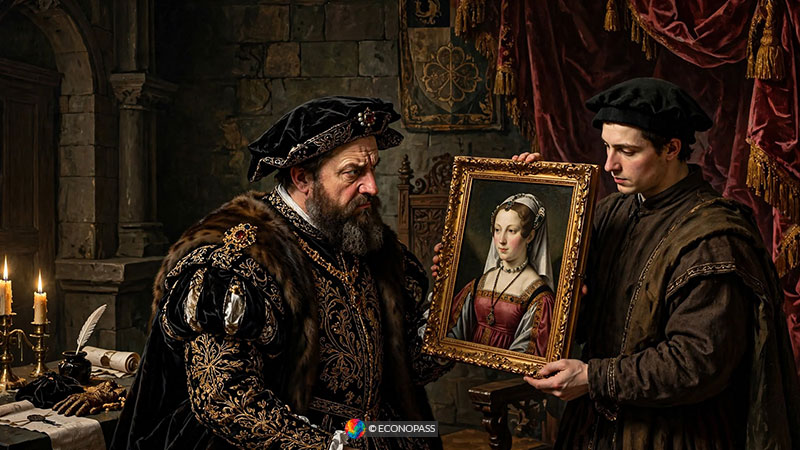
There was one problem. Henry had never met her. He sent Hans Holbein, the most skilled portraitist in Europe, to Cleves to paint her likeness.
Holbein returned with a portrait. Henry approved it. The marriage was arranged.
When Anne arrived in England in late December 1539, Henry rode out to meet her in disguise at Rochester, a romantic gesture he had apparently enjoyed with previous wives. He met her. He left almost immediately. That evening, he told his attendants he found her nothing like her portrait, that she was not as his council had reported, and that if he had known the truth he would never have proceeded.
What Holbein Actually Painted
The portrait still exists. It hangs in the Louvre. Anne of Cleves, rendered in Holbein’s characteristic style, looks composed, elegant, and pleasant. Scholars who have studied it for centuries largely agree: it is a competent and probably accurate likeness. Holbein was not known for flattery. His portraits of Henry himself were forensically detailed, capturing the king’s bulk and his eyes with uncomfortable precision.
What the portrait could not convey was personality. Anne spoke no English. Henry spoke no German. At their first real meeting they had no common language and no common ground. The chemistry that Henry had apparently felt with previous wives, particularly with Anne Boleyn, was entirely absent. He found her dull, her manners foreign, her conversation nonexistent.
He also, reportedly, found her physically unattractive in ways the portrait had not prepared him for. The term “Flanders mare” was attributed to him later, probably apocryphal, but his reaction at Rochester was real and documented. He told Cromwell the arrangement was intolerable and demanded a way out.
The Marriage Happened Anyway
Cromwell told the king there was no way out. The alliance with Cleves was politically necessary. The arrangements were too far advanced. Cancelling would cause a diplomatic incident. Henry married Anne on 6 January 1540, reportedly telling his attendants on the wedding night that he liked her even worse than before, and that he believed she was no true maid.
He then spent the next six months doing almost nothing else except trying to annul the marriage.
His lawyers found the grounds eventually: a prior contract of betrothal between Anne and the Duke of Lorraine’s son, never formally dissolved. It was thin. It was enough. The marriage was annulled in July 1540, six months after it began. Henry and Anne had almost certainly never consummated it, which Henry was willing to state publicly and Anne was wise enough not to contest.
Anne Played It Perfectly
What happened next is the part the story usually forgets. Anne of Cleves did not fight the annulment. She agreed to it, renounced her title as queen, accepted a generous settlement, and remained in England for the rest of her life. She received two houses, a substantial income, jewels, and precedence at court above everyone except Henry’s future wives and his daughters.
She outlived Henry by ten years. She outlived all five of the other wives. She was, by most accounts, happier after the annulment than before it, and wealthier than she would have been had she stayed in Cleves.
Contemporary observers noted the irony. The woman Henry rejected as unsuitable turned out to have made the best deal of any of his wives. She had looked at the situation, assessed her options, and chosen cooperation over confrontation. Two of Henry’s wives lost their heads. Anne of Cleves kept hers and built a comfortable English life around the ruins of a marriage that lasted less than half a year.
The Man Who Paid for the Portrait
Thomas Cromwell did not fare as well. Henry blamed him for the Cleves disaster, for insisting on a marriage the king had not wanted and could not escape. The charges against Cromwell accumulated through the spring of 1540. He was arrested in June, attainted by Parliament without trial, and executed in July, the same month the annulment was finalised.
The man who commissioned the portrait that started everything died on Tower Hill ten days after the marriage it produced was officially ended.
Holbein kept his position at court. A painter was harder to blame than a minister. He continued working for Henry until his own death in 1543, leaving behind a body of work that remains the most precise visual record of the Tudor court in existence.
The portrait of Anne of Cleves still hangs in the Louvre. She looks exactly as composed as Holbein painted her. Whatever Henry saw when he met her in Rochester, the canvas gives nothing away.
The world is stranger than anyone told you. I am just keeping count. Marco Bellinari
Think that was strange? These books will finish the job.
Thank you for reading. Every fact in this article is documented and sourced. You will find the references at the bottom if you want to dig further. I hope it surprised you at least once. That is always the intention.
I would love to hear your thoughts. Follow Econopass on social media and share your reaction hereafter as a social comment. And if you do not want to miss the next story, hit follow. There is always another forgotten truth waiting to be told.
Disclosure: This article may contain affiliate links. This means we may earn a commission if you click on a link and make a purchase at no extra cost to you. This applies to featured Amazon products or any other Econopass's partners.
FediBack: Henry VIII Married a Woman Based on a Portrait. He Met Her and Immediately Tried to Annul the Marriage.
These articles and stories are free because of a few non-intrusive ads. To support us, simply turn off your ad blocker for Econopass. It takes one click on the ad blocker icon in your browser. Thank you!
We use cookies to ensure that we give you the best experience on Econopass website. If you continue to use this site we will assume that you are happy with it.