
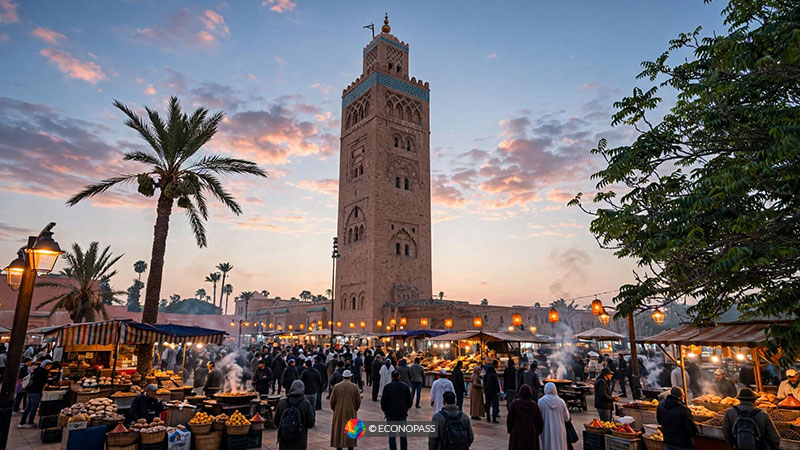
By eight in the evening, Jemaa el-Fna has become something that resists description in ordinary language. The smoke from two hundred food stalls hangs low over the square. Gnawa musicians in embroidered robes play beside snake handlers and troupes of acrobats. The orange juice vendors line the edge of the square in a bright corridor of competing lights. Somewhere in the crowd, a halqa storyteller is performing a tale that has been performed in this square for centuries, in Arabic, to an audience sitting on the ground.
It is extraordinary. It is also, according to the UK Foreign Office, the US State Department, and several other government travel advisory services, a location that visitors should monitor their belongings in with particular care.
Both of these things are true simultaneously. That is what makes Jemaa el-Fna worth understanding before you arrive.
What UNESCO Actually Recognized
In 2001, UNESCO designated Jemaa el-Fna as a Masterpiece of the Oral and Intangible Heritage of Humanity, one of the first sites in the world to receive that designation. The recognition was not for the square’s architecture, which is unremarkable, or for its food stalls, which are a relatively modern addition. It was for the halqa tradition: the oral storytelling, the musicians, the performers who have gathered in this square for centuries as a living transmission of Moroccan cultural memory.
The designation was confirmed permanently in 2008 when the UNESCO Convention for the Safeguarding of the Intangible Cultural Heritage came into force. Jemaa el-Fna became a UNESCO-protected cultural space by virtue of what happens inside it, not what it looks like.
The square’s name is itself a matter of some linguistic dispute. One translation gives “assembly of the dead,” referencing public executions once held there. Another gives “mosque at the end of the world,” referencing a mosque that no longer stands. Neither translation appears in the tourism materials.
Travel media routinely describes Jemaa el-Fna as one of the most photographed public squares in Africa. Morocco’s National Tourist Office, known as the ONMT, uses the square as the central image in much of its international promotional material. It is the face of Marrakech, and Marrakech is the face of Moroccan tourism, which received more than thirteen million international visitors in 2019 before the pandemic disrupted those numbers.
Weirdly Useful Things Under $25
Real stuff, real low prices. Amazon's best-kept budget finds, picked for everyday usefulness, not just novelty.
Browse the FindsWhat the Travel Advisories Actually Say
The UK Foreign Office travel advice page for Morocco states, in its current published form, that visitors should be alert to pickpocketing and bag snatching, particularly in busy areas of the medina. Jemaa el-Fna is the busiest area of the medina. The US State Department Morocco travel advisory similarly notes that petty crime, including pickpocketing, is common at crowded tourist sites.
These are not vague warnings. Travel safety researchers and tourist police reports from Marrakech document consistent patterns of tourist scams and petty theft: working in pairs or small groups, using the crowd density of the square during peak evening hours, targeting camera bags, phone screens visible in hand, and open backpacks. The technique depends on the same conditions that make the square spectacular. The density, the noise, the movement, the distraction of the performance are features, not incidental to the problem.
Morocco operates a dedicated tourist police force, the Brigade Touristique, with officers stationed in and around Jemaa el-Fna. Their presence is real and visible. It has not eliminated the problem, which suggests the problem is structural rather than a simple enforcement gap.
The tourist advisory about unlicensed guides compounds the picture. The Moroccan government licenses official guides, identifiable by their credentials, who charge regulated fees. Alongside them operates a persistent network of unofficial intermediaries, known locally as faux guides, who approach visitors outside the square and offer to show them the souks, the tanneries, or the spice markets. The visit typically ends at a shop where a commission arrangement operates. This practice is documented, widely reported, and not specific to Marrakech, but it concentrates heavily around Jemaa el-Fna because that is where visitors congregate.
The Tourism Board’s Position
The ONMT is not unaware of these problems. Morocco has invested significantly in tourism infrastructure and in improving the visitor experience in Marrakech over the past two decades. The 2019 visitor figures, before the pandemic, represented a substantial increase from earlier years and reflected genuine improvements in hotel capacity, transport links, and official guidance.
What the promotional materials do not reflect is the operational reality of arriving in Jemaa el-Fna at night for the first time without orientation. The gap between the UNESCO cultural heritage site and the crowded, loud, aggressively commercial space a visitor actually enters is not mentioned in the brochures. It is mentioned in the travel advisories.
This is not unique to Marrakech. Tourism boards in every country promote their flagship sites without advertising the friction those sites generate for unprepared visitors. What makes Jemaa el-Fna notable is the scale of the gap between the official framing and the documented ground-level experience.
Morocco has been working to address the faux guide problem through enforcement and licensing reform. The tourist police presence at Jemaa el-Fna is genuine. Reports from visitors who have been assisted by that presence are real. The improvement is incremental. It has not closed the gap.
What to Actually Know
Jemaa el-Fna at peak evening hours is worth seeing. The halqa performers, the Gnawa musicians, the density of human activity concentrated in one open space in the North African night is not something that photographs adequately reproduce. The UNESCO designation, whatever its limitations as a protective mechanism, points at something real about what the square preserves.
What the square does not preserve is the conditions under which a first-time visitor can wander through it without paying attention. Front pockets, not back. Bag straps crossed, not hanging. Phones not visible between uses. Groups staying oriented toward each other. Any guide who approaches you outside your hotel or riad without an official credential and an agreed fee in advance should be declined with no further engagement.
The tourist advisory is a travel advisory, which means it describes conditions, not prohibitions. Jemaa el-Fna is not dangerous in the sense that makes a destination inadvisable. It is a site where the conditions that create a memorable cultural experience are the same conditions that require a visitor to pay attention. That is true of most significant urban public spaces in the world. It is simply truer here than the tourism board’s materials suggest.
The square has been in continuous use for centuries. It will be in continuous use after the next advisory is published. The question is not whether to go. It is whether to arrive knowing what the square actually is.
Not the highlights reel. Not the itinerary. Just what actually happened.
Simon De Lafronde
Sources
- UNESCO, Jemaa el-Fna Square in Marrakesh
- Wikipedia, Jemaa el-Fna
- UK Foreign Office, Morocco Travel Advice
- US State Department, Morocco Travel Advisory
- Wikipedia, Marrakesh

A Note from Simon de Lafronde
The advice and information in this article come from my experience and research. It’s intended to support your reading with evidence-based insights. If the article is covering wellness or any other health topics, this is not professional advice. Please consult appropriate professionals for your specific situation.
📖 Read MoreStill Curious? Don't Stop Here!
They Crossed Into Myanmar Through a Border Town Listed as Safe. The Forum Had Not Been Upd...

The Island Was Listed as a Premier Snorkeling Destination. The Reef Had Been Dead for Six ...
Mount Everest Has Over 200 Bodies on Its Slopes. Most Are Used as Landmarks. The Families ...
Venice Has Fewer Than 50,000 Residents for the First Time in Six Centuries. On Peak Days, ...
They Posted Their Itinerary on Instagram. By the Time They Arrived at the Guesthouse, It W...
The Ferry to the Island Left on Time. The Return Ferry Was Cancelled Due to Weather. They ...
He Rented a Scooter in Vietnam Without an International Licence. He Had an Accident. His T...